TFB Review: Kestrel 5700X Elite with Applied Ballistics & WEZ

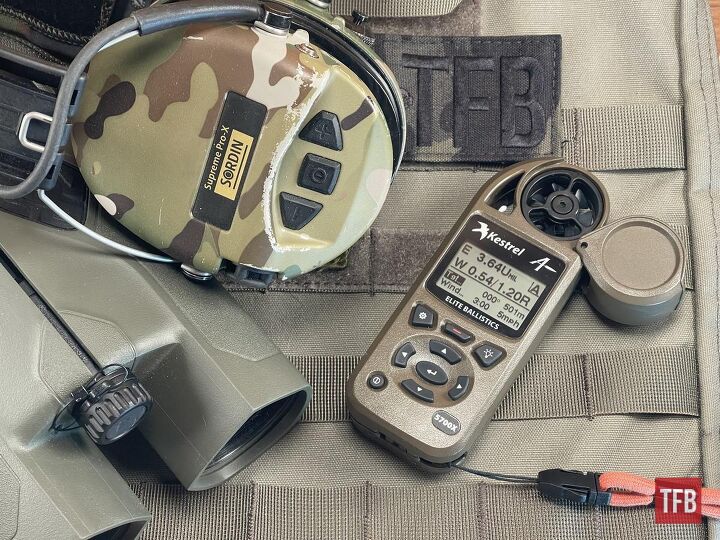
The Kestrel 5700X WEZ is the 5700X family member equipped with Applied Ballistics’ Elite solver, plus a built-in Weapon Employment Zone (WEZ) analysis. It keeps all the weather measuring and basic ballistics features Kestrel is known for, but adds a statistical layer that quantifies the probability of hit (P HIT) and shows how different uncertainties (wind, range, muzzle velocity, shooter consistency, etc.) drive that probability. That makes this unit aimed squarely at long-range shooters, instructors and system evaluators who want to move beyond single-shot solutions and into error budgeting and decision-making. You can use it as a beginner, and probably to infinity in terms of how advanced you’d like things to be.

For this review, I used my existing Kestrel 5700X Elite and upgraded the software through the LiNK app. If you have a 5700 Elite, it’s not going to work. If this is your first Kestrel, it’s the Kestrel 5700X WEZ you should get. More details on this later in the article.

One of the challenges as a reviewer is that sometimes the device we’re trying to describe can be so advanced that it’s virtually impossible to understand, let alone explain all the features. This is such a case, but I’ll give it a try as you’re probably reading this as you’re considering whether or not to get one, or to upgrade your existing Kestrel 5700X with the WEZ?

At its simplest, WEZ is a Monte Carlo-style statistical tool built on Applied Ballistics’ solver. Instead of giving a single aim-point for a single set of inputs, WEZ runs thousands of simulated shots using your gun profile and the uncertainties you define (for example: how well you know range, how variable your muzzle velocity is, how big your wind reading error is). From those simulations, it computes hit-probability (P HIT) for the target shape/size you define and shows which variables hurt your hit chance most.
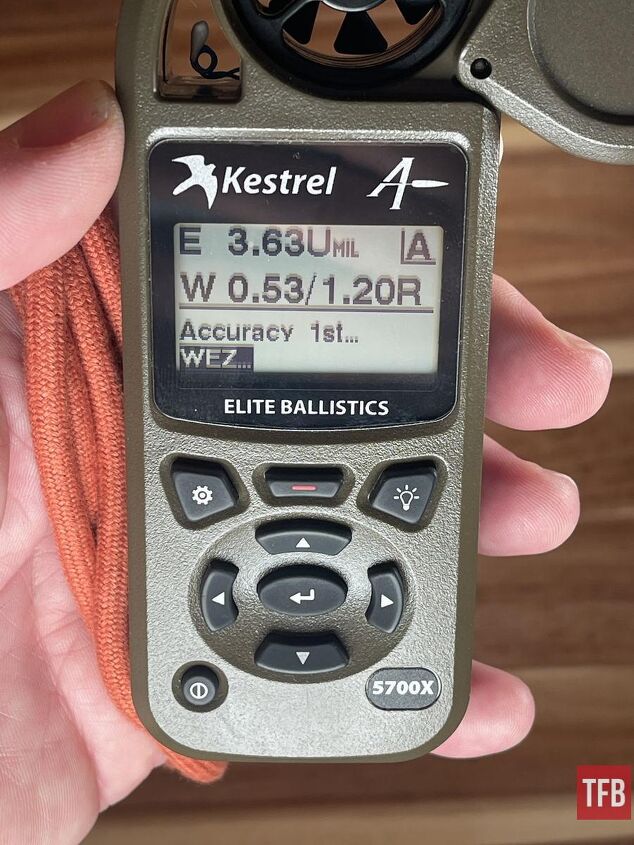

In plain language: WEZ helps you ask and answer questions like “am I losing hits because my ammo spreads too much, or because my wind calls are unreliable?” and then quantify how much improvement each change would buy you. The Applied Ballistics page and Kestrel documentation walk through the Monte Carlo concept and the WEZ inputs in more detail. There are tons of information to browse if you’re having a hard time trying to sleep.

Essentially, this is weaponized math, and it isn’t easy. In fact, the deeper you dig, the harder it gets. Luckily, curious and intelligent people have done the hard work for us and produced this wonderful pocket device and software. All we have to do is learn how to use it! I really hope we didn’t lose you already.

On the 5700X WEZ, the workflow is: create or select a gun/bullet profile, enter your target geometry and range, set standard deviations (your uncertainties) for relevant variables, then run the WEZ analysis to get P HIT and sensitivity breakdowns. Kestrel supplies guidance on which standard deviations map to common real-world uncertainties, but honest inputs matter. This might be a bit of a problem to some, as accuracy grouping is like fishermen describing the amount and size of their catch. The tool is said to only show realistic results if you don’t “under-claim” your errors, so be true about your limits. The WEZ outputs can be used on the range to prioritise what to work on (ammo, zeroing, wind reading) or to compare ammo/optic/gear choices in a quantified way.

To be honest, for me personally, I enjoy shooting - pure and simple - more than statistics. But I have friends who spend more time reloading, zeroing, upgrading the reticle and reading books than shooting, and for some of them WEZ is another dimension.

Performance and solver details
The Kestrel 5700X WEZ unit ships with Applied Ballistics’ Elite solver, the same solver used in other AB products, so ballistic solutions account for advanced effects (BC modeling, Coriolis, spin drift, atmosphere, etc.). The WEZ layer sits on top of that solver and performs the error-sensitivity and Monte Carlo calculations to produce P HIT and related metrics. In practice, the 5700X WEZ is said to offer faster firing solutions and more advanced analytic capability than non-WEZ 5700 models. I have to admit that for me, who is probably best described as a beginner rather than a long-range pro, these solutions are probably not going to have any impact on my speed.
Quick how-to for newcomers who want to try WEZ today:
- Build a gun profile in the Kestrel LiNK Ballistics app (or import an existing one).
- Put credible numbers into your standard deviation fields, use real group sizes and a measured MV spread if possible.
- Define the target (shape/size - see image below) and range, then run WEZ to get P HIT and the sensitivity table.
- Use the sensitivity output to pick one variable to improve (for example: reduce MV SD with better ammo/chrono, or practise wind calls), then re-run WEZ to see the quantified effect. Kestrel’s WEZ guide and Applied Ballistics’ WEZ white papers are good references when you’re learning this workflow.


Upgrading older Kestrel units - What you need to know
Owners of a 5700X (non-WEZ) can add WEZ functionality via the Kestrel LiNK Ballistics app. The 5700X can be upgraded to include WEZ for a fee (I paid $100) through the LiNK Ballistics app. Follow the app prompts while your unit is connected to perform the upgrade. For me, it worked without issues, but it took longer than expected. Note that earlier 5700 Elite units are not upgradeable to WEZ because they lack the processing power required for the analysis. If you have an existing 5700X, you should be able to see and purchase the upgrade through LiNK, as described in Kestrel’s FAQ.


- Applied Ballistics Elite Solver: WEZ functionality, AB G1/G7/Custom Curve Drag Models, Aerodynamic Jump & Spin Drift Corrections
- Durability: MIL-STD-810G drop-tested, IP67 waterproof
- Wireless Communication: LiNK (Bluetooth Low Energy)
- Sensors: Pressure, Relative Humidity, Temperature, Digital Compass
- High-Contrast Display: Sunlight-readable with standard and night vision backlight options
- Performance Calibration: Muzzle Velocity Calibration, MV-Temp Table, Zero Offset
- Storage: Up to 30 Gun/Bullet Profiles and 10 Targets
- Ease of Use: Intuitive keypad and multilingual menus (English, French, Spanish, German)
- Additional Tools: Range card, Target Range Estimator, Subsonic Drop Calibration, and more.
The backlight function is quite appreciated in some situations. Choose between white (more intense) or red/amber (better at night).


Conclusion
Pros
- Adds quantitative, Monte Carlo WEZ analysis to a pocketable weather meter. Useful for honest error budgeting and training.
- Uses Applied Ballistics Elite solver (robust, well-known solver).
- Upgrade path exists for many 5700X owners via the LiNK Ballistics app.
Cons
- WEZ is very data and math-heavy. To get meaningful results you must enter realistic standard deviations. This requires either measured data (chrono, group sizes, wind call error testing) or honest estimation, which takes time and effort to gather. Newcomers can also be misled by optimistic or false inputs, and I’m sure it happens to pros as well.
- Not every 5700 family model is upgradeable.
- There is a learning curve to interpret sensitivity breakdowns and convert them into practical training/equipment changes. I can’t really say I got nearly close, but at some point the review has to be written (it’s winter now, and the range is frozen).
- The keyboard and user-interface of the Kestrel isn’t my favorite, but it works.
- An improved, even more readable, screen wouldn’t hurt my old eyes.

If you already use a Kestrel 5700X and you want to move from “single shot solutions” to data-driven decision making about ammo, zeroing, optics and training, the WEZ upgrade is a logical step. For shooters who want quantified P HIT, error-budgeting capability and a way to compare gear/techniques objectively, the 5700X WEZ brings powerful tools into a familiar handheld package.

If you’re new to long-range shooting and unwilling to collect or honestly estimate input uncertainties, you’re better off with a simpler solution like the Kestrel 5700X. The main point is that you head out to the range and get the experience, talk to more experienced people, and build on with the gear you think you need. Sooner or later, you’re going to need the most advanced “wind meter” you can afford as much as you need a rifle, ammo and hearing protection.

Kestrel 5700X WEZ Weather Meter with Applied Ballistics
Useful links: https://kestrelmeters.com/kestrel-5700x-wez-weather-meter-applied-ballistics and https://appliedballisticsllc.com/
We are committed to finding, researching, and recommending the best products. We earn commissions from purchases you make using the retail links in our product reviews. Learn more about how this works.
Ex-Arctic Ranger. Competitive practical shooter and hunter with a European focus. Always ready to increase my collection of modern semi-automatics, optics, thermals and suppressors. TCCC Certified. Occasionaly seen in a 6x6 Bug Out Vehicle, always with a big smile.
More by Eric B







Comments
Join the conversation
Or you could spend all this money on ammo, go shooting, and learn about your gun.