MCG Dark Force Binoculars Review: A Fun Stocking Stuffer for Kiddos

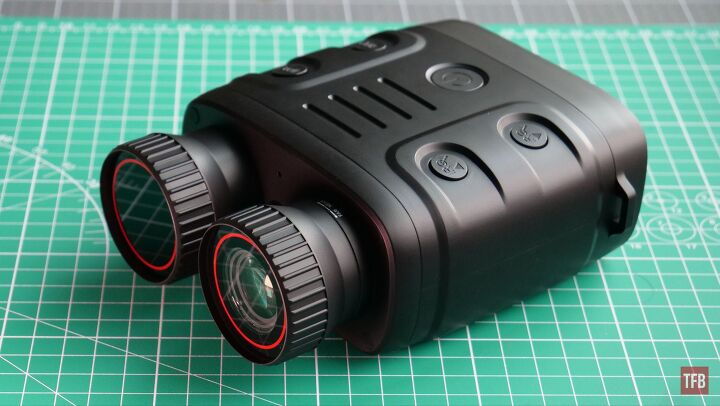
Following up on our review of the MCG Tactical Stinger red dot— the $79 "not EOTech" that surprisingly held zero for some casual plinking, we’ll be taking a similar look at another budget piece of kit from the same crew: the Dark Force Night Vision Binoculars. Clocking in well under the price of even a single Gen 1 analog tube, these digital “Binoculars,” according to the MCG product page, promise "tactical advantage" in the dark with a screen, IR illuminator, and recording. But is this chinesium gadget a PVS-14 killer or just a fun toy for the truck bed? Spoiler: it's the latter, and I think that's mostly okay, especially for the right crowd.
More Gear Reviews on TFB:

MCG "Dark Force" Binoculars Review: A Fun Stocking Stuffer for Kiddos
The Dark Force arrives in completely different packaging than either of the Stingers did. While the Stingers are shipped in very plain, non-branded cardboard boxes, the Dark Force comes shipped in a more fancy printed box that lists some of the unit's specifications and features. Inside, you’ll find the binoculars, a USB-C charging cable plus an adapter, a lanyard, a microfiber cloth and case, and a thin manual that's equal parts translated and aspirational. Everything aside from a MicroSD card is there to get you scanning the backyard the same evening you get it.

In hand, it's a featherweight 10.5-ounce unit with a smooth black plastic shell that immediately indicates to me that this is 100% a “consumer gadget" more than "duty optic." The binocular form takes shape via the sensor and IR emitter array on the front of the unit. A single 2.5" IPS LCD screen adorns the back of the unit and seems suitable enough, if not a bit bright, for casual peeks, though the thin materials and rubber membrane buttons have that familiar "will it survive a drop?" feeling. IP54 means light rain is fine, but this thing definitely isn’t rated for harsh or even mild environmental conditions. Silver lining: so light that even your kids can run it all night without arm fatigue. Although the unit does include a laser designator on the front so one should take the proper time to familiarize oneself with how this thing works before heading off into the night with it.


On paper, the Dark Force is more or less as feature-rich as you should expect. You can record, observe, and illuminate with IR without extra gear. Reality check: those specs listed on the box above are optimistically a best-case with max IR blazing. One thing I’ve learned about Day/Night cameras and even IR Optics is that the specs do matter here.


Do They Work?
I’ve been toying around with this thing both at home, around the neighborhood, and even on a few camping trips. Powered up, the screen is extremely bright to the uninoculated eye even on its “low” setting. After a brief startup window in bright white, the screen flips to a live video feed. Switching to IR-boosted mode is accomplished by touching either of the IR buttons on the left-hand side of the unit, and it has 7 total IR illumination levels. However, I couldn’t really perceive much of a difference at the different levels of illumination. At close range, out to about 75 yards, shapes are discernible enough, motion is trackable, and recording captures decent clips for replay, but if you’re an audio or cineophile, you’ll probably be disappointed even with the maximum resolution and quality settings selected (QHD 30P).


If you’re trying to get clear images, the best practice is to mount the Dark Force Binos on a tripod, as any type of movement while viewing or recording introduces lag. The tiny 10° FOV tunnels your view like bad binoculars, and all focus is manual - no auto-focus here. My NVM-14 monocular has 4 times the FOV at 40°. Closer images are clear enough once you get them processed, but viewing them on the tiny 2.5” screen produces what I’ll call Minecraft graphics at a distance. But hey, great for the rest of the family who doesn’t have the money for a last-generation analog tube or a proper pair of Day/Night/Thermal binoculars like those from AGM that cost upwards of $7,500. The onboard IR barely reached out to 75 yards on overcast nights, but clear nights with a full moon let it ID livestock or neighborhood animals reliably from the truck or porch. The included rechargeable batteries hold for a couple of hours of mixed use, and can be recharged without removing them. Below is a direct comparison between the Dark Force binos, my cell phone, and a genuine Analog White Phos night vision device on an overcast night with a full moon behind it.


The red laser pointer I mentioned earlier is easily activated with a single push of the power button. However, I’m not exactly sure why it's included. I think it's kind of gimmicky for zero-light pointing, but it is also visible day or night, so perhaps it has some utility if you’re using this thing with a group and are trying to point something out to someone else. I have directly compared these binoculars against my Belarusian NVM-14 monocular as well as some of my night-time shooting options from my cell phone, and the results above are pretty clear (if they weren’t already). Night and day, even last-generation analog tubes are perfect for wide, instant, crystal views out to very long distances, and their use is even further magnified with even a commercial-grade (but still expensive) IR illuminator. The Dark Force, on the other hand 100% needs IR floodlights to operate and lags like a security camera. Price gap? $150 vs $2-5k. No shame in buying one as long as you know what to expect from it, and you’ll be stuck with only JPG for image format, and AVI for video format.

Final Thoughts
On the plus side, the Dark Force is dead simple for kids and noobs. Simply power it on, see a little bit more of your surroundings at night, and even record some of it along the way. The recording ability, in particular, I think, adds real value for youngsters who are learning alongside the adults, and is probably great for getting a basic understanding of what devices like this are capable of on the very low end of the spectrum. While the lightweight unit survives truck life and light drops, it's probably best to keep this one inside the cab or on the back porch window sill for when you want to capture a quick IR glance at something lurking in the unlit backyard near the shed. The downsides, however, should be predictable: it's IR-dependent, fairly laggy, and has a narrow FOV. The plasticky build suits more casual or curious users rather than those with the money and experience with real IR, Thermal, and Analog Night Vision devices.

These might be great for ranchers glassing from the ATV, campers spotting critters in the woods at night, or dads introducing junior to some property pest control. Gold. Let the kid scan fields at night with their friends without taking out a high-interest loan through Creedova. It might be fun for airsoft nights, backyard security patrols, and even junior pre-season scouting. It’s not all bad, especially for the price, but it's definitely not the “real Night Vision” that you’d find anywhere in the tactical space.


To sum it all up, MCG's Dark Force binoculars are functional, kinda fun, forgiving for little hands, and can even be educational when employed with the right knowledge and expectations. Much like the previously reviewed MCG Tactical Stinger red dot, the Dark Force Binoculars might make a great stocking stuffer or fun gift for the young ones with the right proclivities this Christmas season. I’d like to thank MCG Tactical for sending out the Dark Force binos for this review.


Reloader SCSA Competitor Certified Pilot Currently able to pass himself off as the second cousin twice removed of Joe Flanigan. Instagram: https://www.instagram.com/ballisticaviation/
More by Luke C.







![The NEW 10mm Extar Arms EP10 [GunCon 2025]](https://cdn-fastly.thefirearmblog.com/media/2025/07/03/01202/post.jpg?size=350x220)

Comments
Join the conversation
Great for the kids, but I think I'll keep my Pulsar Merger thermal binos.