DOJ Opens Second Amendment Rights Section

The U.S. Department of Justice has opened a dedicated Second Amendment Rights Section within its Civil Rights Division, marking the first time the federal government has created an office specifically tasked with investigating state and local infringements on gun rights.
The new section began operations on December 4, according to documents the DOJ sent to Congress in late November. The move represents the culmination of nearly a year of groundwork following President Trump's February 7 executive order directing Attorney General Pam Bondi to review federal gun policy and "assess any ongoing infringements of the Second Amendment rights of our citizens."
What the New Section Does
According to the Congressional notification reviewed by Reuters, the Second Amendment Rights Section will investigate state and local laws or policies that limit gun rights. The office will operate using existing DOJ personnel and funding, with no congressional approval required for the reorganization.
The section joins other specialized units within the Civil Rights Division focused on voting rights, housing discrimination, and police accountability. This marks the first time Second Amendment enforcement has received its own dedicated section within the division, placing it alongside other constitutional rights in terms of federal civil rights priorities.
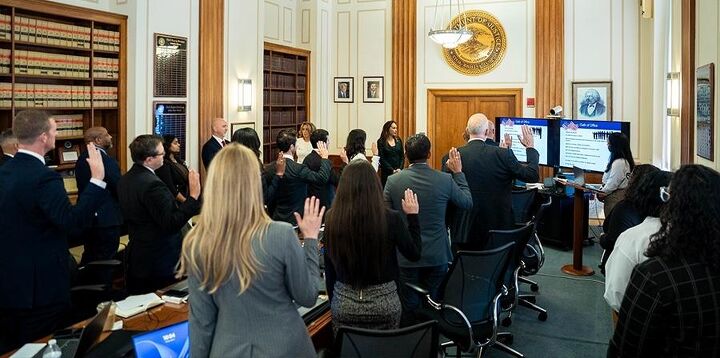
Assistant Attorney General Harmeet Dhillon, who heads the Civil Rights Division, has been vocal about the new focus. Dhillon was confirmed by the Senate on April 3 and sworn in on April 7. In court appearances and public statements throughout 2025, she's repeatedly stated that "the Second Amendment is not a second-class right."
The Background: From Executive Order to New Office
The path to this new section began with Trump's February 7 executive order titled "Protecting Second Amendment Rights." The order gave AG Bondi 30 days to examine "all orders, regulations, guidance, plans, international agreements, and other actions" from the Biden administration and develop a plan to protect gun rights.
That directive specifically called for review of:
- ATF rules from 2021-2025
- The "enhanced regulatory enforcement policy" (the so-called zero tolerance policy)
- White House Office of Gun Violence Prevention documents
- DOJ positions in ongoing litigation
- Firearm and ammunition classifications
- Processing of NFA applications
Two months later, on April 8, Bondi created the broader Second Amendment Enforcement Task Force via an internal memo. That task force, which Bondi chairs with the Associate Attorney General serving as vice chair, includes representatives from multiple DOJ divisions, the ATF, and the FBI. The newly opened Second Amendment Rights Section appears to be the Civil Rights Division's specific contribution to that larger effort.
First Actions: The LA County Investigation
The Civil Rights Division didn't wait for the new section to formally open before taking action. On March 27, the DOJ announced its first-ever Second Amendment "pattern or practice" investigation, targeting the Los Angeles County Sheriff's Department over concealed carry permit delays.
According to the DOJ, applicants in LA County faced wait times exceeding 18 months for CCW permits—far beyond California's statutory requirements. The investigation reviewed data from over 8,000 permit applications.
On September 30, the Civil Rights Division filed what the DOJ called "the first affirmative lawsuit in support of gun owners filed by the U.S. Department of Justice," seeking relief for affected applicants. The lawsuit specifically challenged the department's permitting delays, fees, and approval processes.
"This lawsuit seeks to stop Los Angeles County's egregious pattern and practice of delaying law-abiding citizens from exercising their right to bear arms," Dhillon said in the DOJ's announcement.
The agency even established a specific email address (Community.2ndAmendmentCA@usdoj.gov) for anyone who has waited more than four months for a concealed carry decision to report their experience.
What It Means for Gun Owners
In practical terms, the new section creates a federal avenue for addressing state and local gun restrictions that may violate the Second Amendment. Gun owners and federal firearms licensees now have a specific DOJ office to contact when facing what they believe are unconstitutional restrictions.
The section's creation also signals a significant shift in federal priorities. During the Biden administration, the White House Office of Gun Violence Prevention coordinated gun control efforts across federal agencies. That office, established in September 2023 and overseen by then-Vice President Kamala Harris, was shut down within days of Trump taking office.
The contrast is stark: instead of a federal office working to implement gun restrictions, there's now a federal office investigating those restrictions.
The Broader Context
This development comes amid several other pro-Second Amendment policy changes at the DOJ:
- The ATF scrapped the Biden-era "zero tolerance" enforcement policy in April
- The DOJ began reviewing two controversial ATF rules: the stabilizing brace rule (2021R-08F) and the expanded definition of "engaged in the business" (2022R-17F)
- The DOJ filed Supreme Court briefs supporting challenges to restrictive state gun laws, including Hawaii's concealed carry restrictions
The Second Amendment Enforcement Task Force that Bondi created in April has been actively involved in litigation. Dhillon personally appeared in federal court in Chicago to argue against Illinois' assault weapons ban, and the DOJ has filed amicus briefs supporting Second Amendment challenges in multiple jurisdictions.
Industry and Advocacy Response
The National Shooting Sports Foundation called the new section "a historic course correction in federal policy" and noted it gives the firearm industry and gun owners "somewhere to turn when their rights are targeted through back-door regulation."
Gun rights organizations, including the Firearms Policy Coalition, had specifically recommended creating a dedicated Second Amendment section within the Civil Rights Division, making this a direct response to advocacy group requests.
Critics, including former Civil Rights Division attorney Stacey Young, argued that the focus on Second Amendment issues represents a departure from the division's traditional civil rights mission. "The Civil Rights Division's new focus on the Second Amendment, which is far outside its longstanding mission, is moving us even further away from our nation's commitment to protecting all Americans' civil rights," Young told Reuters.
Looking Ahead
The Second Amendment Rights Section now joins the existing framework of federal firearms policy enforcement, which includes the ATF's regulatory role and the DOJ's prosecutorial functions. How the new section will coordinate with these existing agencies—and which state and local restrictions it will challenge—remains to be seen.
What's clear is that this represents a fundamental shift in how the federal government approaches Second Amendment issues. Rather than focusing solely on enforcing federal gun laws, the DOJ now has an office dedicated to investigating whether state and local governments are properly respecting gun rights.
For gun owners facing permit delays, excessive fees, or restrictive local ordinances, there's now a federal office specifically tasked with addressing those concerns. Whether that translates into meaningful relief will depend on how aggressively the section pursues investigations and litigation.
Josh is the Editor in Chief of The Firearm Blog, as well as AllOutdoor and OutdoorHub.
More by Josh C


![[SHOT 2026] FAB Defense AMP Pistol Conversion Kits](https://cdn-fastly.thefirearmblog.com/media/2026/01/22/19411/post.jpg?size=350x220)




![[SHOT 2026] The New Staccato HD C4X Compensated Pistol](https://cdn-fastly.thefirearmblog.com/media/2026/01/30/13111/post.jpg?size=350x220)


Comments
Join the conversation
OTC, non serialized suppressors.
The 2nd amendment refers to arms AKA the same arms in ITAR. Americans should have uninfringed access to purchase grenades, artillery, military aircraft, etc. So if the "2nd amendment rights section" is legit, they should make those connections. 2A has been horribly infringed since the founding of the nation when private ownership of cannons and even warships was common.