Fudd Friday: When Craftsmanship Was More Than a Marketing Term

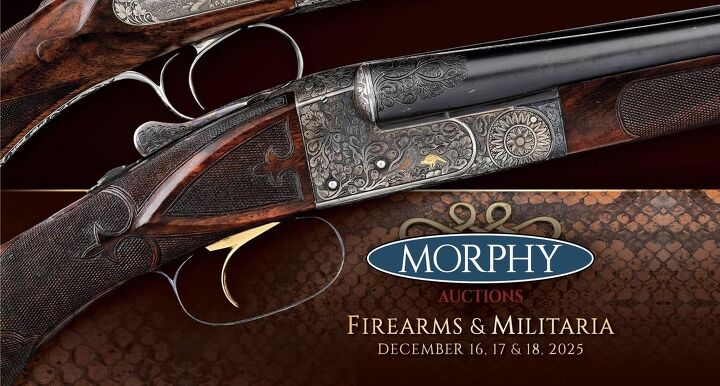
Morphy's December 16-18 firearms auction reads like a catalog from a different century—one where engravers signed their work, walnut was selected by eye and grain rather than price point, and the word "custom" meant something a man with calloused hands had actually customized.
The 1,343-lot selection spans the utilitarian to the sublime, but it's the latter that deserves our attention on Fudd Friday. These are firearms that predate the MBA-ification of the gun industry, built when makers still believed their work would outlive them.
The Italian Argument
A matched pair of Rizzini R1 shotguns anchors the sale: a .410 and 28-gauge, both with 23-3/8-inch barrels and engraving by Angelo Galeazzi that makes you understand why some men spend more on their guns than their vehicles. The imagery tells its own story: mourning doves and ducks rendered with the kind of attention that requires you to actually study the birds in question, rose-and-scroll work that flows across metal like it grew there.

Both guns were proofed in 1982. The .410 carries Italian superior proof marks with three-inch chambers; the 28-bore shows standard proof marks with 2¾-inch chambers. The stocks are exhibition-grade walnut, the kind with figure so pronounced you can trace the tree's growth rings with your finger.
They rest in a Nizzoli felt-lined leather case, itself a small work of art.
Estimate: $150,000 to $250,000
These are not guns you take through brambles chasing roosters. These are guns you leave to someone in your will, assuming you can find an heir who understands what they're receiving.
The English Counter-Argument
For those who find Italian exuberance a bit much, there's a 28-bore J. Purdey & Sons over-under that makes its case more quietly. Master engraver Giancarlo Pedretti handled the decoration: blackleaf scroll and game-scene vignettes executed with the restraint that distinguishes British work from continental flourish.

The specifications read like a checklist of what separates a fine gun from everything else: 28-inch file-cut vent rib barrels, Prince of Wales stock, single non-selective mechanical trigger on round bar action, auto-safety, hold-open top lever, gold-lined cocking indicators. Even the brass-cornered oak and elephant-hide presentation case demonstrates more care than most modern guns receive in their entire manufacture.
The accessories (turnscrew, chamber brush, two-piece ebony cleaning rod) all wear buffalo-horn handles, because someone decided that mattered.
Estimate: $80,000 to $120,000.
The American Exception
The Ithaca Grade 7 NID .410 carries a story that elevates it beyond mere craftsmanship into the realm of a genuine artifact. Serial number 448950. One of only two .410s Ithaca ever produced in this grade.

Manufactured in October 1927, it was shipped to John Boa, Ithaca's marketing director, for display among the company's finest work. In 1928, someone stole it from the Isaac Walton League in Omaha, Nebraska. The gun was sold, as stolen things often are, then later recovered and returned to its rightful owners.
It has remained with that family ever since. Nearly a century of provenance, documented with an Ithaca factory letter.
The condition speaks to careful stewardship: 98% of the gold-wash finish on the receiver, 98% factory blue on the barrels, brilliant bores. The factory embellishment includes rose- and yellow-gold inlay, the kind of work that required steady hands and better eyes than most of us possess.
Estimate: $30,000 to $50,000
This is the gun in the sale that deserves the closest attention. Rarity, provenance, condition, and a theft-and-recovery story that reads like something from a detective novel. Fresh to market after generations with one family.
The Frontier Aesthetic
A circa-1919 Colt Single Action Army in .38 WCF demonstrates what happens when cowboy nostalgia meets skilled engraving. Weldon Bledsoe covered the revolver in cattle-brand imagery: not random decoration, but actual working brands rendered against a punchdot background with scrollwork accents.

The nickel plating and gold wash on the ejector rod housing, cylinder, and hammer catch light the way silver coins used to before we started making them from base metal. Mother-of-pearl grips with Rampant Colt medallions complete what could easily have become gaudy but instead landed somewhere between ornate and honest.
Estimate: $15,000 to $20,000.
The Artist's Signature
Conrad Ulrich signed his work three times on this Model 1866 Winchester with boxed touch marks on the left side of the upper tang, placed where only someone looking for them would find them. Manufactured in 1871 in .44 Henry Rimfire, the rifle carries engraving that functions as both decoration and documentary record.

There's a Native family with a crocodile. A buck and doe in the woods. A saddled horse. Western animal vignettes: charging bison, standing grizzly bear, skulking cougar. Each image tells part of a larger story about the West as it was imagined in 1871, before the frontier closed and the mythology calcified.
The blued rifle-length octagon barrel is marked with Ulrich's second-style two-line address. It has a drift-adjustable German silver-blade front sight and ladder rear. The gilt-finished brass frame shows patina in places, proving someone actually carried this rifle rather than keeping it locked away.
Estimate: $30,000 to $40,000.
This is the kind of gun that belongs in a museum, and probably will. But for now, it can still be owned, held, and perhaps occasionally fired by someone who understands what it represents.
The Military Offerings
The auction includes serious military hardware for those whose interests run toward destructive rather than decorative: a Rheinmetal MG42/59 machine gun with the extraordinarily low serial number 61-00001 (the first one) estimated at $50,000 to $80,000, and a factory-original 1984 Heckler & Koch MP5SD3 in the same range. Both require BATF approval, which adds months to the process but keeps the riff-raff at bay.

There's also Major General Smedley Darlington Butler's summer uniform, complete with Chinese tailor marks inside and cloisonné ribbon bars that correspond to his awards. Butler remains one of only two Marines awarded two Medals of Honor, and the only officer to achieve that distinction. The uniform stayed with his family through the early 2000s before entering the collector market. Estimate: $15,000 to $25,000.
What These Numbers Mean
Let's address the obvious question: Are these prices justified?
From a strictly utilitarian perspective, no. You can buy guns that shoot just as straight, handle just as well, and perform just as reliably for a tenth (or a hundredth) of these estimates. Modern manufacturing has democratized competence in ways that would astonish the craftsmen who built these pieces.
But utility was never really the point, was it?
These firearms represent a different set of values: The time required to master a trade, the commitment to signing your work, the belief that beauty and function need not be mutually exclusive. They come from an era when planned obsolescence was called fraud rather than business strategy.
Someone will pay these prices. Someone will carefully inspect each piece, verify the provenance, secure the financing, and place the winning bid. In twenty years, that person will almost certainly be vindicated. Quality compounds differently than stock portfolios, accumulating value through time rather than interest.
The rest of us can admire from a distance, perhaps learning to recognize true craftsmanship when we see it—even if we can't afford to own it.
The Practical Details
Morphy's December 16-18 auction begins at 9:00 AM Eastern each day. The gallery is located at 2000 North Reading Road, Denver, Pennsylvania. Bidding is available in person, by phone, through absentee bid, or live online through Morphy Live.
The full catalog is viewable at morphyauctions.com. Registration requires the usual verification of identity and funds, which takes time if you've never dealt with Morphy's before. Plan accordingly.
And remember: The catalog is free. So is window shopping. It's the bidding that costs money, sometimes more money than you intended to spend, which is how auctions work and always have.
But looking at what was possible, what was achieved, what endures? That costs nothing at all.
Josh is the Editor in Chief of The Firearm Blog, as well as AllOutdoor and OutdoorHub.
More by Josh C


![[SHOT 2026] Beretta Introduces the A300 Ultima Patrol in 20ga!](https://cdn-fastly.thefirearmblog.com/media/2026/01/20/11561/post.jpg?size=350x220)


![[SHOT 2026] Drone Round Defense Multi-Projectile Anti-Drone Ammo](https://cdn-fastly.thefirearmblog.com/media/2026/01/27/21091/post.jpg?size=350x220)


Comments
Join the conversation