Self-Defense Training Redefined - A Weekend at W.O.F.T.

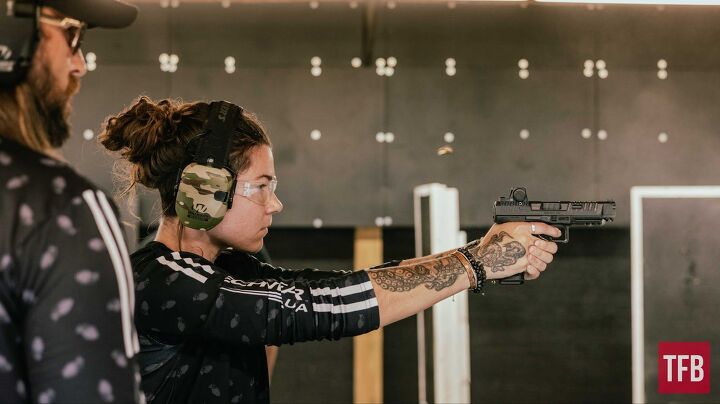
This past spring, I was invited to a training facility in Florida for a two-day set of courses. The Faculty was called W.O.F.T. and while I thought the name sounded a little funny, I looked into them and soon realized how unique this place looked to be. W.O.F.T. stands for “Where Our Families Train,” and after looking over their website, I agreed to visit their facility.
More Articles @TFB
- Reptilia Releases New Handguards for AR-Platform Rifles
- A Shotgun Nobody Liked? - Browning A500R
- The Smith & Wesson Model 1854 Series Adds in the .30-30 Win Cartridge
- Polish-Ukrainian AK Collab at WBP: First Look at the KRUK
I would like to thank Rick Lindsey and his team at X Insurance for funding my trip down to W.O.F.T. and allowing me to participate in all of the training. I got to sit down with Rick and talk a little bit about the challenges of providing proper insurance for a facility like W.O.F.T., and I will be writing a separate article on that conversation because it was actually very interesting. All you need to know now is that without X Insurance, W.O.F.T would be uninsurable with how dynamic the training is.
What is W.O.F.T. ?

W.O.F.T. is a premier education center located in Lake County, Florida, dedicated to conscious self-defense and preparedness for real-life scenarios. Its mission is to empower individuals and families to navigate potentially harmful situations with confidence and composure by providing custom, personalized instruction in a secure, private facility. Founded on the principle of holistic self-defense, W.O.F.T. goes beyond traditional training to focus on awareness, posturing, and de-escalation techniques drawn from nature and practical psychology, ensuring participants are equipped for everyday environments like coffee shops, gas stations, or parking lots. The center emphasizes building a supportive community that encourages repeat visits for skill refinement, making self-defense accessible and transformative for diverse groups, including women, business leaders, first responders, and entire families.

What sets WOFT training apart is its scenario-based, adaptive approach that simulates unpredictable real-world encounters, such as carjackings, low-light ambushes, or verbal confrontations, while incorporating tools like knives, flashlights, pepper spray, and firearms only as options within a broader toolkit. Unlike military-style drills, W.O.F.T. tailors each iteration to the individual's reactions, varying threats to prevent predictability and foster genuine decision-making under stress, often guided by the OODA Loop (Observe, Orient, Decide, Act). This family-friendly program targets everyone from teenagers to seniors, including those with unique needs like dementia, prioritizing "soft skills" to avoid overreaction and promoting lifelong confidence through debriefs and combatives that blend hand-to-hand with environmental awareness.


Day 1: Orientation and Classroom Foundations

We kicked off the first morning with an excellent breakfast provided by the staff, followed by a short orientation. We discussed the core purpose of self-defense training, emphasizing safety and the OODA Loop.
The OODA Loop is a cyclical decision-making model developed by U.S. Air Force Colonel John Boyd in the 1970s, originally designed to help fighter pilots outmaneuver opponents in aerial combat by processing information faster than the enemy. It stands for Observe, Orient, Decide, and Act, forming a continuous loop that enables rapid adaptation in dynamic, high-stress environments.
In the Observe phase, you gather raw data about your surroundings—scanning for threats, cues, or changes in the situation. Orient involves analyzing that information through the lens of your experience, training, biases, and context to form a mental model of what's happening. Decide is where you select the best course of action based on that analysis, and Act executes it, whether that's evading, de-escalating, or engaging. The loop then restarts, allowing for ongoing adjustments as the situation evolves. This framework emphasizes speed and agility, disrupting an adversary's own OODA process to gain the upper hand.

In the context of W.O.F.T, the OODA Loop is integrated into scenario-based self-defense training to empower participants, individuals, and professionals with instinctive, safety-first responses to real-world threats. Founded by Philip Toppino, W.O.F.T uses the model during orientations and immersive drills to stress situational awareness and prevent overreactions.
For instance, in low-light or verbal confrontation scenarios, trainees apply OODA to observe subtle cues (e.g., body language), orient to assess intent (e.g., distinguishing a lost elderly person from a predator), decide on options (e.g., walk away or use a flashlight for illumination), and act decisively without escalating harm. Toppino highlights its broader applicability beyond military roots, adapting it for personal and family safety to build confidence and proactive habits in everyday settings like parking lots or coffee shops. This tailored use ensures training remains unpredictable and personalized, fostering a "herd mentality" of vigilance drawn from nature, as discussed in W.O.F.T.'s classroom sessions.

Before diving into the scenario training, we spent nearly an hour in a classroom setting exploring posturing and lessons from nature. We talked about how animals adapt to avoid predators—things like herd mentality or evolutionary traits, such as the eye spots on a Bengal Tiger or the defensive charges of Cape Buffalo herds. I found it fascinating, especially the comparisons of reaction times between humans, snakes, and cats.
Philip emphasizes scenario-based training tailored to each individual. Scenarios are customized based on how a person reacts, and they're varied for every iteration. This ensures no two reps are the same, so one student can't just watch another and anticipate the outcome. Coming from a military background, where training often follows the exact same script for everyone (and if you're last in line, you only get one live rep before watching the rest), I really appreciate this approach. It keeps things fresh and realistic.
This is the end of Part 1, there’s a lot more to cover, in Part 2 I’ll detail W.O.F.T’s low light, carjacking, and hand to hand combat classes!
-Former Army Photographer / Videographer -Current Aviation Student -Future in debt due to Firearm collection
More by Patrik O







![[SHOT 2026] Streamlight New Releases](https://cdn-fastly.thefirearmblog.com/media/2026/01/21/02461/shot-2026-streamlight-new-releases.jpg?size=350x220)




![[SHOT 2026] Falco Holsters New Hybrids & Upgrades The Timeless Series](https://cdn-fastly.thefirearmblog.com/media/2026/01/22/01191/post.jpg?size=350x220)
Comments
Join the conversation