Secret Service Seeks New 5.56 Duty Rifle

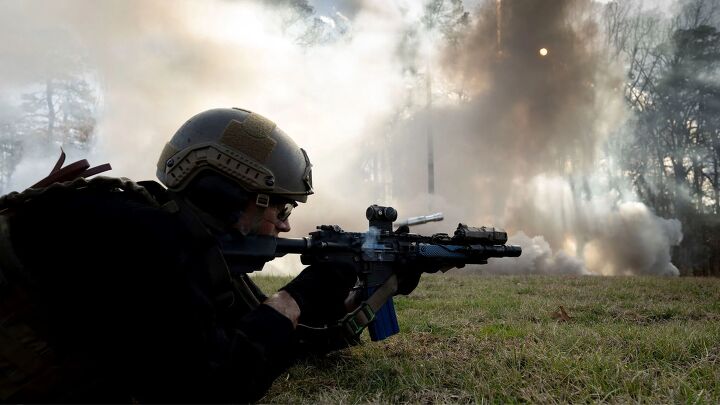
The United States Secret Service has issued a Request for Information for a new 5.56x45mm duty rifle, and the requirements tell an interesting story about how the agency plans to use these guns.
Posted to SAM.gov with a December 5, 2025, response deadline, this RFI represents the Secret Service's effort to identify manufacturers capable of providing a suppressed, semi-automatic rifle that maintains operational consistency with their existing Knight's Armament SR-16 service rifles. The procurement is described as eventually moving to a firm fixed price contract with a base period and four option periods—meaning this could represent a substantial, multi-year rifle program.
What They're After
The requirements are specific and clearly written by people who actually use rifles. The Secret Service wants a rifle that's no taller than 8 inches without accessories, weighs no more than 8 pounds including suppressor, and measures no longer than 29 inches with the stock folded and suppressor attached. Barrel length must fall between 12.25 and 14 inches.
That folding stock requirement is notable. When you're protecting dignitaries in close quarters or need to move rifles in and out of vehicles discreetly, every inch counts. A 29-inch maximum overall length with the stock folded makes for a much more manageable package than a standard 16-inch carbine.
The weapon must be semi-automatic only and operate via either direct impingement or short-stroke gas piston. It needs to run everything from 55-grain to 77-grain ammunition, including frangible rounds. The barrel must maintain 2 MOA accuracy and no more than 125 fps velocity loss over a 10,000-round service life.
Mandatory Components
Here's where it gets interesting. The Secret Service isn't leaving much to chance on certain components. They've specified mandatory parts:
Suppressor: HUXWRX FLOW 556K, mounted per manufacturer specifications. No crush washers allowed.
Pistol Grip: Magpul MIAD GEN 1.1 Grip Kit – Type 1 (MAG520), black.
Stock: Magpul CTR Carbine Stock (MAG310) mounted to a folding stock adapter, black.
The standardization makes sense from a logistics and training standpoint. Everyone trains on the same controls, spare parts inventories are simpler, and there's less risk of a critical accessory breaking in a way that sidelines the weapon.
The Details Matter
The fire control selector must be ambidextrous with a single lever paddle design, positioned so shooters don't have to break their firing grip to manipulate it. It needs to rotate exactly 90 degrees from safe to semi-automatic with a positive detent in each position.
The trigger pulls must range between 4.0 and 6.5 pounds and be a non-adjustable two-stage design with a smooth face. No other controls can exist inside the trigger guard area—a sensible requirement when you consider agents might be wearing gloves in all weather conditions.
The charging handle must be ambidextrous with a latch release system and capable of one-handed operation. The bolt hold-open device must work both via magazine follower and manual activation, and the bolt must stay back even after the empty magazine is removed.
The Handguard Specifics
The free-floating handguard must measure at least 9 inches along the 6 o'clock position with at least 8 inches of configurable rail mounting space at 3, 6, and 9 o'clock. That "configurable" designation means either direct Mil-Std-1913 mounting or M-Lok slots with removable rail segments.
The contractor must provide enough M-Lok rail segments (in 3, 5, or 7-slot aluminum configurations) to cover the full length at all three positions simultaneously. Handguards with permanently attached Picatinny rails at those positions are also acceptable.
The upper rail must align perfectly with the handguard's top rail when assembled, and the combined receiver and handguard must provide at least 16.375 inches of continuous Picatinny rail at the 12 o'clock position.
Magazine Compatibility and Sling Mounts
The magazine well must be compatible with Magpul PMAG 30 AR/M4 magazines (NSN 1005-01-628-5106 and NSN 1005-01-615-5169). The magazine release must allow magazines to drop free without assistance, but the receiver design must provide some shielding against inadvertent activation when pressed against body armor or uniform equipment.
Sling mounting points must be rotation-limited (4-position) quick-detach cups at the rear of the receiver and on the handguard, allowing interface with quick-detach push-button swivels.
Manufacturing Requirements
The offeror must be the original equipment manufacturer of the serialized lower receiver, and site inspections may be required. All external metal parts need a dark, subdued, rust and corrosion-resistant finish that won't be affected by Simple Green or other common gun cleaning solvents used in heated ultrasonic tanks. No flaking, peeling, or blotching.
The lower receiver must carry a minimum 20,000-round warranty from the manufacturer.
Context and Background
This procurement follows the Secret Service's continued modernization efforts. Their Counter Assault Team currently runs Knight's Armament SR-16 CQB rifles with 11.5-inch barrels, which we documented in detail after the July 13, 2024, assassination attempt on President Trump. Those rifles featured KAC QDC/MCQ-PRT suppressors, Aimpoint T-2 optics, and LAW Tactical folding stock adapters.
This new requirement appears aimed at a slightly longer-barreled configuration—that 12.25 to 14-inch barrel length suggests they're looking for a bit more velocity and effective range than the 11.5-inch guns provide, while still maintaining a compact overall package with the folding stock.
The Secret Service has been actively updating its weapons systems across the board. Earlier this year, they issued an RFI for 6.5 Creedmoor designated marksman rifles to replace their 7.62x51mm M110 SASS rifles. That procurement is separate from this 5.56 requirement and aimed at their counter-sniper elements.
Who Can Compete
The Secret Service makes clear this is a Sources Sought/Request for Information, not yet a solicitation. They're conducting market research to determine which manufacturers can meet these requirements. The eventual procurement will use NAICS code 332994 (Small Arms, Ordnance, and Ordnance Accessories Manufacturing).
Interested parties must submit capability statements of no more than three pages describing their manufacturing capability, facility locations, lead times, relevant experience from the past five years, and potential challenges in meeting requirements. If referencing past contracts, they need to provide contract numbers and points of contact.
Several manufacturers likely have rifles that could meet these specs with minimal modification. Knight's Armament has obvious advantages given the requirement for SR-16 consistency, but companies like Daniel Defense, LMT, Noveske, LWRC, and others build quality rifles in this configuration space.
The requirement for OEM lower receiver manufacturing narrows the field—they're not looking for assemblers using purchased lowers. They want vertically integrated manufacturers who forge or machine their own receivers.
What This Tells Us
These requirements reflect real operational thinking. The specific overall length with folded stock, the mandatory suppressor, the requirement that all controls be accessible without breaking grip—these aren't arbitrary specs. Someone who carries these rifles in vehicles, protects protectees in close quarters, and might need to go from transport to action quickly wrote these requirements.
The standardization on Magpul furniture and HUXWRX suppressors suggests the Secret Service has done their testing and knows what works for their mission. They're not interested in experimenting with untested components when they're responsible for protecting the President.
That 10,000-round barrel life requirement is also telling. These aren't going to be safe queens—the Secret Service expects to shoot them. A lot. The 2 MOA accuracy standard with a service barrel life requirement shows they're balancing durability against precision.
The December 5 deadline for responses means we should see movement on this procurement relatively soon. Given the level of detail in the requirements, the Secret Service likely has a good idea of what's available and is confirming manufacturers can deliver before moving to formal solicitation.
Responses to this RFI should be submitted electronically to Contract Specialist Theresa Williams ( Theresa.Williams@usss.dhs.gov) and Contracting Officer Erik Syfert ( Erik.Syfert@usss.dhs.gov) by 4:00pm Eastern Time on December 5, 2025.
Josh is the Editor in Chief of The Firearm Blog, as well as AllOutdoor and OutdoorHub.
More by Josh C



Comments
Join the conversation
Sounds as if they have already decided what they want even if there is something that fits operational requirements better. Typical government procurement.
They want the MCX, without saying it…