A Reevaluation of Squad Lethality and Firepower, the New FN MTL-30
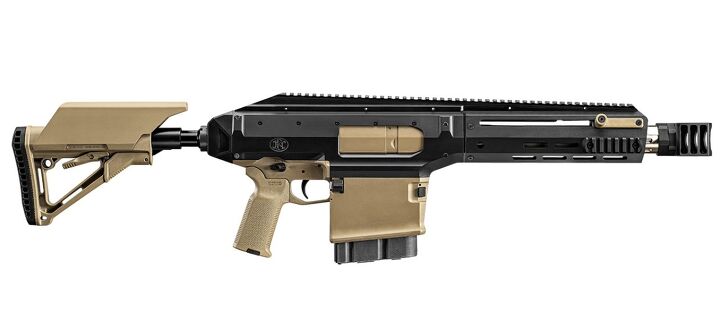
The U.S. Army’s selection of FN America’s MTL-30 (Multi-Purpose Tactical Launcher) as a leading entry in the Precision Grenadier System signals a significant shift, or more accurately, a reevaluation, in how infantry squads will project force at the small-unit level. The MTL-30 is a shoulder-fired, semi-automatic launcher chambered for 30mm medium-velocity flat trajectory grenades that blends rifle ergonomics with grenade-launcher, and the Army has already moved to mature the design under a Prototype Project Opportunity Notice. This is a reevaluation since the XM25, which was tested in Afghanistan in 2010, and the program was terminated in 2018.

The Gun
Unlike legacy 40mm low-velocity underbarrel launchers, the MTL-30 is designed for medium-velocity 30mm rounds on a much flatter trajectory. It’s built more like an enlarged rifle than a traditional stand-alone grenade tube: semi-automatic operation, detachable three- or five-round box magazines, an M4 telescoping stock, and an M-LOK rail system for enablers, and a top M1913 Picatinny rail for optics. The launcher measures roughly 35 inches, weighs around 10 to 11 pounds unloaded, and is designed to be comfortable for soldiers already familiar with modern infantry rifles. Depending on the ammunition weight, it is possible to double the weight and make it even heavier with an optic or other enablers. The weapon also features a stock assembly with a buffer system to help absorb recoil from the new medium velocity ammunition.

The faster, flatter trajectory of medium-velocity 30mm ammunition reduces time of flight and the steep arcing solutions that plague traditional low-velocity 40mm rounds. Practically, that means direct-fire engagements at far greater ranges become achievable without the same degree of manual range compensation or indirect-fire style aiming. Reported effective ranges for systems like the MTL-30 reach roughly 500 meters for point targets, which pushes a squad’s organic, precision-capable fires well beyond the 400-meter envelope of legacy grenade launchers. The new system gives small units more options for shaping an engagement from standoff positions. Existing Russian and Chinese systems already equal this point range; the MTL-30 gives the same advertised point engagement ranges as our adversaries, with no advertised overmatch capability. Of course, arching and lobbing the rounds would provide an indirect increase in range capability.

The medium-velocity 30mm grenade families are being developed alongside an array of warhead types, from high-explosive and fragmentation to airburst, and more. When combined with optical sighting and fire-control enablers, that arsenal lets squads tailor effects to mission needs: punch through light cover, defeat enclosed positions, or deliver controlled effects in urban environments where minimizing collateral damage is desired. The MTL-30’s design, which accepts modern optics and potentially integrates with squad sensors, makes it a precision tool.

The operational advantages map directly onto squad lethality and survivability. First, increased standoff and accurate direct fire allow the grenadier to suppress or defeat enemy positions before assault elements have to close. That reduces the exposure of assaulting fire teams and enables maneuvering with greater freedom of movement with increased capability. Second, having precision fires organic to the squad reduces the potential reliance on mortars for close, time-sensitive targets, a decisive advantage in fast-moving engagements. Third, a lightweight, controllable launcher that soldiers can sling and operate like a rifle, and maintain squad mobility and tempo. These factors together amplify distributed lethality: every squad becomes capable of doing more, faster, and with less external coordination. The new grenade launcher will be issued one per squad, giving the infantry squad 30mm grenade launchers and three per infantry platoon. It replaces one M320 grenade launcher for one fire team and retains the second M320 in the second fire team. However, this could change as things develop.

Countering new threats
Modern battlefields increasingly include small, maneuverable threats, unmanned aerial systems (UAS), pickup-mounted weapons, and small armored vehicles. Medium-velocity 30mm munitions, when paired with a precision aiming device, give squads an organic option to counter or deter these threats at the squad level without calling in heavier assets. The MTL-30 has been explicitly discussed as useful against emerging threats such as small UAS, where a directed, fast-impact or airburst munition is preferable to slow or area-effect approaches.
Designing a more capable weapon means nothing if it’s too heavy, awkward, or poorly supported to be used in the field. FN’s MTL-30 prioritizes soldier familiarity to shorten the learning curve and allow grenadiers to operate more intuitively under stress. But adoption still requires investment: training to exploit medium-velocity ballistics and new sighting solutions; logistics for new calibers, magazines, and spare parts; and doctrine updates so squads and platoons can reconfigure roles and tactics to get the most from the new capability. Those are significant but manageable hurdles compared with the combat payoff. At the tactical level, commanders can expect squads equipped with MTL-30s or equivalent precision grenadiers to close with the enemy on better terms, defeat key positions without external fires, and respond to fleeting threats more quickly.

U.S. Army fielding
When fielded, the new system is slated with a table organization and equipment at one per squad, three launchers per platoon, nine per company, a distribution designed to place precision grenadiers where they will produce the greatest tactical effect. With an estimated 20-25 grenades per grenadier, this, along with the semiautomatic capability, gives the grenade launcher the ability to provide the density of fire to gain fire superiority. That density gives each infantry squad a markedly stronger target-engagement capability: squads gain organic, direct-fire options against covered or dispersed threats at extended ranges, potentially cutting reliance on mortars or higher-echelon fires and enabling maneuver elements to close under more favorable conditions. Lastly, I would like to address the fact that the new system sighting equipment must be strong enough to hold up to the infantry's individual movement techniques, or IMTs, such as low crawl or bounding, especially if this weapon is slung. At the same time, the grenadier carries their primary weapon, the M4 or M7.

Conclusion
The MTL-30 or any other proposed medium velocity grenade launcher and other modern precision-grenadier concepts represent an evolution in how infantry squads generate effects on the battlefield. By marrying rifle ergonomics with medium-velocity, precision munitions and modern sighting systems, these launchers expand reach, increase hit probability, and broaden the palette of selectable effects available to a squad leader. When fielded with proper training, logistics, and doctrine, the result is a small-unit force that hits harder than before, a needed boost to squad lethality and firepower in the 21st-century fight.

Lynndon Schooler is an open-source weapons intelligence professional with a background as an infantryman in the US Army. His experience includes working as a gunsmith and production manager in firearm manufacturing, as well as serving as an armorer, consultant, and instructor in nonstandard weapons. His articles have been published in Small Arms Review and the Small Arms Defence Journal. https://www.instagram.com/lynndons
More by Lynndon Schooler





![[SHOT 2026] Century Arms Partners with Live Free Armory for Apollo 11](https://cdn-fastly.thefirearmblog.com/media/2026/01/31/20011/post.jpg?size=350x220)
![[Partner 2025] Zastava Unveils New Machinegun Chambered in 6.5 Grendel](https://cdn-fastly.thefirearmblog.com/media/2025/09/28/05281/partner-2025-zastava-unveils-new-machinegun-chambered-in-6-5-grendel.jpg?size=350x220)


![[SHOT 2026] FAB Defense AMP Pistol Conversion Kits](https://cdn-fastly.thefirearmblog.com/media/2026/01/22/19411/post.jpg?size=350x220)


Comments
Join the conversation
As always, it'll be interesting to see which offering wins the PGS trials and why. I pray we never see it tested in actual battle because that means our Men would be in harm's way, but given the Dems' domestic terrorists antifa/blm's penchant for gorilla tactics against good Americans, we may see it here at home before anywhere else. Allowing those Nazis and Brownshirts to stay on American soil is't a smart long term solution toward making America great Again.
This is like when your teacher tells you to write a 1000 word essay and you say the same thing a bunch of times with different words. Could have been like 2 paragraphs instead of 10. Do you ppl get paid by the word or something? Lol
This weapon is too heavy and fires a projectile that is too small.