Fudd Friday: Does Fitz Equal Fudd?


If you were to do show and tell with a snub-nose revolver with the front half of the trigger guard sawed off and the hammer bobbed, watch the reactions. Some old-timer will nod knowingly and say "Fitz Special." Someone else will look horrified and ask what bubba did to that poor gun.
Welcome to another edition of Fudd Friday, where we examine whether Depression-era custom gunsmithing is brilliant problem-solving or peak fudd mythology. Today's topic is Fitz Specials, revolvers modified by literally removing half the trigger guard and bobbing the hammer and whether this 1920s carry gun philosophy has any business existing in 2025.
Fudd Friday @TFB:
- Fudd Friday: Thompson/Center's Return - Why Classics Keep Coming Back
- Fudd Friday: Converting Mil-Surps - Once Necessity, Now Blasphemy
- Fudd Friday: Rifle Cartridges in Revolvers - Why Keep Making Them?
- Fudd Friday: The Remington 550-1's Useful Floating Chamber
- Fudd Friday: Winchester 1911 SL - Was the "Widowmaker" Really Deadly?
The Man Behind the Modification
John Henry Fitzgerald came up in Manchester, New Hampshire around 1870. Before getting into firearms, he fought bare-knuckle - back when that was an actual profession rather than a drunken parking lot dispute. He was built heavy with oversized hands, which becomes relevant later when we talk about why he started cutting up revolvers.

Fitzgerald's early career included stints with NYPD and the New York State Troopers. Somewhere in there he got serious about competitive shooting and became legitimately good at it. By 1918, Colt hired him as a company rep, demonstrator, and custom gunsmith - a position he held until 1944.
This wasn't just some guy with a Dremel and opinions. Fitzgerald wrote a book on defensive shooting in 1930, advocated for two-handed pistol technique before it was standard practice, and taught law enforcement agencies across the country. His influence on defensive handgunning is legit. Guys like Rex Applegate and Charles Askins - actual gunfighters, not Instagram operators - carried his modified revolvers and praised them publicly.
What Makes a Fitz Special
The modification package Fitzgerald developed typically included:
- Barrel shortened to 2 inches - Standard concealment work, nothing controversial here.
- Hammer spur bobbed flush - Eliminates the snag point when drawing from a pocket. These guns were meant for actual pocket carry in heavy wool suits and overcoats, where an exposed hammer could catch fabric and slow your draw or prevent it entirely. Since the gun becomes double-action only, you lose single-action capability, but for close-range defensive work that wasn't considered a problem.
- Front portion of trigger guard removed - This is the modification everyone fixates on. Fitzgerald cut away roughly half the trigger guard to give faster, more direct access to the trigger. His reasoning: men with large hands (like himself) wearing gloves in winter needed unobstructed trigger reach. There's also documentation suggesting this allowed firing from inside a pocket if necessary, though that gets into sketchy territory tactically. The rear portion of the trigger guard remained, providing some side protection. Combined with the heavy double-action trigger pull typical of these revolvers, Fitzgerald considered the risk of accidental discharge manageable, especially since these guns were intended for trained professionals, not general public carry.
- Additional work - Ejector rod shortened, grip butt rounded for comfort, all sharp edges smoothed, and action work to improve the double-action trigger pull.
How Many Actually Exist
Real Fitzgerald conversions done by the man himself at Colt are rare. Best estimates suggest somewhere between 40 and 200 guns total from the 1920s through 1940s. These weren't production items. They were custom shop work for specific customers who actually needed what Fitzgerald offered.

What happened afterward is predictable. The concept got popular, every gunsmith with a file started offering "Fitz conversions," and quality varied from competent to catastrophic. Fitzgerald's work on Colts inspired similar modifications on Smith & Wesson revolvers and other makes sometimes called "Fitz-style" rather than genuine Fitz Specials.
One modified Smith & Wesson with the trigger guard removed ended up painted on the cover of Ian Fleming's From Russia With Love in 1957. Firearms expert Geoffrey Boothroyd lent his personally-modified snub to artist Richard Chopping for the cover art. That particular gun later became police evidence in a Glasgow triple murder case. Boothroyd had to explain why his cut-trigger-guard revolver was relevant to an investigation when it was actually on loan to Fleming for a book cover. The cover art story is pretty interesting.

By the 1960s, poorly-executed amateur Fitz jobs were common enough to create the collector market paradox we see today: a genuine Fitzgerald-modified Colt brings $6,000-$8,000 at auction, sometimes dramatically more with provenance. Clyde Barrow's Fitz Special sold for north of $48,000 because of who owned it, even though there's no documentation Fitzgerald actually did the work.
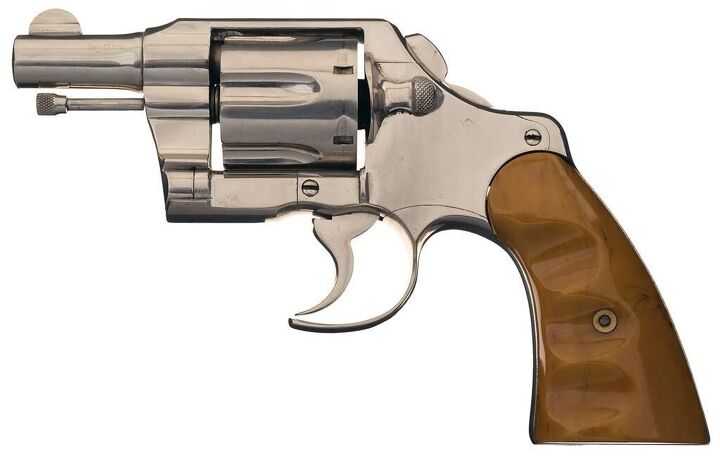
Amateur jobs? They destroy whatever collector value the base gun had. You're looking at a revolver that would be worth more if nobody had touched it.
Modern Guns That Solve the Same Problems
Smith & Wesson figured out how to get the benefits without the controversy in 1952. Rex Applegate (who carried a Fitzgerald-modified .45 ACP New Service) convinced S&W to build what became the Centennial.

The J-frame Centennial family gave you everything a Fitz Special offered: enclosed hammer for snag-free pocket carry, double-action only operation, fast comfortable deployment. But they kept the full trigger guard and added modern internal safeties. The concept worked well enough that Smith & Wesson's been making variants ever since. Models like the 40, 42, 640, 642, the entire Centennial and Bodyguard line.

Ruger's LCR series follows similar logic. Taurus also makes hammerless snubs. The problems Fitzgerald was solving through modification got solved through industry acceptance and manufacturing. Better materials, improved designs, factory warranties, modern safety features, etc. Things that are taken for granted as being standard now.

Should Anyone Build a Fitz Special Today?
If you want a Fitz conversion for actual carry use - No. Absolutely not. Modern J-frame models or Ruger LCRs do the job better, safer, and cheaper than having old school custom work done. A Smith & Wesson 442 or 642 gives you every functional advantage Fitzgerald was pursuing, with none of the liability concerns or explanations to the judicial system if you ever have to use it. Modification made sense when factory alternatives didn't exist. They exist now.
If you've got a beat-up old revolver with no collector value - Sure, if you want a historical curiosity and understand it's purely a project gun. I did exactly this with a non-functioning Smith & Wesson Model 36 that was already mechanically shot and cosmetically trashed. I took a week and did some proper Fitz work on it, got it running again, finished it up, and gifted the result to Adam S, a long-time Smith & Wesson collector, Managing Editor at AllOutdoor, and a fellow TFB writer.
The gun had near zero value as-is, so converting it made sense as a historical piece. Maybe he will do a Wheelgun Wednesday on it at some point. I know when I have time I will roll out a TFB Armorer’s Bench on it. I really enjoyed it and would love to do it again if I found a gun cheap enough or messed up enough to justify it.

But that's the critical distinction: project gun versus carry gun. Modern factory snubs are objectively better for actual defensive use. The only reason to create a Fitz Special in 2025 is historical interest/novelty, not practical application.
The Fudd Question Answered
Was John Henry Fitzgerald a fudd? No. He was a professional solving legitimate problems with the technology and understanding available in his era. The modifications made sense given 1920s-1940s carry methods, clothing, holster technology, and ammunition. His work influenced how we think about defensive revolvers and led directly to modern hammerless designs we take for granted.

Is insisting on actual Fitz modifications today fudd behavior? Yeah, if they are asking for it for what they are meant for. We've got better solutions now. Factory hammerless revolvers do everything a Fitz Special was meant to do, with improved safety, better materials, modern sights, and manufacturer support. Cutting trigger guards off revolvers in 2025 when superior alternatives exist at every price point is pure nostalgia, not practical problem-solving.
Fitz Specials represent an important development in defensive firearms. That history deserves appreciation and understanding. Actually replicating these modifications for modern carry use instead of buying today’s equivalents? That's where it crosses into fudd territory. The reverence for the concept has outlasted its practical relevance. Understanding why it mattered is valuable. Insisting it's still necessary is just obstinate.

What's your take? Ever handled a Fitz or seen amateur conversions? Would you carry a hammerless snub today? Do you think this modification done now is blasphemy? Let us know in the comments below. We always appreciate your feedback.
Staff Writer: TheFirearmBlog & AllOutdoor.com | Certified Gunsmith | Published Author | Firearm History Enthusiast
More by Sam.S



![[SHOT 2026] EAA Brings Back Affordable Combo Guns](https://cdn-fastly.thefirearmblog.com/media/2026/01/27/11111/shot-2026-eaa-brings-back-affordable-combo-guns.jpg?size=350x220)



Comments
Join the conversation
I’ve had a SW M49 for decades and carried it in an ankle rig as a BUG when I worked patrol as a CA LEO. Also carried it off duty in a pocket holster when wearing shorts and very occasionally do today though I’m retired. Added CT laser grips about 10 years ago as my vision went south. I would never consider lopping off half the triggerguard though.
Nice article, however, you missed the point of the cutaway trigger guard. The purpose, according to Fitz himself, was to prevent a broken trigger finger in the event someone attempted to twist the revolver out of your hand.