Fudd Friday: Blunderbusses, Pilgrims, and How Art Rewrote History

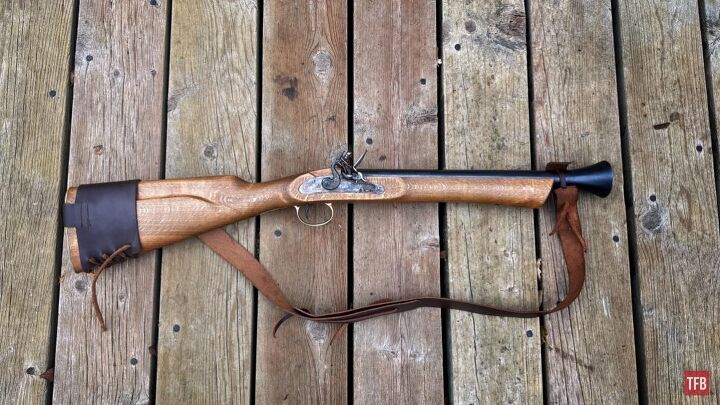
I think a lot of us can flash back to elementary school days, gluing construction paper onto a Thanksgiving diorama. There's a turkey made from a handprint. There's a Pilgrim in a buckled hat. And clutched in that Pilgrim's hands is a blunderbuss with its distinctive bell-shaped muzzle, ready to bag the big turkey for the harvest feast.
A teacher likely wouldn't have corrected this accuracy or dramatization. Their parents saw the same artwork. It's been wrong for so long that it feels right. But here's the problem: the Pilgrims landing at Plymouth Rock in 1620 carrying blunderbusses is pure fiction. The guns didn't exist yet. The timeline is off by decades. Yet this image has become so embedded in American Thanksgiving mythology that correcting it feels almost un-American.
Welcome to Fudd Friday, where today we're examining how artistic license in the 1800s created a firearms myth that refuses to die and what blunderbusses actually were when they finally showed up decades after the Mayflower landed.
Fudd Friday @TFB:
- Fudd Friday: Does Fitz Equal Fudd?
- Fudd Friday: Converting Mil-Surps - Once Necessity, Now Blasphemy
- Fudd Friday: Rifle Cartridges in Revolvers - Why Keep Making Them?
- Fudd Friday: The Remington 550-1's Useful Floating Chamber
- Fudd Friday: Winchester 1911 SL - Was the "Widowmaker" Really Deadly?
How The Myth Started
When America started celebrating Thanksgiving as a national holiday in the mid-1800s, artists rushed to create imagery of the "first Thanksgiving." The problem was, nobody had photographs from 1621. Artists worked from imagination, historical descriptions, and whatever looked good on canvas.
These painters wanted their work to be dramatic and memorable. A Pilgrim holding a boring straight-barreled matchlock musket doesn't grab attention. But a Pilgrim with a blunderbuss, that wide, flared muzzle that screams “effectiveness," now that's a painting people remember.
The artistic choice made sense from a compositional standpoint. That flared barrel creates a strong visual element. It's immediately identifiable as an "old gun" to viewers who don't know firearms history. It photographs well, for lack of a better phrase. It sticks in memory.

By the early 1900s, when Thanksgiving imagery really exploded in popularity through magazines, advertisements, and eventually film, the blunderbuss-armed Pilgrim was already established iconography. Nobody questioned it. Why would they? The paintings looked authoritative; they'd been around for decades, and most people didn't know enough about 17th-century firearms to spot the problem.
The Actual Timeline Problem
The "first Thanksgiving" celebration happened in autumn 1621. Blunderbusses as a distinct firearm type started appearing in Europe around the 1650s, primarily in Dutch and German arsenals. They didn't become common until the 1700s.
That's a 30-50 year gap minimum. The Pilgrims couldn't have carried blunderbusses because blunderbusses didn't exist yet in any meaningful form. It's not ambiguous. It's not "maybe they had early prototypes." They just weren't there.

What the Pilgrims actually carried were matchlock muskets. These required keeping a slow-burning rope cord lit to ignite powder in the pan, which then ignited the main charge in the barrel. They were finicky, weather-dependent, and required constant attention to keep that match burning. But they were proven technology, relatively affordable, and what most English settlers would have owned.

Matchlocks are historically accurate but visually fairly boring. Blunderbusses are historically wrong but visually striking. Artists chose striking. We've been living with that choice ever since.
What Blunderbusses Actually Were
The name tells you what they did: "donderbus" in Dutch means thunder pipe. These weren't subtle weapons. They were loud, intimidating, and built for specific tactical problems where standard muskets failed.
Where they actually worked:
- Naval combat: Below-deck corridors made 42-inch muskets useless. Short barrel, large bore, devastating at 10 feet in tight spaces. Naval crews and boarding parties carried them enthusiastically.
- Stagecoach defense: British Royal Mail guards used them from 1788-1816 as standard equipment. Point a bore that looks like a small cannon at a highwayman and watch them reconsider.
- Mounted combat: Full-length muskets were impractical on horseback. Cavalry needed short barrels that they could fire one-handed and load easily. European armies issued them to dragoons specifically for this role.
These guns excelled in confined spaces and mounted combat. They were terrible past 20-30 yards, useless for precision, and impractical as general-purpose weapons. Militaries used them in specific roles - naval service, some cavalry units, fortress defense - but line infantry kept their muskets and hunters kept their fowlers and later rifles. Blunderbusses filled gaps. They didn't replace anything.
Design Features That Actually Mattered
The flared muzzle is the defining visual characteristic, but it doesn't work the way most people think.
Common assumption: the flare spreads projectiles in a wider pattern, like a funnel spraying water.
Reality: The shot pattern is determined by what happens after pellets leave the barrel. That flare at the very end has minimal effect on the spread.

So why build them that way? Loading speed. Try pouring powder and shot down a standard-bore musket while sitting on a moving horse or standing on a ship deck in rough seas. Now try it with a 2-inch opening. The flare made reloading faster, and less precise movements were required. In combat situations where speed mattered, this was a genuine advantage.
Barrels typically ran 14 to 30 inches - extremely short by musket standards of the era, when 40+ inches was normal. This made them easier to handle in confined spaces and while mounted.

Bore sizes varied wildly, but .75 caliber was common, with many examples going significantly larger. Some exceeded one inch. This allowed loading multiple projectiles - buckshot being most common, though in emergencies, users reportedly loaded whatever was available: nails, rocks, broken glass. Whether this was practical or just dramatic storytelling is debatable.
When Americans Finally Got Them
Blunderbusses did eventually make it to America, just several decades after the Pilgrims landed. By the Revolutionary War era, they were known and used, though not as commonly as muskets and rifles. George Washington praised their capabilities for the Continental Dragoons in certain tactical situations.
Lewis and Clark brought them on their expedition west. Various militia units and frontier settlers owned them. But these were 18th and early 19th century firearms showing up in 18th and early 19th century contexts, over 150 years after the Mayflower landed.

Does it matter that there is this glaring firearm inaccuracy in history? No, not really. It's the modern-day equivalent of a period piece movie having a gun that it shouldn't have when telling a true story. It's just Thanksgiving decorations, not a history exam.
But for the sake of argument, it is integral to understanding what firearms actually existed at a certain time. How they were used gives us better insight into how people lived, fought, and survived in different eras. The blunderbuss-Pilgrim myth is small in the grand scheme of historical misconceptions, but it's emblematic of a larger pattern where visual appeal rewrites facts.

Is this peak fudd behavior? Not really. The myth persists because of artistic choices made 150+ years ago, not gun shop wisdom. But it fits the Fudd Friday theme of examining firearms history distorted by time, mythology, and cultural transmission. Sometimes, distortion comes from gun counter legends. Sometimes it comes from 19th-century painters who wanted more dramatic Thanksgiving scenes.
Final Thoughts - Happy Thanksgiving!
The myth is comfortable. It's been around longer than anyone at the Thanksgiving table has been alive. It looks right in artwork, cartoons, and school plays.
Just know that it's incorrect. The Pilgrims had ‘boring’ matchlocks. Blunderbusses showed up decades later as specialized weapons that filled specific tactical niches very effectively while being useless for general purposes. And somewhere, an artist in the 1870s decided the truth was less interesting than fiction. As silly as a nitpick as it is, we are still dealing with the consequences of that choice.
What other firearms myths drive you crazy? Ever encountered historical misconceptions that won't die no matter how many times they're corrected? Let us know in the comments below, we always appreciate your feedback.
Staff Writer: TheFirearmBlog & AllOutdoor.com | Certified Gunsmith | Published Author | Firearm History Enthusiast
More by Sam.S








Comments
Join the conversation
....not exactly sure why a pacifist Puritan sect would be anything other than very 'lightly armed'? They raised livestock. They had no hunting traditions as they were not from England's 'gentry'. Indeed Britain's current anti-firearm laws stem more from statutes to curb poaching on wealthy estates, rather than public safety. 70 years after Plymouth Rock the English Bill of Rights spelled out exactly why Englishmen could choose to be armed '...to resist the violence of oppression'.... if you were a 'Papist' you were SOL.
Too many myths to even list. Things like .50 cal rounds killing people by just passing by them, AKMs shooting 5.56 rds in Vietnam, shooting someone and it knocks the 3 ft in the air, 5.56 rounds doing crazy things when they hit people, ditto not being lethal, cant shoot shotgun slugs through a full choke barrel etc etc