Zastava's New 6.5x39 LMG Prototype

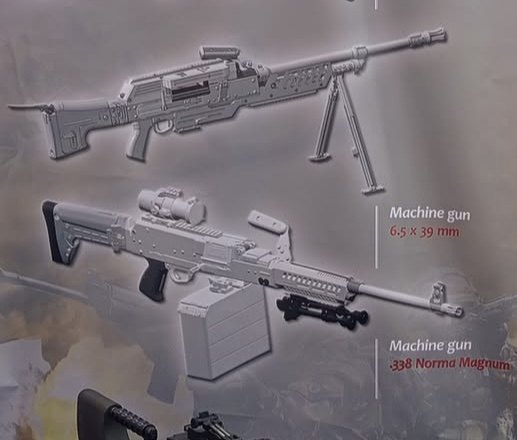
At Partner 2025, Zastava Arms unveiled what may be the next step in Serbia’s small-arms evolution: a light machine gun (LMG) derived from the company’s long-running M84 general-purpose machine gun, but chambered for the intermediate 6.5x39 (6.5 Grendel) cartridge. This new variant follows a wider Serbian program to move away from purely legacy calibers toward modern intermediate cartridges that offer improved ballistic performance without the weight and recoil penalties of full-power rifle rounds. The result is a clear operational requirement: a lighter, more accurate squad automatic weapon in 6.5x39 that extends reach and terminal effect while keeping logistics and carry weights manageable for infantry squads.
I couldn't attend Partner 2025 this year in Belgrade. Still, observing the event, the 6.5x39 LMG stood out as one of the most interesting small arms solutions on display, trailing behind Zastava’s .338 Norma Magnum medium machine gun, which was the most interesting of the exhibition.
Why 6.5x39?
The 6.5x39 Grendel occupies a practical middle ground between classic intermediate cartridges and full-power rifle rounds. It retains supersonic performance with bullets that commonly have higher ballistic coefficients than typical 5.56x45 or 5.45x39 projectiles, producing flatter trajectories, reduced wind drift, and better retained energy at longer ranges. Compared with 7.62x51 or other full-power rounds, 6.5x39 delivers these benefits with less recoil and lighter ammunition. For armies seeking to push effective engagement windows for designated marksmen and squad automatic weapons out toward 600-800m, the caliber is compelling, especially when the goal is to extend the practical reach of a squad without moving to heavier logistics and larger weapon systems. Also, incremental body armor penetration performance compared to 7.62x39.

The Gun
The M84 is a proven, belt-fed general-purpose machine gun in Serbia’s inventory and on international markets. Adapting the M84 concept into a dedicated LMG is Zastava's logical, engineering choice: it reuses similar manufacturing methods and familiar weapon ergonomics while creating opportunities to shave weight for a squad-level role.
Rather than inventing an entirely new mechanism, Zastava’s approach appears to be evolutionary. It preserves the ruggedness and service life reputation of the M84 family but repackages it for the lighter-weight, intermediate-caliber niche that modern infantry doctrines increasingly demand. From TFB writer Vlad's article, the advertised weight of the prototype is 14.5 lbs. (6.6 kg).
European militaries and several non-NATO states have long moved toward commonality of calibers at the squad level. A squad built around rifles and an LMG in the same intermediate caliber simplifies ammunition supply chains and training. The superior medium-range ballistics of 6.5x39 compared with 5.56 and 5.45 mean a standard squad can more credibly engage point targets at extended ranges with fewer weapons dedicated exclusively to marksman roles. That tactical elasticity is precisely why Serbia’s armed forces would look to pair a 6.5x39 rifle family (the M19/M20) with a section LMG in the same caliber.
The new LMG offers a PK-style quick-change barrel system, M1913 feed tray cover for optics, and a handguard rail system for enablers. A new handguard mounting method is visible: instead of connecting to the tripod mounting points (as seen on the M20 GPMG), the handguard bolts to the piston tube with pairs of bolts on each side. The prototype also lacks tripod mounting points, a plausible weight-saving decision for a squad automatic weapon rarely deployed on fixed tripods (similar to the M249 to MK46); alternatively, this omission could reflect an early developmental configuration.
The company’s recent use of electrochemical rifling (ECR) in barrels, rather than cold hammer forging, suggests the new LMG will follow that approach to improve mechanical properties, boost accuracy, and reduce dispersion; chrome lining is also likely to enhance corrosion resistance and service life.
Design changes, such as the PK feed paw and cover seen on classic M84 guns, appear absent on the right side of the prototype, implying a modified operating or feed system. Based on the belt, the weapon uses a push-through feed system, visible with an RPD or RPD-type belt displayed with the weapon, a metallic, non-disintegrating belt. The ammunition box may share compatibility with existing M84 ammo boxes and soft pouches or be a proprietary design for the shorter and smaller cartridge, but is expected to have a larger capacity.

Strategic implications
A domestically produced 6.5x39 LMG advances several Serbian priorities: modernizing infantry lethality, maintaining sovereign control over procurement and logistical support, and fielding an exportable product for nations evaluating intermediate-caliber concepts. The 6.5x39 market is niche today, so exportability will hinge on flexibility. Caliber-swap capability (for example, between 6.5x39 and 7.62x39) would broaden appeal by allowing customers to gradually match existing logistics or transition.
Regionally, the prototype signals that Serbia is serious about adopting small-arms trends emphasizing precision, modularity, and now weight efficiency. For current Zastava customers, a like-caliber LMG offers an accessible upgrade path with low integration friction.

Trade off
The new LMG reduces soldier weight and allows each gunner to carry more ammunition than the M84, which increases the time of supporting operations, if the situation allows. That advantage comes at the cost of a shorter effective range and less overwatch capability compared with the M84. Decision-makers must therefore weigh overmatch against additional ammunition capacity. In most typical engagement scenarios, units favor a lighter weapon with a higher capacity. Serbia’s planned move from 7.62x39 to 6.5x39 for its service rifle improves ballistic performance. Still, the gain is smaller than the trade-off lost by replacing the M84, which historically served both as the squad LMG and the platoon’s medium machine gun in the Serbian Army.

Conclusion
Zastava’s M84-derived 6.5x39 LMG represents a practical and technically conservative response to an operational problem many modern armies face. How can effective squad reach be extended without the logistical and physical costs of full-power ammunition? Suppose the prototype can marry the M84 family’s durability with weight savings, modern mounting options, and 6.5x39 performance. In that case, it will be a credible addition to Serbia’s small-arms lineup, and an interesting export proposition for other nations considering intermediate-caliber solutions. The next step will be detailed testing, adoption, and eventual fielding, budget permitting. Until then, the new 6.5x39 LMG shown at the Partner 2025 exhibit offers an intriguing preview of how small arms quietly transition from legacy calibers to more efficient, better-performing intermediate cartridges.

Lynndon Schooler is an open-source weapons intelligence professional with a background as an infantryman in the US Army. His experience includes working as a gunsmith and production manager in firearm manufacturing, as well as serving as an armorer, consultant, and instructor in nonstandard weapons. His articles have been published in Small Arms Review and the Small Arms Defence Journal. https://www.instagram.com/lynndons
More by Lynndon Schooler


![[SHOT 2026] Zastava M84 Machine Gun Cometh!](https://cdn-fastly.thefirearmblog.com/media/2026/01/21/03291/post.jpg?size=350x220)


![[SHOT 2026] Automatic For The People: Now You Can DIY A Gatling Gun](https://cdn-fastly.thefirearmblog.com/media/2026/01/23/22092/post.jpg?size=350x220)


![[SHOT 2026] Name Game And New Features: Henry Rifle Lineup Evolves](https://cdn-fastly.thefirearmblog.com/media/2026/01/19/21081/post.jpg?size=350x220)

![[SHOT 2026] 4-Lb 308 Bolt Gun – The Weatherby Mark V Backcountry Capra](https://cdn-fastly.thefirearmblog.com/media/2026/01/21/13301/post.jpg?size=350x220)

![[SHOT 2026] AS Designs MP5 Forced Reset Triggers](https://cdn-fastly.thefirearmblog.com/media/2026/01/24/16111/post.jpg?size=350x220)


Comments
Join the conversation
6X42 SAW would have been great
It’s about time the 6.5 Grendel gets some love. Great Caliber.