Vietnam’s Bizon – A Homegrown Take on a Russian Submachine Gun
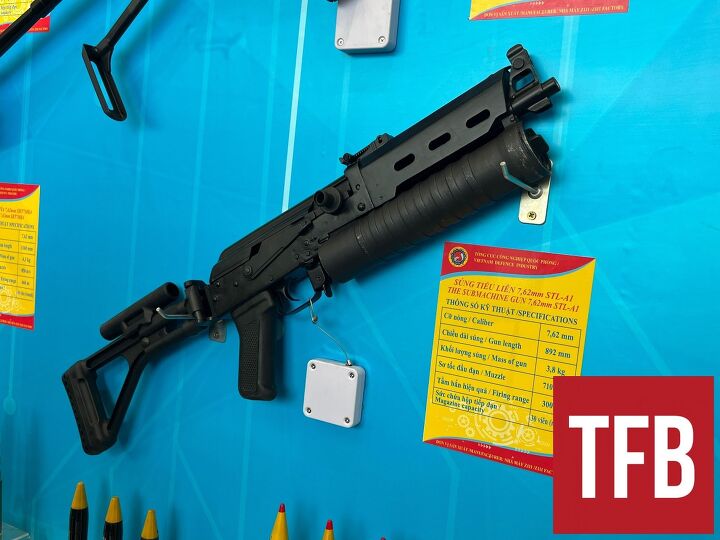
When most people think of Vietnam and small arms, they picture battle-worn AKs carried through the jungles of the Cold War era. But half a century later, the country’s defense industry is no longer just a consumer of foreign weapons; it’s a creator. One of the most curious examples of this shift is the STL-15, a homegrown submachine gun inspired by Russia’s PP-19 Bizon. It is famous for its helical magazine, which was built not in Izhevsk but in Vietnam’s own Factory.
Developed and built by Factory Z111, a state-owned facility under the General Department of Defense Industry, the STL-15 reflects Vietnam’s push to indigenize foreign designs, especially Russian ones, without relying on licensed production.

The STL-15 is a Bizon derivative chambered in 9x19mm and equipped with a Galil-style folding stock. Internally, it often appears under the designation SN9P, while another closely related model, the SN7P, is chambered in 7.62x25mm Tokarev. The weapon first appeared at regional defense exhibitions in the late 2010s, where Vietnam showcased a growing portfolio of “made-in-Vietnam” small arms. Notably, STL stands for “Súng tiểu liên”, the Vietnamese term for submachine gun.
Factory Z111 has long been Vietnam’s primary center for small-arms production and refurbishment. From Cold War–era Kalashnikov variants to the newer STV rifles, derived from experience with the Israeli Galil ACE, Z111 has steadily grown its industrial base. In this progression, the STL-15 fills a different niche: a compact, high-capacity submachine gun designed for law enforcement, close protection, and special military units operating in confined spaces. While not a direct copy of the Bizon, the STL-15 borrows heavily from the Russian concept.

The Bizon
The Russian PP-19 Bizon is instantly recognizable for its under-barrel helical magazine, which offers capacities of 53 or 64 rounds, depending on caliber. The advantage is straightforward: an unusually high onboard ammunition supply in a slim, compact package.
The STL-15 adopts this same philosophy. Vietnamese sources consistently describe it as closest to the Bizon-2-01 in 9x19mm, but with some localized changes. Chief among them is using a Galil-pattern folding stock instead of the original Russian triangle stock. Given Z111’s familiarity with the Galil ACE, this decision makes sense. Some prototypes have even been observed with STV-style charging handles.
Of course, the defining feature remains the helical magazine. Unlike stick or drum magazines, a helical design arranges cartridges in a spiral track, allowing for high capacity without bulking out the profile. This makes the weapon especially useful for CQB, internal security, and protective details. But it’s not without drawbacks: the design is mechanically more complex.

Building a Bizon
I had the chance to experience the Bizon firsthand. I put together a Russian Izhmash Bizon from an original kit, using a reactivated bolt, a Recreator Blanks receiver, and a Lothar-Walther 9x18mm barrel blank. I’ve always trusted Recreator Blanks. They make the best AK receivers on the market, and at the time, they had just released Bizon receivers when I built it.
Over the years, I’ve built hundreds of AKs, but this Bizon stood out as something different. Mine was chambered in 9x18mm, and even though I only had one magazine to work with, the gun ran flawlessly. It quickly became one of those builds I was genuinely proud of. That perspective made it easy to appreciate Vietnam’s effort with the STL-15: it’s not just about copying a Russian design but learning from it and tailoring it for local manufacturing practices.

Caliber and Operating System
The STL-15 SN9P is chambered for 9x19mm Parabellum, a logical choice given its global availability and wide range of loadings. Like the Bizon, it uses a simple blowback, closed-bolt system, a rugged and cost-effective operating method that keeps manufacturing straightforward and maintenance easy.
Externally, the STL-15 retains its AK-inspired stamped sheet-metal receiver, though with lots of modifications. The controls are the same as those of the Bizon or any Kalashnikov. Paired with a Galil-style folding stock and the signature under-barrel helical magazine, the STL-15 takes on a distinctive profile, different enough to stand out.
Where It Fits
The STL-15 isn’t designed as a frontline infantry weapon. Instead, its purpose is more specialized:
- Law enforcement and internal security operations
- Military special units needing a compact weapon for CQB
- Close protection and convoy personnel working in confined spaces
So far, there have been no confirmed reports of domestic or foreign customers, but the weapon has clear export potential to nations seeking affordable CQB submachine guns. For now, its primary significance lies in strengthening Vietnam’s own defense industry, diversifying beyond rifles into specialized small arms.
Strengths and Trade-Offs
Strengths:
- High-capacity magazine (53–64 rounds based on the original Russian magazine capacity)
- Compact, folding stock for maneuverability
- Familiar AK-style/STV controls
- Simple blowback mechanism
Trade-Offs:
- Helical magazines demand precision manufacturing
- Reloads can be awkward
- Feeding reliability

Conclusion
The STL-15 has clear applications for CQB, law enforcement, and protective details. At this stage, the STL-15 appears more like a developmental prototype than a finalized service weapon. Its future remains uncertain, as it is still unclear whether it will see formal adoption of any type or remain primarily a showcase of Vietnam’s expanding small-arms capabilities.
So, in the end, the STL-15 isn’t just a ‘Vietnamese Bizon.’ It shows Hanoi’s push to do things on its own and proves that copying can demonstrate its manufacturing capability.

Lynndon Schooler is an open-source weapons intelligence professional with a background as an infantryman in the US Army. His experience includes working as a gunsmith and production manager in firearm manufacturing, as well as serving as an armorer, consultant, and instructor in nonstandard weapons. His articles have been published in Small Arms Review and the Small Arms Defence Journal. https://www.instagram.com/lynndons
More by Lynndon Schooler



![[SHOT 2026] Show Low's Gen 3 PCC Now In 10mm, .45 ACP](https://cdn-fastly.thefirearmblog.com/media/2026/01/23/00522/post.jpg?size=350x220)


![[SHOT 2026] First Look: YHM Victra 20-gauge Silencer](https://cdn-fastly.thefirearmblog.com/media/2026/01/23/16111/post.jpg?size=350x220)





Comments
Join the conversation
Wonder why they have this and have the STV-022 PDW (also covered by TFB). This, frankly, seems more generally useful than the stockless PDW that's chambered in 7.62X39 and uses15 rd mags. Cool article.
neato!