Building a Fix with the Men who Designed it

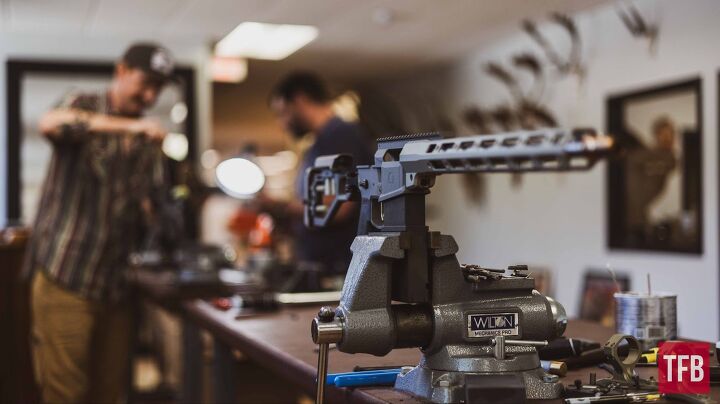
At Q, the philosophy is simple: “Nobody really cares what you do as long as you have fun,” said Nick Schaefer, one of the engineers behind many Q products. That attitude sets the tone for everything the team does, from design sessions to customer builds. It’s a mix of irreverence, deep engineering, and plenty of laughter — exactly what you’d expect from the crew that gave the world the Honey Badger and the Fix. Back in July, I was fortunate enough to get to spend a few days at Q and even got to build a few guns while there. Trust me, I was blown away by the offer to do a build when Q offered it to me, but now I get to share my experience with all of you.
More Q @TFB
- TFB Review: Q Unveils SPEAKEASY And BLIND TIGER Silencers
- TFB Preview: Q Boombox 8.6 Rifle – The Honey Badger Replacement
- Q Fix Review: Does It Actually Live Up to the Hype?
- Kevin Brittingham Explains Why the Q Honey Badger is Better than the AR-15
After a fun morning touring the Q Factory, me and the boys from Black Canyon Systems sat down for some lunch. We scoffed down pizza while the anticipation of building some Q rifles continued to build. Finally, we approached the benches where all the parts lay flat. I was accompanied by Nick Schaefer, one of the engineers behind many Q products, and he would be walking me through how to build the Fix. I really appreciated getting to talk to him because, since he helped design many of the rifle's components, he had a wealth of knowledge to share.

Purpose Behind the Builds
What makes the Fix unique is that almost every part of the rifle was designed with intention. As Nick explained: “Almost every feature has a purpose. If we didn’t need it, we didn’t do it.” When the project began, Q had a choice. The bolt-action market was stale. “All the bolt actions were the same, and they’d been the same for a long time. We thought—why not shrink the features of big, heavy sniper rifles into something smaller?” That simple question led to a complete rethinking of what a bolt action could be.

Instead of just bolting parts onto a chassis, they decided to start fresh. “Let’s just do the receiver from aluminum. Nobody’s really released a new rifle design in decades.” That choice led to the Fix’s signature approach—packing complexity into specific areas to create simplicity everywhere else. “We pack a lot of complexity into a few areas in order to create simplicity in others.” - Nick

The Receiver and the Magazine
The Fix’s receiver, carved from billet 6061 aluminum, looks deceptively simple but carries layers of innovation. One of the most important decisions was the magazine. “Where is the magazine, and what type are you going to use? That’s the most important choice in any gun design. If your mag sucks, what’s the point?” - Nick Q went with the SR25 pattern. It wasn’t the trendy choice, but it was the right one. That decision alone shaped the Fix’s geometry, its feeding system, and even its unique 45-degree bolt throw.

The Fix is full of details most shooters wouldn’t even think about until they fail. The mag catch, the trigger guard, even the placement of springs—every decision tied back to performance and reliability. As Nick put it: “We start with what we need to hold, then only put material where it’s necessary. Everything else comes out.”

Folding Stock, Tight Hinge
The folding stock shows the same thinking. Q wanted a right-side folder that could still shoot accurately and carry comfortably on the chest. It had to lock tight, feel solid, and stay reliable. Nick explained, “Kevin loves to tell everyone I was super anti-Hinge, and he’s right. But after a lot of iteration, we got a hinge that snaps together tight and stays that way.”

Even the trigger carries clever engineering. Dubbed the elephant’s head for its shape, it uses a balancing mass to avoid accidental movement if dropped. Nick noted “it’s not phenomenally special—just good design practice.”
Barrels and Customization
Barrel changes were designed with shooters in mind. Using a jam nut system, every barrel is headspaced to a master bolt, making them interchangeable without fuss. “If you need to change barrels, we’ll sell you one. All you’ve got to do is swap it out.”
Customization is part of the fun. From wild color names like Mink and Used Condom, to modular grips and adjustable cheek pieces, every build becomes personal. One of the Black Canyon System guys summed it up perfectly: “It’s just so much cooler building one than just being given a gun.”

The Bolt System
The Fix’s bolt system is where Q truly broke new ground. Instead of a traditional sear, the Fix uses a system that reduces bolt lift effort while maintaining reliability. “We packed all the difficulty into one part so the rest could be simple. The result is something pretty unique.” - Nick
So why not make it a straight-pull? The team didn’t hesitate: “Americans won’t freaking buy one. The perception is they’re not accurate. So we solved the speed problem with a 45-degree throw instead.”

Complicated, But Not Difficult
From the anti-rotation shroud to the replaceable bolt head, everything on the Fix reflects Q’s mix of irreverence and engineering focus. Even the most complex parts are designed to be serviceable by hand. “It’s complicated, but it’s not difficult”, Nick said.
And that’s the Fix in a nutshell: a rifle born out of stubborn problem-solving, built with intentional design, and infused with Q’s signature sense of humor. Or as one of the crew said with a grin: “This is just what God intended.” I want to thank everyone at Q for making this happen, and it's hard to put into words just how much more fun it is to build a rifle yourself and know where every part goes rather than just grabbing one off the shelf.

-Former Army Photographer / Videographer -Current Aviation Student -Future in debt due to Firearm collection
More by Patrik O




Comments
Join the conversation
The q glazing will continue until morale improves.