The Rimfire Report: First 1,000 Rounds – S&W M&P 22X

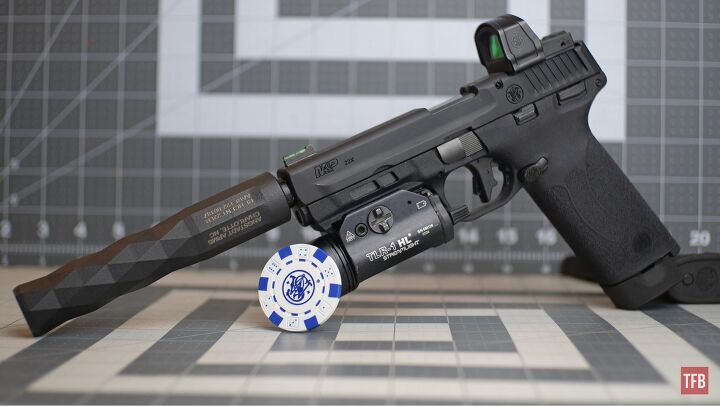
Last summer, I had a chance to head out to Smith & Wesson’s Maryville, TN, facility to check out a bunch of new guns, including an at-the-time prototype version of the M&P 22X. To be frank, I wasn’t that impressed with the prototype version, and to be fair, it was in pretty rough, fast-prototyped condition (read, 3D printed). What has come out on the other side of that, since the official release of the 22X, is probably one of the best new entries into this specific genre of 22LR pistol I’ve seen since SIG released the P322. I’ve recently been able to acquire a copy of the new Smith & Wesson plinker and have been able to put about 1,000 rounds of various ammo through it over two range sessions over the last week. Today, I’ll be giving you guys my thoughts so far on Smith & Wesson’s newest semi-auto rimfire pistol.
More Rimfire Report @ TFB:

The Rimfire Report: First 1,000 Rounds – S&W M&P 22X
Product Link: https://www.smith-wesson.com/product/m-p-22x

Specifications:
- Width: 1.13 in
- Length: 7.25 in
- Height: 5.75 in
- Weight: 16.32 oz
- Caliber: 22 LR
- Size: Full
- Capacity: 20
- Action: Internal hammer fired
- Barrel Length: 4.1 in
- Grip: Polymer
- Sights: Fiber optic
- Optic Ready: Yes
- Safety: Thumb safety
- Color/Finish: Black
- State Compliance: N/A
- Threaded Barrel: Yes
- Barrel Material: Stainless steel
- Laser: No
- Number of magazines: 2
- 10 lb trigger: No
- Model: M&P 22X
- Frame Material: Polymer
- MSRP: $499.00
While the new M&P 22X shares the same naming convention as the original M&P 22 line, the M&P 22X is more of a spiritual successor, in my opinion. Directly compared with the legacy model M&P 22 pistols, the 22X features a larger, entirely new grip frame design, out-of-the-box optics-ready capability with an RMSc pattern or Holosun K-pattern (RMR) footprint optics. I eventually attached a spare SIG Romeo Zero Elite, as it is one of the lightest red dots I had sitting around, and I figured this would impact the cycling of the slide the least for better performance across ammo types. I also noticed that the 22X has a steel breech face that is held in place by a roll pin, with the breech face itself featuring a small cutout that serves as a handy way to see if the chamber is loaded.

Ergonomics
The new grip design is what largely sets the 22X apart from its M&P cousin, which shared a lot of the same grip features that made the M&P line popular in the first place. The 22X drops the replaceable backstrap for a slimmer, more 1911-style grip that allows for a very high and repeatable grip even if you have larger hands.

Those with smaller hands might suffer from this design change, especially since it is quite long compared to the overall width of the grip. The grip itself allows the 20-round magazines to sit flush with the baseplate, meeting the grip of the gun with plenty of room to spare to avoid pinching during hasty reloads.

The grip features a very nice blend of smoothness and grit in areas where you want it, giving you positive control of the pistol even in humid conditions. This isn’t as aggressive as some of the centerfire M&P 2.0 pistols, but it’s good for the pistol's power level and weight.
Trigger and Controls
Some of you may remember that last time a 22LR pistol like this came out, I was extremely excited. As stated earlier, I was sort of underwhelmed by the prototype that I saw last summer, but the production model not only feels and looks a lot better, but it genuinely does have a quality construction feel to it while still feeling a bit like an airsoft toy due to how light it is.

The trigger is fairly light without crossing into unsafe territory. The average trigger pull weight on my Lyman scale read in right at 3lbs, similar to the P322 but with a much more distinct wall and less spongy break. I’ve found the trigger to be quite pleasant, and while not as clean feeling as a Ruger MK IV, it’s definitely a contender for being the best in this particular class of 22LR pistols.

Moving on, the ambidextrous safety is easy to use despite how small it is and how closely it hugs the frame of the 22X. The slide stop/release follows a similar pattern and isn’t so large that it breaks the lines of the 22X’s slim frame, nor is it so small or recessed that it’s inaccessible from a normal firing grip for most hands.


The M&P 22X, as mentioned above, comes with two 20-round magazines, both of which feature loading tabs on either side of the magazine body. These greatly speed up and assist the loading process, and I found it rather easy to get all 20-rounds into the magazines with the last round requiring a decent amount of force to get set. This, however, eased up as testing went on. What’s interesting is that while SIG’s 20-rounders allow you to secretly stuff up to 25-rounds in their factory 20-round mags, the 22X mags do genuinely top out at exactly 20-rounds.

The First 1,000 Rounds
Before I was able to get my camera out and a red dot on the gun, I went ahead and slapped on a prototype suppressor from Zer0 & Sons, who kindly sent out a few of their 3D printed suppressors just to break the pistol in a bit before I mounted a red dot and a light on it. The sound signature, at least for the first couple of hundred rounds, with the combo was quite pleasant at first, but got drastically louder as I ran more rounds through the pistol. Keep in mind the point here was to get some lead down the barrel, and some fouling in the gun to see if it at least ran right out of the box - it did. However, in the process of shooting the first 200 rounds or so, I ended up destroying the 3D printed core of the Zer0 & Sons 1225 Suppressor. Luckily, I can just 3D print a new one. You’ll be seeing what that process is like, and a more detailed look at the 1225 in a future Rimfire Report article.


After the 1225 shot plastic spaghetti out of the front of it, I decided it was time to add an optic and switch up suppressors for some more testing. Angstadt Arms was also kind enough to send out their new Reticent 22LR suppressor which is not only one of the lightest 22LR suppressors I’ve ever seen, but also one of the quietest - again, we’ll have a closer look at the Reticent 22 in a future article but for what it's worth, Angstadt’s fancy suppressor combined with the 22X has to be my new favorite “sporter” 22LR pistol combo.

The remainder of my testing was split up between a combination of both bulk ammo (Remington Thunderbolt, Federal Champion) as well as some more standard off-the-shelf ammo, and a few sleeves and boxes of more specialized ammo, just for fun. For the most part, virtually every ammunition ran just fine, but the 22X seemed to struggle with the slightly thicker cases of the Federal Champion, with 1 or 2 rounds from each magazine failing to detonate.


I also ran into this issue with one particular box of CCI Standard, but I determined that this was the ammo itself, as it also didn’t run/fire out of any of my other .22s I had at the range that day. I also wanted to test a few rounds of some very expensive ELEY Contact Subsonic Semi-Auto, but it unfortunately failed to cycle out of the pistol (luckily, my 11/22 likes it just fine).

Accuracy
During the first 1,000 rounds, I also took the time to put some 10-round groups on a ReNine Safety silhouette target, which has just enough bullseye targets to allow me to test a bunch of ammo head to head on the same target. Since this is what I’d consider a “sport” 22LR pistol and not a genuine target pistol, I’m mostly looking for good accuracy at about 15 yards, which is the mean average distance of Steel Challenge targets. If the pistol and ammo can give me a roughly 2” group at that distance, I’m pretty satisfied as long as it runs reliably. Here’s a breakdown of how each 10-round group turned out, plus any notes I had about how the ammo worked, or didn’t, out of the pistol.

For what it's worth, the fiber optics are just fine and are, in fact, very usable when paired with dedicated 22LR suppressors like the ones I used during this review. However, this is a 21st-century pistol, so we are going to use 21st-century technology with the SIG Romeo Zero Elite red dot for the remainder of testing.

CCI Standard 40-gr
This was a great group for fairly cheap ammo. The dispersal was pretty even across the roughly 1” sized circular group (the circles on the targets are 1” in diameter), and despite its relatively conservative load, CCI Standard ran the pistol just fine every time and had very reliable ignition for 2 out of the 3 50-round boxes I tested out of it. The third box must have been left outside overnight at some point, as I had quite a few failures to fire out of that ammo during my second range session. CCI Standard 40gr suppresses very well out of virtually any gun/suppressor combo, but the Angstadt Reticent and Faxon TwentyToucan in particular handled this load out of the pistol very well.

CCI Mini-Mag 36-gr Hollow Point
Since the 22X is a rimfire pistol and can easily mount a red dot, many people might want to use it for some light-duty pest control or small game hunting. Mini-Mag 36-grain hollow points deliver great terminal performance, and also some okay accuracy out of the 22X, with one out of the ten rounds landing well outside of the mean group. Since this is a higher velocity ammo, it was much louder but still hearing safe out of any of the suppressors, and extremely reliable, as are most CCI Mini-Mags. I experienced no failures to fire out of this particular load.

CCI Clean-22 Sub-Sonic 40-gr
I fired 10 rounds of CCI Clean Sub-Sonic through the gun to evaluate both sound suppression and accuracy—something I forgot to do with the ELEY Contact. The results were satisfying: aside from one flyer (likely my own fault, as with the CCI Mini-Mags), the group measured about an inch vertically. Overall, I’d definitely recommend this ammo if you’re after a truly “Hollywood quiet” experience and appreciate the extra attention CCI puts into their premium sub-sonic 40-grain .22LR line. I experienced no failures to fire out of this particular load.

CCI Clean-22 High Velocity 40-gr
I managed to squeak in a sub-1” group out of this load, and I think the ammo itself allowed me to slightly out-shoot myself when compared to the CCI Standard. Being that CCI Clean-22 High-Velocity is marketed directly towards steel challenge shooters like myself, I was pretty happy with the results, as it definitely produced on the accuracy side of things, even if it did have to sacrifice quite a bit of the noise comfort that CCI Standard gives you. I experienced no failures to fire out of this particular load.

Blazer 22 Long Rifle 40-gr
This is the last of my legacy Blazer ammunition, and I thought that the 22X was a good excuse to shoot it up before it became unusable. While it produced a curiously shaped group, it was still a nominal 1.2” in size, and I still think that’s pretty good even when compared to the more circular groups that we’ve seen so far from the other loads. Blazer 22LR was also pretty quiet, perhaps just a smidge louder than the CCI Standard. I experienced no failures to fire out of this particular load.

Federal Champion 36-gr Hollow Point
As the name suggests, at least for today and in this pistol, the Federal Champion 36-grain is the champion in terms of accuracy in my 22X. While it’s not the quietest load, it proved extremely reliable and impressively precise for a budget bulk ammo that is a nominal $0.06 per round. The group measured just under an inch, trending about an inch lower than the higher-velocity CCI loads and roughly half an inch higher than the CCI Sub-Sonic.

Remington Thunderbolt 40-gr Round Nose
Remington Thunderbolt was run last through the 22X for the remainder of the shooting after the accuracy testing. Similarly, I also accurately tested this ammo last by opening up a fresh 500-round box of Thunderbolts as an excuse to at least try and put a higher round count through the 22X to get a good first impression of the pistol. The group was the least impressive in terms of accuracy.

Thoughts After the First 1,000 Rounds
With the bulk of those thousand rounds coming from a 500‑round box of Remington Thunderbolts and a 525‑round box of Federal Champion, most of my performance observations and overall impressions of the 22X are based on these two loads. The 22X is a budget‑oriented plinker, after all, so it makes sense that many people will want to run budget ammunition through it—and I’d say it handles that role very well right out of the box.

For those who may not know, Remington Thunderbolts often get a lot of playful nicknames (some of which I like) because users frequently report issues with reliability or excessive fouling. In the past, Thunderbolts have indeed led up some of my rimfire plinkers faster than other uncoated lead loads. But Remington appears to have updated the formula, likely around the time they launched their newer 22LR lines, and this newer‑production box of Thunderbolts showed no obvious excessive leading, with only two or three duds in the entire 500‑round box.

All that said, the new Smith & Wesson 22X earns a solid pass from me. I was pleasantly surprised by just how well put together this package is and how well it did with all of the suppressors, including the Fletcher Rifle Works Taquito. Alongside Taurus and SIG, Smith & Wesson has now given us another modern 22LR plinker that offers larger magazine capacity, the ability to mount muzzle devices, lights, and optics, and is significantly more budget-friendly than expensive all-metal target pistols.

If you’re shopping for something like the SIG Sauer P322 or Taurus TX22, or you just want a slightly modernized take on your beloved legacy model Smith & Wesson M&P 22, the M&P 22X is a well-rounded, accurate, and reliable option that won’t break the bank and fits neatly into the slowly growing lineup of modern rimfire semi-auto pistols.

Much like with the P322, you can expect that I’ll keep trying to run a couple of hundred rounds of bulk ammo through the gun every range session to try and drive the pistol to its limits.

Smith & Wesson M&P 22X Pistol
Your thoughts, as always, are welcome below. I’d certainly love to hear your experiences with the M&P 22X as well if you’ve been lucky enough to get your hands on one. Thanks as always for stopping by to read The Rimfire, and we’ll see you all again next week!


We are committed to finding, researching, and recommending the best products. We earn commissions from purchases you make using the retail links in our product reviews. Learn more about how this works.
Reloader SCSA Competitor Certified Pilot Currently able to pass himself off as the second cousin twice removed of Joe Flanigan. Instagram: https://www.instagram.com/ballisticaviation/
More by Luke C.



Comments
Join the conversation
My P17 gets gummed up after a couple hundred rounds. My Huntsman just chews through box after box. Bought a Tx22 and it runs somewhat better than the Kel-Tec, but only buy a hundred rounds or so. I so want a good modern 22 for blasting trash...
I'm curious with the screws you used, how much they protruded past the base of the optic. My 22X runs flawlessly, until I put a CAT dot on it. The screws I think made it light strike constantly.