Russia’s Silent Budget 9x39 Weapon Program - The 9A91 & VSK-94
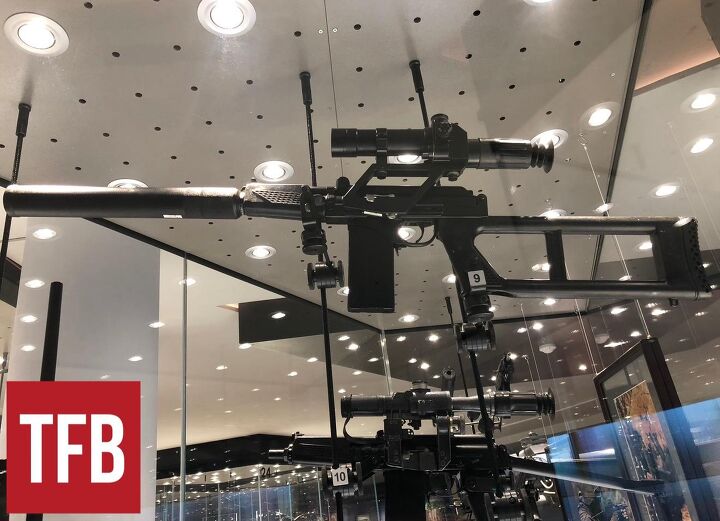
Right after the fall of the USSR, the collapse of the most difficult economic years in modern Russian history, the sudden scarcity of specialized ammunition reshaped Russia’s small-arms market. In the newly formed Russian Federation, demand for suppressed, subsonic performance offered by the 9x39mm weapon systems remained high among police and special units. Still, the cost of weapons and ammunition became prohibitive for many customers at the time, primarily law enforcement. Into that gap stepped the Tula-based KBP Instrument Design Bureau with a budget-driven weapon program: an inexpensive, compact assault rifle; a budget sniper rifle; and a low-cost cartridge intended to keep 9x39 capability within reach.

9A91
The program’s outcome was the compact assault rifle developed at the Tula bureau as a low-cost alternative to more sophisticated projects that were already established at other institutes, the VSS and AS VAL. The 9A-91 was designed in 1992 as a smaller, simpler counterpart to the SR-3 “Vikhr,” which at the time was being developed at TSNIITochMash. While the SR-3 was a more advanced design and cost more to produce, the 9A-91 prioritized manufacturability and affordability. Production began in 1994 or 1995, and the rifle found a niche among law-enforcement special units that needed compact firepower for urban operations but could not afford the TSNIITochMash-designed offerings.
Running alongside the 9A-91 was an equally realistic attempt to reduce ammunition costs, as the new Russian Federation was rebuilding after the fall of the USSR. The inexpensive PAB-9 armor-piercing cartridge was developed specifically for the 9A-91 and VSK-94 (Military Sniper Complex-94) as a cheaper alternative to the established SP-6 cartridge. Cost savings came from replacing precision-machined penetrator cores with stamped-steel cores, an obvious shortcut in an era when machining capacity and funds were limited. The trade-off proved painful: stamped cores reportedly accelerated barrel wear and reduced muzzle performance and accuracy compared with the SP-6. Those drawbacks ultimately led to the PAB-9’s abandonment, and it is no longer in production. The 9A-91, however, proved to be a more durable idea. Its simple construction, compact size, and lower price allowed it to survive in service well beyond that early, turbulent decade.

VSK-94
Part of the same Tula low-cost 9x39 program was a lightweight sniper rifle system conceived as an affordable alternative to the established VSS “Vintorez”. That rifle, the VSK-94, was designed in 1992 at the KBP Instrument Design Bureau by Vasily Gryazev and Vladimir Kulitsky, and manufactured by Tula Arms Plant. Adopted for service in 1995 under the GRAU index 6V8, the VSK-94 was intended from the outset to reduce production complexity and price without abandoning the tactical benefits of subsonic 9x39 ammunition.

One of the VSK-94’s defining choices was the use of a detachable suppressor instead of the integral, vented barrel and suppressor that characterizes the VSS “Vintorez”. The detachable unit simplified manufacturing, reduced costs, and increased flexibility: units could omit the suppressor for training or transport and attach it only when required. Despite its simplified construction, the VSK-94 used the same subsonic 9x39 cartridges as the VSS and delivered comparable terminal performance for typical law-enforcement engagement ranges. Lightweight and compact, the rifle tipped the scales at roughly 6.17 pounds without optics or magazine, the VSK-94 offered a balance between firepower and mobility.

Because it met a real need at an attractive price point, the 9A91 and VSK-94 achieved broad distribution. It was widely issued to elements of the Internal Troops of Russia, to riot-control and rapid-response teams such as OMON, and to the Federal Penitentiary Service of Russia. By contrast, the more complex VSS “Vintorez” was primarily issued to elite military intelligence formations and select Federal Security Service special forces units; its more expensive design made it less suitable for those organizations with smaller budgets.

The cheaper PAB-9 shows how financial constraints can prompt innovation that appears sensible on paper but fails in reality. On the other hand, the 9A-91 and VSK-94 show how modest engineering choices, simplified manufacturing, and a less expensive detachable suppressor design can keep capability accessible when budgets disappear. Even as some specialized cartridges and niche projects faded, the two rifles endured: the 9A-91 and VSK-94 remain in use among internal security forces and police units.
Conclusion
Today, examples of both designs remain in service with various Russian security organizations and in limited numbers abroad in places like Syria and now Lebanon. They continue to be found among elements of the National Guard of Russia and special units of the Ministry of Internal Affairs of Russia, reflecting its success as a realistic, affordable, suppressed system. The story of Tula’s early-1990s program is a compact case study in post-Soviet arms economics: where resources were scarce, designers trimmed complexity, accepted trade-offs, and delivered tools that fit the budgetary realities of the day.
That blend of compromise and utility is why, more than three decades after their births, amid hard economic times from the collapse of the USSR, the 9A-91 and VSK-94 have remained relevant. They are reminders that in small arms, as in many fields, cost-aware engineering can produce solutions durable enough to outlive the circumstances that created them.

Lynndon Schooler is an open-source weapons intelligence professional with a background as an infantryman in the US Army. His experience includes working as a gunsmith and production manager in firearm manufacturing, as well as serving as an armorer, consultant, and instructor in nonstandard weapons. His articles have been published in Small Arms Review and the Small Arms Defence Journal. https://www.instagram.com/lynndons
More by Lynndon Schooler


![[SHOT 2026] Updated Burris Veracity Scopes and Rapid Engagement Design](https://cdn-fastly.thefirearmblog.com/media/2026/01/22/13021/post.jpg?size=350x220)
![[SHOT 2026] Winchester Supreme Long Range Keeps Accuracy In-House](https://cdn-fastly.thefirearmblog.com/media/2026/01/21/22391/post.jpg?size=350x220)
![[SHOT 2026] Safariland HOLLE Belt System & SafariMesh Communications](https://cdn-fastly.thefirearmblog.com/media/2026/01/22/16031/post.jpg?size=350x220)





Comments
Join the conversation