POTD: Thermal Scope or Clip-On? Two Paths to Seeing in the Dark

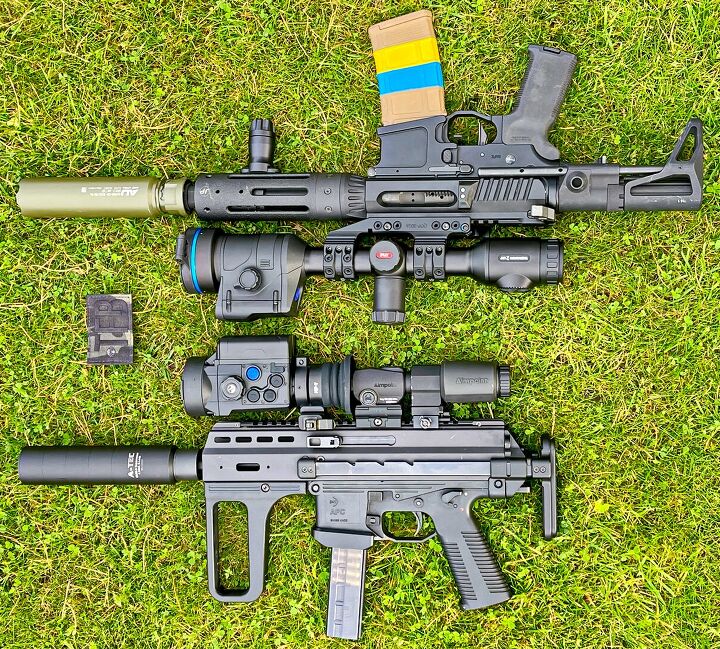
This Photo Of The Day is just for fun, but there’s a serious question behind it, asked by many. Should I buy a clip-on thermal or a dedicated thermal rifle scope? Hang on and get some advice, while you admire some cool, suppressed firearms in 300 Blackout and 9mm.
Thermal clip-on devices are mounted in front of a conventional day optic. Their primary advantage is flexibility: the shooter retains a familiar daytime rifle scope, including its reticle, zero, magnification range, and ergonomics. A properly aligned, quality clip-on does not require re-zeroing when mounted and removed, allowing fast transitions between day and night use. Clip-ons are especially popular on precision and hunting rifles, where daytime performance still matters. The main trade-offs are added length and weight to the rifle, and reliance on the quality of the day optic behind it. The balance of your rifle will also change.
It’s pretty odd to use a red dot with a thermal clip-on, but it’s perfectly doable, as you can see. Here is the Aimpoint Duty RDS-MR with a 3xMagnifier and Pulsar's PSP-V Picatinny adapter. The main unit is Pulsar’s Krypton 2 FXG50. I’ve never seen an optical setup like this anywhere, but I’m sure it’s not the first. To the best of my knowledge, everything above, apart from the front grip, is made in Europe.
Dedicated thermal rifle scopes integrate the thermal sensor, display, reticle, and controls into a single unit. They are generally simpler to set up, often lighter and more compact, and usually less expensive than a high-end clip-on plus a premium day optic. Dedicated thermals excel as purpose-built night systems, offering onboard ballistic profiles, recording features, and streamlined handling. However, they require their own zero and typically replace the daytime optic entirely, reducing flexibility.
All of these thermals can also have laser range finders built in, and/or remove controls. Here you’re looking at a Pulsar Thermion LRF XP60, one of the contenders in TFB’s Best Thermal Rifle Scope.
In short: Choose a clip-on if you want one rifle to seamlessly handle both day and night roles without sacrificing your primary optic. Go for a dedicated thermal scope if nighttime use is the priority, and if you hunt a lot at night.
All images by the author.
Ex-Arctic Ranger. Competitive practical shooter and hunter with a European focus. Always ready to increase my collection of modern semi-automatics, optics, thermals and suppressors. TCCC Certified. Occasionaly seen in a 6x6 Bug Out Vehicle, always with a big smile.
More by Eric B



![[SHOT 2026] Navy Arms Raids France's MilSurp Supply](https://cdn-fastly.thefirearmblog.com/media/2026/01/22/04271/post.jpg?size=350x220)








![[Partner 2025] Zastava Arms Showcases New Sniper Rifle In .338LM](https://cdn-fastly.thefirearmblog.com/media/2025/10/21/04211/post.jpg?size=350x220)

Comments
Join the conversation
Whatever you do stay away from pulsar! Service is garbage and will treat your optic trash also.