Azerbaijan’s AN-12.7 Heavy Machine Gun
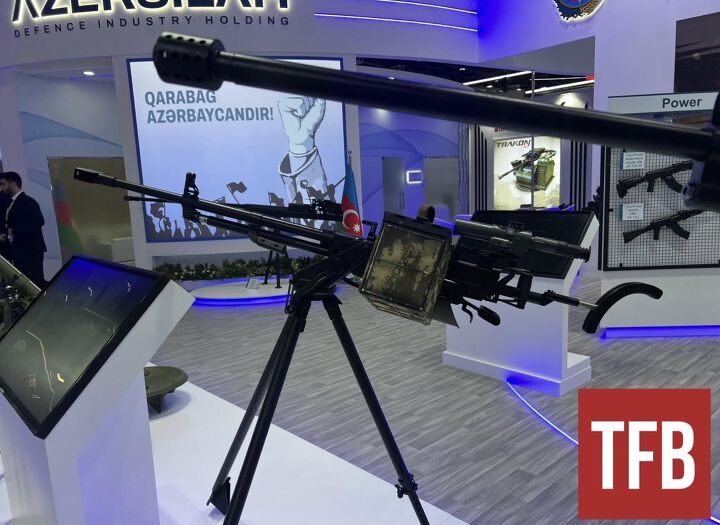
Over the years, Azerbaijan has steadily moved from licensed production toward designing and manufacturing its own weapons systems, blending proven features from established designs with local manufacturing practices. One of the latest developments has been in heavy machine guns. Azerbaijan’s AN-12.7 heavy machine gun represents a notable step in the country’s efforts to develop indigenous small arms capabilities and reduce reliance on foreign suppliers. Chambered for the widely used 12.7x108mm cartridge and produced by enterprises under the Ministry of Defence Industry, the AN-12.7 draws on two familiar heavy-machine-gun families, the Soviet DShK lineage and the Chinese W-85, while incorporating modern refinements intended to meet contemporary battlefield requirements. I examined the weapon at IDEX-2025 in Abu Dhabi, where it was on display.

The Gun
Based on the combination of weapon systems, the DShK-M (DShK-38/46) or the Chinese Type 54 established a proven template for heavy machine guns, providing a long-range, heavy-caliber weapon capable of engaging light armor and low-flying threats. China’s W-85 belongs to the same class while emphasizing manufacturability and reduced weight. The Azerbaijani design team took elements from both platforms, the rugged simplicity and firepower of the DShK combined with manufacturing and ergonomic lessons drawn from later Chinese guns, and built these into a machine gun tailored for national production and operational requirements.
The AN-12.7 is a belt-fed, air-cooled, heavy machine gun firing 12.7x108mm rounds, a logical choice given the cartridge’s prevalence across post-Soviet arsenals. This commonality simplifies logistics for units transitioning to the AN-12.7, allowing them to draw on existing ammunition stocks. Mechanically, the weapon adheres to the reliable DShK-M design to endure challenging field conditions.

One of the more modern aspects of the AN-12.7 is its attention to accessory integration. Contemporary conflicts demand that crew-served weapons interface with a range of enablers, from optical magnified sights to thermal and night-vision devices. The AN-12.7 includes attachment points for optical sights and day/night devices, and its receiver appears to accommodate a range of rail-type mounts. This makes it easier for crews to exploit improved aiming systems for both direct and indirect fire, and to operate effectively in low-light conditions.
Compared with the original DShK, the AN-12.7 benefits from modern materials and updated manufacturing methods that can reportedly significantly reduce weight without compromising durability. The AN-12.7 is reported to weigh approximately 46 lbs. (gun only), whereas the DShK-M weighs approximately 77 lbs. (gun only), representing a reduction of roughly 40%. Compared with the W-85, which prioritizes manufacturable simplicity, the AN-12.7 seeks to strike a balance: retaining rugged components where reliability is non-negotiable, while introducing upgrades to meet 21st-century integration needs. These choices reflect a pragmatic approach to domestic production, seek weight and handling gains where they matter, but avoid unnecessary complexity that could harm sustainment. The weight reduction alone is a significant advantage, provided it is as reliable as, or more reliable than, its predecessors.

Tactically, the AN-12.7 fills several roles. It is well-suited to vehicle mounting, where its reduced weight aids in moving it around and makes it an effective weapon for convoy protection, checkpoint security, force protection, and expeditionary deployments. With suitable elevation mounts and optics, it can also perform an anti-aircraft function against slow, low-flying targets, the classic multipurpose employment for heavy machine guns of this caliber.
Strategically, domestic production of the AN-12.7 has broader implications for Azerbaijan, particularly in light of the region's geopolitical situation. Manufacturing the weapon at home reduces reliance on foreign suppliers, preserves sovereign control over armaments, and helps develop a skilled defense industrial base capable of iterative improvement and customization to domestic needs. There is also export potential: in regional markets where 12.7x108mm compatibility is prized, a modernized heavy machine gun could be attractive, offering compatibility, contemporary features, and possibly competitive pricing. Greater self-sufficiency in small arms and crew-served weapons can translate into political and operational leverage during periods of supply disruption due to war or sanctions.
While the AN-12.7 demonstrates promising design decisions, a few areas remain to be assessed in service. Longitudinal reliability under harsh conditions, barrel life under sustained fire, and the logistics of spare parts and trained armorers will determine its actual field value.

Conclusion
The AN-12.7 heavy machine gun illustrates how a national defense industry can modernize a well-proven design class to meet current needs. By combining the enduring strengths of the DShK with the lessons in manufacturability from later designs and a substantial weight reduction, Azerbaijan has produced a versatile heavy weapon tailored to its logistical ecosystem and tactical requirements. Seen at IDEX-2025, the AN-12.7 appears less like a radical reinvention than a careful, capability-driven evolution, one that reflects a broader national effort to build domestic defense capacity and to secure a degree of strategic autonomy that extends far beyond any single design.

Lynndon Schooler is an open-source weapons intelligence professional with a background as an infantryman in the US Army. His experience includes working as a gunsmith and production manager in firearm manufacturing, as well as serving as an armorer, consultant, and instructor in nonstandard weapons. His articles have been published in Small Arms Review and the Small Arms Defence Journal. https://www.instagram.com/lynndons
More by Lynndon Schooler







Comments
Join the conversation