SR-2M Veresk - Russia’s MP7
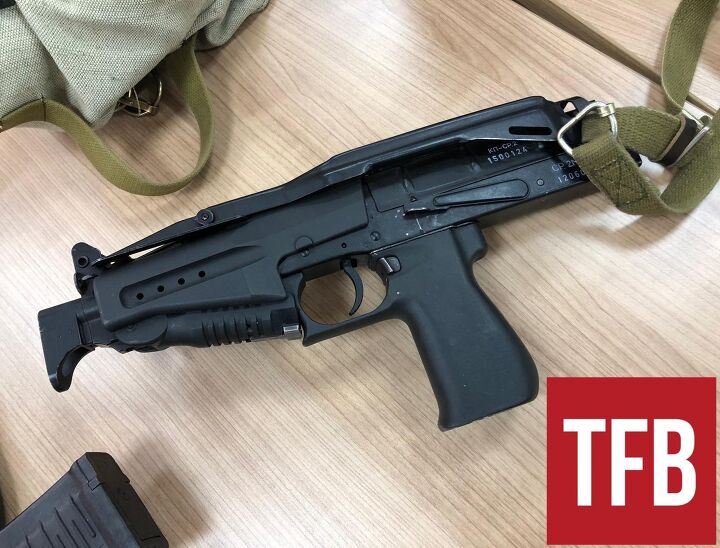
At the dawn of the 21st century, Russia developed a new submachine gun and personal defense weapon. Reportedly, it entered production a few years before the Heckler & Koch MP7. They are both very similar concepts, though significantly different in their chambering. The Russian approach adopted the new Russian 9x21 cartridge, whereas the Germans adopted a new micro-caliber approach.
The gun
The SR-2M “Veresk” is a compact Russian submachine gun and personal-defense weapon notable for its combination of a high-velocity pistol cartridge and a gas-operated system. Developed in the late 1990s by TsNIITochMash (Central Research Institute of Precision Machine Engineering) at the request of Russian security services, the SR-2 series was intended to give special-forces and law-enforcement teams a small, highly controllable weapon that could defeat soft body armor, berriers, and provide effective fire out to distances where ordinary pistols and traditional SMGs lose their effectiveness.
The FSB was the first organization to express interest in a compact submachine gun chambered for the powerful 9x21 ammunition. In the mid-1990s, it approached Pyotr Serdyukov at TsNIITochMash to develop such a weapon, who had previously designed the SR-1 pistol. The result was the SR-2 Veresk, officially designated Spetsialnaya Razrabotka (Special Development). By the early 2000s, the SR-2 had entered service with FSB Spetsnaz, OMON units of the Ministry of Internal Affairs, and SOBR units under the National Guard. In practical use, the SR-2 offers effective soft-armor penetration out to roughly 40 meters and an effective range out to 200 meters, with notable stopping power. Exceptionally compact, lightweight, and concealable, it has become a preferred weapon for shield operators, who can fire it one-handed without sacrificing control or lethality.

At the heart of the Veresk concept is the 9x21mm “Gyurza” family of cartridges, such as the SP-10/SP-11/SP-12 loadings, a high-pressure cartridge designed to deliver greater penetration than standard 9x19mm Parabellum loads. Rather than relying on a simple blowback operating system, as many submachine guns do, the SR-2 and its later SR-2M upgrade use a gas-operated system with a multi-lug rotating bolt, a layout more typical of assault rifles than of SMGs. This reduces felt recoil and enables the weapon to reliably handle the hotter 9x21 ammunition while offering improved controllability in full-automatic fire. It also employs a linear hammer, a mechanical design choices that enable a more compact receiver. The fire-control layout is ergonomic: a right-handed shooter can operate the safety with the index finger on the right side and the selector with the thumb on the left. An ambidextrous magazine release sits behind the trigger group, and a folding charging handle protrudes from the right side of the weapon. A folding vertical foregrip is positioned behind the removable hand stop, which can be detached to mount a suppressor.

The Ammunition
The 9x21mm SP-10 cartridge uses a 103-grain projectile with a muzzle velocity of 1,245 ft/s. The second cartridge in the series, the SP-11, features a full-metal-jacket ball round, making it suitable for use against unarmored targets and for training loads due to its lower cost and reduced risk of ricochet. The SP-11 has a 121-grain projectile and a muzzle velocity of 1,279 ft/s from the SR-1, for reference. Russia also produces the SP-12, a jacketed hollow-point round for situations requiring expansion. Among the family, however, the armor-piercing SP-10 remains the most widely fielded.
The SR-2M is the modernized production version that followed initial SR-2 models in service from around 1999. It retains the Veresk’s distinctive profile, rectangular receiver, folding buttstock, and vertical foregrip. Still, it adds practical updates, including proprietary optics rail, improved sights, and compatibility with a sound suppressor. Magazines are conventional 20- or 30-round double-stack, dual-feed magazines that are inserted into the pistol grip, which helps keep the weapon compact while preserving balance. Typical published weights place the SR-2M at 3.6 lbs. unloaded, with an overall length of roughly 23.7 inches with the stock extended and around 14.4 inches folded, and a 6.9-inch barrel. Despite its compact size and light weight, the weapon is surprisingly controllable at its cyclic rate of 900 rounds per minute.
The SR-2M's cartridge provides the gun with substantial firepower, while the gas system and rotating bolt help keep recoil manageable. The 9x21 Gyurza rounds produce significantly greater muzzle energy and penetration versus standard 9x19 loads, which is precisely why the cartridge and weapon were requested by counter-terror and protective services.

In service, the SR-2M has been fielded in modest numbers with Russian internal security units, notably FSB and various OMON and spetsnaz detachments, where its compactness, penetration, and modularity are appreciated for close-quarters operations, VIP protection, and vehicle crews. It was not intended as a general-purpose infantry weapon but rather as a mission-specific tool for situations in which conventional pistols or larger rifles were either impractical or inadequate against body-armor-wearing opponents. Export and game-world popularity have raised the weapon’s profile outside Russia, though its adoption remains limited compared with mainstream Western SMGs.
Practical strengths of the SR-2M include its compact ergonomics, the magazine-in-grip layout that shortens overall length, and the weapon’s ability to fire specialized armor-piercing pistol rounds reliably because of the stronger gas system. The folding stock and accessory rails make it suitable for close-quarters combat while still accommodating an optic for quick engagements or extended-range use as an SMG. I would point out that the use of a specialized 9x21 cartridge complicates logistics relative to more common calibers and increases the cost of training and supply; as with many niche designs, those trade-offs have limited the extent to which the Veresk is issued.

Tactically, the SR-2M is best understood as a PDW-class weapon, small and light enough for vehicle crews or plainclothes teams, yet capable of defeating lightly armored threats that would stop ordinary pistol bullets. In urban counter-terror operations, it offers an appealing combination of concealability, automatic-fire capability, and penetration. For operators who need to move quickly within buildings, vehicles, and tight corridors, the Veresk is a practical compromise between a pistol and a full-sized carbine. It is commonly seen as the shield bearer's weapon on an entry team.
The SR-2 quickly evolved into the SR-2M, which replaced the original screw-on foregrip with a folding version, added a removable hand stop near the muzzle, and incorporated a redesigned stock compatible with reflex sights. The original SR-2s remain in service with units operating older equipment or limited budgets; they serve alongside the updated SR-2M. The newest variant, the SR-2MP, adds M1913 rails on the sides of the handguard and on the receiver, and a stock to clear gas masks. It is exportable and demonstrates the platform’s ability to modernize in line with contemporary mission requirements. However, the caliber restricts its export potential.

Conclusion
Today, the SR-2M is in circulation; although less common than its rival, the H&K MP7, its compact, rugged design and performance keep it relevant in close-quarters and specialist roles. The SR-2M fulfills the specialist roles and can be described, essentially, as a scaled-down version of the SR-3/VSS/VAL. While it hasn’t achieved the same export profile or visibility as the MP7, the SR-2M remains a practical, purpose-built SMG used by select units that prioritize compactness, controllability, and reliable stopping power.

Lynndon Schooler is an open-source weapons intelligence professional with a background as an infantryman in the US Army. His experience includes working as a gunsmith and production manager in firearm manufacturing, as well as serving as an armorer, consultant, and instructor in nonstandard weapons. His articles have been published in Small Arms Review and the Small Arms Defence Journal. https://www.instagram.com/lynndons
More by Lynndon Schooler


![[SHOT 2026] SIG Sauer Introduces Additional P211 Options!](https://cdn-fastly.thefirearmblog.com/media/2026/01/23/20277/post.jpg?size=350x220)


Comments
Join the conversation
"The 9x21 Gyurza rounds produce significantly greater muzzle energy"
Not according to BBTI. Consider the facts that they don't even show the really hot stuff (Underwood, Grizzly, Liberty, Buffalo Bore) and that the Veresk has a 6.9" barrel.