Capital Comrades - Two American 7.62x39 Platforms

The AK family of weapons is notorious, but the platform’s infamous partner is the 7.62×39 cartridge. Like Bonnie and Clyde, the AK’s reputation is inseparable from its chambering. That the cartridge is historically simple, robust, and effective is the key variable that makes the platform meaningful. With predictable terminal ballistics and near-mythical reliability, the AK and its round occupy a distinct niche within the 2A community.
To Each According to Their Abilities
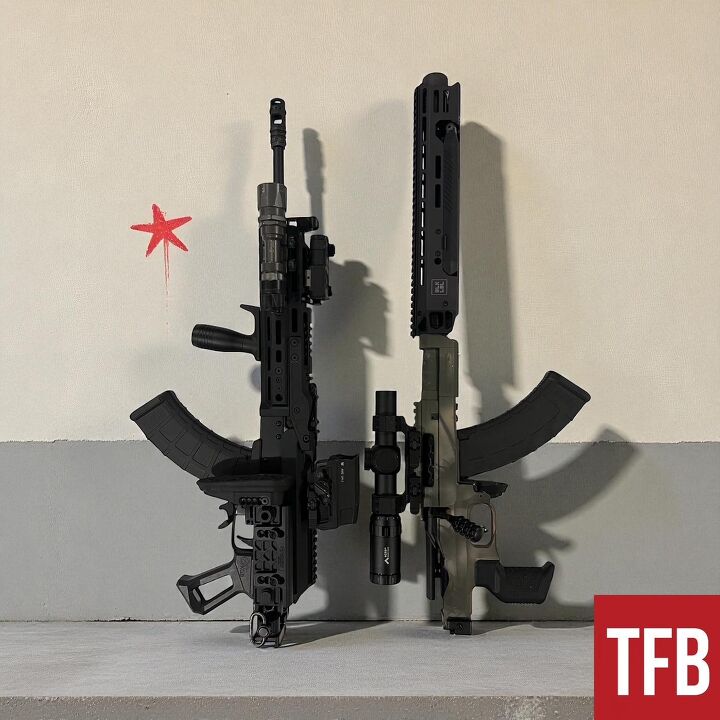
The goal is to build a pair of supporting platforms that perform significantly different tasks, yet, when combined, would cover roughly 90% of my daily combat and survival needs. Crucially, they had to be caliber- and magazine-compatible: full cross-platform interoperability. Think pragmatic modularity — one round, shared magazines, two complementary mission roles.
The result was the Capital Comrade System: a Palmetto State Armory (PSA) GF5E paired with a Ruger American Ranch bolt-action, both in 7.62×39 and both capable of taking AK-pattern magazines. I also aimed to keep the system U.S.-made and supported where possible. The goal was simple: a combat-capable rifle for daily carry and civil defense, and a bolt-action platform performing precise, consistent shots for defense or hunting — both sharing logistics and ammunition.
A Match Made in 'Merika
The AK is no longer merely a cultural lightning rod; it’s a proven technical solution with clear trade-offs. The 7.62×39 cartridge has limitations (reduced long-range energy and a less flat trajectory than many modern cartridges), yet it remains pragmatically valuable: strong terminal performance at short-to-intermediate ranges, manageable recoil for rapid follow-up, and good penetration through common barriers and soft tissue. The broader debate over AKs tends to be cultural disputes about “true” Kalashnikov pedigree rather than strictly ballistic. Commercially, a notable gap persisted until recently: no adoption of the AK-pattern magazine format in U.S. bolt-action and precision-capable platforms. Harmonising magazines and ammunition across two platforms dramatically simplifies logistics and field adaptability.
PSA has been disruptive in the U.S. small-arms market. Their willingness to iterate and vertically integrate, including using high-quality barrels from FN matters: barrel quality is a measurable input for group size and dependability. Once PSA solved manufacturing tolerances and fitment for a modern AK, the GF5E emerged as the obvious option. My confidence in the GF5E’s reliability was reinforced by long-duration full-auto stress tests conducted by JMac Customs, which reportedly pushed some competitors to failure while the PSA GF5E continued to function. Stress tests aren’t the whole story, but they are a useful validation of baseline engineering.
The Ruger American Ranch in 7.62×39 is the other half of the system. Ruger’s action and price-to-performance positioning make it a natural “scout” candidate, but the stock configuration uses Ruger Mini-30 magazines and lacks the logistical compatibility necessitated. Converting a bolt-action to accept AK-pattern magazines is not trivial: feed geometry, magazine catch, and receiver dimensions must be addressed and validated. My approach was a practical compromise, to preserve the Ruger’s bolt-action strengths (accuracy potential, hunting suitability) while making it logistically compatible with the GF5E and technically supportive.

Nyet, AK Not Good Enough
The PSA GF5E build was the lower-friction project. Disassembly, a trigger upgrade, and modern furniture accomplished the mission without invasive receiver work, a conservative, reliability-focused approach. I installed an ALG Match AK trigger to sharpen the break (improving shootability without substantially increasing risk in a defensive rifle), then fitted Midwest Industries furniture for a well-engineered, American-made complement that directly and effectively supports modern combat or defensive needs. I prioritized secure attachment points for optics and lights, an adjustable folding stock for ergonomics and passive co-witness, and a mount system that returns to zero reliably.
Hardware choices were driven by compatibility and durability more than aesthetics: Midwest’s Alpha handguard and railed dust cover give secure interfaces for optics and aiming lights; the Alpha folding stock offers multiple adjustment axes (length of pull, comb height, shoulder pad) and a robust folding mechanism. A Swamp Fox Raider 1× prismatic sight was chosen for short-to-intermediate engagements (0–300 m): wide field of view and a permanent reticle favor rapid target acquisition over long-range optics. Planned upgrades include an adjustable gas piston from KNS Precision and experimentation with a binary or FRS-style trigger to increase capabilities.
Parts list:
- Palmetto State Armory GF5E
- ALG Trigger
- Midwest Industries full Alpha furniture complement and ported compensator
- KGB skeletonised grip
- Swamp Fox Raider 1x Prismatic Red Dot

Cooper Would Be Proud
The Ruger required more substantive modification to meet the shared-magazine requirement and the “scout” concept that would elevate to a Gen2 status. Conversion involved coordination among specialized shops rather than off-the-shelf parts: Fire Castle Customs handled receiver modifications for AK-magazine feed; Indian Creek supplied an aluminium chassis and Hero handguard mount; Anarchy Outdoors provided an ergonomically improved charging handle and bolt knob. AD Arms performed hexagonal fluting, micro-slicking of the action, and a billet firing-pin back to improve cycling smoothness and lock-time consistency, refinements that translate to better real-world accuracy and quicker follow-ups under stress. I then adorned the platform with an A3 90-degree grip, Midwest Industries Alpha stock, and Blk Lbl 15.5” handguard with integrated bipod. Topping off the build with an inline compensator to keep the entire barrel protected and inside the handguard.
The Primary Arms 1–6× LPVO with an ACSS reticle and a 7.62×39 BDC provides both fast low-magnification engagement and usable reach for deliberate shots. The result is a pragmatic compromise: a narrow range of very usable capability rather than a theoretical maximum range. The intent will be to add a Midwest Industry 12 o’clock mount for a red dot to provide faster reflexive fire or rapid glassing of target areas in order to locate targets faster for magnified engagements.
Parts list:
- Ruger American Ranch in 7.62x39
- Fire Castle Custom modification for AK magazines
- Midwest Industries Alpha stock and inline compensator
- A3 90-degree grip
- Indian Creek Designs aluminium chassis
- Blk Lbl handguard with integrated bipod
- Primary Arms 1-6 LPVO and red dot
The People’s Pew Pews
Empirically, the Ruger performed well for hunting to about 200 yards in both open and heavy-vegetated environments. The 7.62×39, when matched with an appropriate optic and a decent barrel, remains highly effective in that envelope. The Ruger’s bolt upgrades and the chosen accessories and furniture allowed controlled, decisive hits on game.
On the GF5E side, no systemic issues arose. The PSA platform, combined with Midwest Industries components, produced a reliable, ergonomically improved AK. The option to tune gas settings and try different trigger configurations offers room to optimize without sacrificing baseline reliability. No surprise, upgrading an AK47 with improved ergonomics and modern capabilities equates to a highly functional classic that continues to perform.
Great Success
My objectives were clear: create a dual weapon system that can embody nearly all modern needs for civil defense or open combat. Use a universally recognized cartridge that has a proven track record of combat performance and capable lethality for defense and hunting. Attempt to keep it American-made (American companies to a minimum), and make it relevant for tomorrow’s needs.
The project succeeded on all counts. Cross-platform magazine compatibility was achieved and functioned reliably, providing a significant logistical advantage. Component sourcing met the American-made preference where feasible. Both platforms proved suitable for civil defense and hunting, and both are carryable in a patrol context in multiple environments. The Scout design philosophy remains relevant when updated with modern optics and accessory choices.
The principal caveat concerns low-light capability. The Indian Creek Hero handguard adapter flex compromises reliable IR-laser integration, requiring consistent passive co-witnessing under night-vision conditions or moving the IR-laser to the base of the handguard. That limitation does not negate the Scout concept but highlights the importance of rigid interfaces when night-vision/IR systems are part of the intended loadout. Addressing adapter flex should be a priority for any future iteration where low-light performance is required. In no way did the handguard itself play any role in the slight flex in the chassis. Running a multi-purpose mount could integrate the IR-laser with the optic on the receiver to ensure proper mounting for effective shooting under night vision.
Fire Castle Customs’ receiver modifications were a project lynchpin; their work enabled AK-magazine compatibility without degrading reliability. The collaboration among small shops and component manufacturers demonstrated that thoughtful, distributed engineering can produce practical system-level results.

Final Thoughts
The Capital Comrade project absolutely met its design goals. By intentionally constraining the system (one cartridge, shared magazines, similar ergonomics), I reduced cognitive and logistical load in operational scenarios. The GF5E is a modernized AK that benefits from better attachment systems and quality control. The Ruger, once modified and bedded into a stiff chassis, becomes a fast, lightweight scout that is lethal and practical inside its expected engagement envelope.
Every system involves trade-offs. The 7.62×39 provides excellent short-to-intermediate terminal performance and magazine availability, but it is not optimized for long-range flat trajectories. Converting a bolt-action to accept AK-pattern magazines solved a logistical problem but introduced a mechanical interface that required attention to engineering issues. Modernizing Cooper’s Scout idea with contemporary manufacturing and optics shows the continued validity of his concept, with the caveat that modern accessories (NV/IR systems, LPVOs, bipods) demand rigid, tested interfaces to deliver consistent performance.
Whether your mission is civil defense, competition, or backcountry hunting, the Capital Comrades offer a pragmatic, interoperable solution. The system’s strength is intentional simplicity: shared ammo, shared magazines, similar handling. In many real-world scenarios, logistical simplicity matters more than theoretical perfection — two reliable comrades that draw from the same supply train are a force multiplier.
3 decades in SOF and high threat contracting, master’s in psychology with a focus trauma, hobby farmer, and outdoors enthusiast .
More by Toby M


![[SHOT 2026] The American Kalashnikov - Stenzel Industries SAK-21](https://cdn-fastly.thefirearmblog.com/media/2026/01/20/03511/post.jpg?size=350x220)


Comments
Join the conversation
Given having been shot at with AKs in Vietnam, and the fact that the supply of cheap 762x39 seems to have dried up, I lack enthusiasm for anything to do with the platform or the ammunition. Still the armaments of the enemy to me.
Gary Paul Johnston
"To each according to their abilities." Especially when your ability doesn't include
PHOTOGRAPHY!