The Quiet Hand of the Kremlin, the Soviet PB Pistol
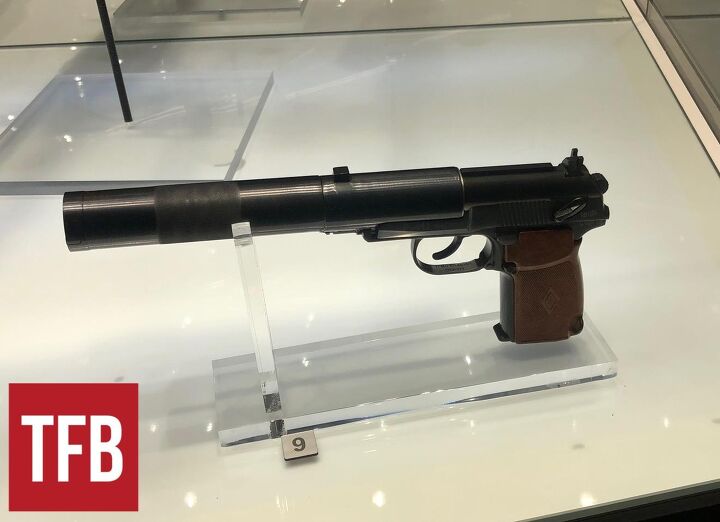
In the 1960s, the Soviet Union sought to close the gap between conventional arms and the specialized requirements of clandestine warfare. Reconnaissance teams, Spetsnaz elements of the Soviet Army, and KGB operatives were expected to operate behind enemy lines or when silent work was required during any operation, and this placed a premium on weapons that were not only reliable and compact but also quiet. Out of that requirement came one of the first mass-produced Soviet handguns purpose-built for suppressed, covert work: the PB (GRAU index 6P9). Designed in the mid-1960s and formally adopted in 1967, the PB became the integral suppressed service pistol for Soviet special forces and state security services.

The PB began life as a heavily redesigned Makarov-pattern service pistol adapted to accept a suppressor system. Anatoly Arsenyevich Deryagin at TsNIITochMash led the development; the final design preserves the simple blowback operation and many of the ergonomics of the Makarov while incorporating a vented barrel and a can for suppression. The solution was unique for the Soviets at the time and may have been influenced by the High Standard HD recovered during the May 1, 1960, shootdown of Francis Gary Powers. The suppressor system is divided into two sections: the expansion chamber and baffle section, which are part of the pistol’s forward assembly (the can), which is detachable and can be carried separately for storage or concealment, and quickly fitted in the field. That two-piece arrangement allowed operatives to transport the weapon in an everyday holster or pouch and assemble the suppressor only when needed. The pistol also operates without the can if required quickly, though with a louder report.
Sound suppression on the PB is not just a matter of baffling; it's integrally suppressed. To prevent the bullet from breaking the sound barrier and producing a supersonic crack, the PB’s barrel is vented, so that some propellant gases are bled off into the suppressor expansion chamber before the projectile leaves the muzzle. The result is a reliably subsonic muzzle velocity for standard 9x18mm Makarov ammunition in the PB, rather than depending on specially loaded rounds. Measured muzzle velocity is roughly 951 feet per second, and that subsonic performance is a critical contributor to the pistol’s much lower report.

The PB’s suppressed report averages approximately 127.5 dB. In plain language: the PB brings a loud, impulsive report down into a range where the pulse is far less conspicuous and where, in many conditions, hearing protection is not required for a single shot. That doesn’t make it silent in an absolute sense; the mechanical noise of slide movement and metallic clatter remains audible, but it dramatically reduces detection range, and the attention of a single close-range shot will attract.

The PB is a fairly compact pistol with a reported empty weight of about 2.2 pounds, and the weapon uses the same eight-round single-stack magazines as the Makarov PM, which aided logistics. The integration of the expansion chamber makes the pistol slightly wider, and its overall length with the suppressor fitted is appreciably longer than that of a standard service pistol. Yet, the detachable front section preserves concealability when the gun is carried for covert tasks.
Operationally, the PB proved to be precisely what it was intended to be: a suppressed sidearm for close-quarters work by reconnaissance teams, Spetsnaz assault elements, and security service operatives. It was adopted into Soviet service in 1967 and first used in the Soviet-Afghan War and thereafter, where suppressed weapons conferred an operational advantage in missions requiring dropping a target to mitigate detection and other missions requiring discretion. Production and service life extended into the post-Soviet era. Although manufacturing was reduced and reportedly halted in 1989 due to economic hardship in the USSR, storage subsequently ran short, and demand for dedicated suppressed sidearms led to renewed production in 2003 and to ongoing limited production at Izhevsk and its successor, Kalashnikov Concern. The pistol’s long service life and continued issuance have made it familiar to multiple generations of Russian special operators.

The PB’s legacy is twofold. Technically, it showed that an effective, suppressed semi-automatic sidearm could be fielded at scale by using an integrally suppressed system. These lessons informed other Soviet specialized systems (and paralleled silent-weapon designs elsewhere). Culturally, the PB became a recognizable symbol of covert Cold-War tradecraft: not a glamorous gadget but a practical tool that matched real operational needs, from reconnaissance missions to the murky, small-scale fights that spilled out of proxy wars and covert operations.

Today, even as modern purpose-built suppressed pistols and compact integrally suppressed systems have been introduced, the PB remains an impressive example of Cold War small-arms engineering. Its unconventional design, emphasis on discretion, and mechanical ingenuity continue to attract interest, and it still sees limited use in the present day. Most strikingly, the weapon has reappeared in the Russia-Ukraine war, revealing its durability and the enduring relevance of specialized suppressed firearms developed decades earlier.

Lynndon Schooler is an open-source weapons intelligence professional with a background as an infantryman in the US Army. His experience includes working as a gunsmith and production manager in firearm manufacturing, as well as serving as an armorer, consultant, and instructor in nonstandard weapons. His articles have been published in Small Arms Review and the Small Arms Defence Journal. https://www.instagram.com/lynndons
More by Lynndon Schooler





![[SHOT 2026] Palmetto State Armory's Fresh Crop Of New Guns](https://cdn-fastly.thefirearmblog.com/media/2026/01/24/23281/post.jpg?size=350x220)



Comments
Join the conversation