The Rimfire Report: .17HMR vs .22WMR Magnum Rimfire Showdown


Both .17HMR and .22WMR are extremely hot rimfire calibers. The magnum rimfire caliber market is geared specifically towards varmint hunters but there are plenty of plinkers out there who choose one or both just for the fun of shooting them. Today we’ll briefly explore each magnum rimfire cartridge and compare them to see where their strengths and weaknesses are.

.22 Winchester Magnum Rimfire (WMR)
22 WMR was first developed back in 1959 and went on to be produced as a standard off the shelf cartridge ever since. .22 WMR was developed out of the 22 Winchester Rimfire (WRF) produced in the 1890s. Eventually, the 22 Long Rifle cartridge came to overshadow 22 WRF because of extensive improvements in powder technology during the early 20th century.

The .22 WMR makes use of a lengthened version of its parent case which is wider than standard .22LR cases. With both increased capacity and sustained pressure capability, 22WMR makes for an extremely fast 22 caliber projectile with a 40-grain bullet moving up to 1,875 feet per second out of a rifle length barrel.

With the bullet traveling so fast, the .22 WMR boasts 50% more kinetic energy at 100 yards range than a .22 LR has at its muzzle. While the cartridge itself isn’t marketed for anything larger than say a coyote or fox, it still does the job more humanely and accurately than any other .22 LR cartridge available. Even with all of its extra power and range, the .22 WMR still makes for a serviceable plinking round, albeit with a much higher price tag than .22LR.

- Parent Case: .22 WRF
- Bullet Diameter: .224 in
- Case Overall Length: 1.350 in
- Ballistic Performance:
30 gr: 2,300 fps40 gr: 1,875 fps50 gr: 1,530 fps
- Effective Range: ~125 yards
- Manufacturers: Winchester (Olin Corporation)
.17 Hornady Magnum Rimfire (HMR)
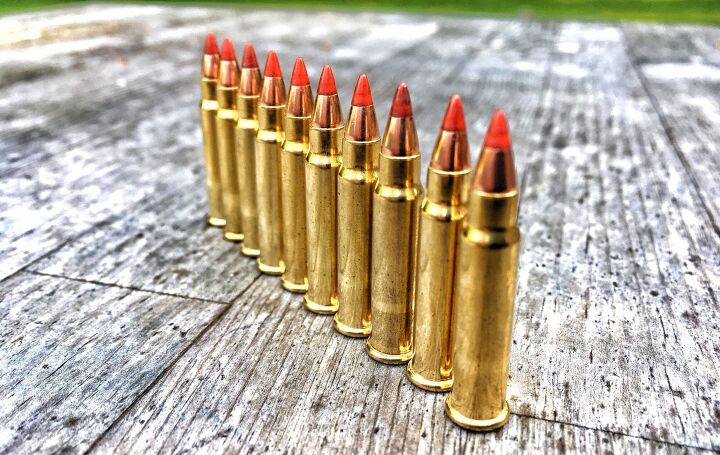
.17 HMR is a relatively modern cartridge offering. Born from the wildcat cartridge community in 2002, the round was developed specifically with the goal of achieving the flattest bullet trajectory possible. With the ballistics of the 5mm Remmington Rimfire Magnum which was off the market between 1974 and 2008, the designers of the .17 HRM set out to match the performance of that cartridge.

Using the .22 WMR mentioned above as a parent case, the .17 HMR uses a necked down .22 WMR case to fit the .17 caliber bullet. This was to circumvent the fact that 5mm RRM cases used an extremely unique case head size and required a completely different bolt and magazine. On top of that, 5 mm RMR barrels were basically nonexistent at the time.

The .17 HMR uses extremely light bullet weights to achieve both high muzzle velocity and a flat ballistic profile. This allows the varmint hunter to achieve greater accuracy and clean kills at longer ranges but sacrifices bullet weight and terminal ballistic capability meaning smaller quarry will be the most affected targets with this rimfire magnum caliber.
.17 HMR Characteristics- Parent Case: .22 WMR
- Bullet Diameter: .172 in
- Case Overall Length: 1.349 in
- Ballistic Performance:
15.5 gr: 2,525 fps17.0 gr: 2,650 fps20.0 gr: 2,350 fps
- Effective Range: ~250 yards
- Manufacturers: Hornady, PMC, Remmington, Winchester (Olin), CCI
Similarities
Off the bat, the biggest similarity between the cases is that they both share the same case as a starting point. Even when .22 WMR is necked down to .17 HMR it only loses 3 thousandths of an inch in case length.

Both cartridges are designed for varmint hunting within 300 yards. The .22WMR and .17HMR both achieve this via extremely light projectiles traveling at high velocity. Both are more than capable of taking down small game such as squirrels, small birds, groundhogs, coyotes, and foxes.

At first glance, it would seem that both rounds accomplish basically the same thing but next, we’ll go over some key differences. Upon closer inspection, you’ll see that both rounds have different characteristics that will help you determine which one might be better suited for one application or another.
Major Differences
The first notable difference is going to be clear just in the name: Bullet Diameter. The standard .224 diameter .22 bullets are much wider and in ballistic tests, will tend to mushroom out without fragmenting too much. This can be good for creating clean relatively heavy-hitting wound channels when compared to .17HMR. Most suitable if you’re planning on eating the critter you just shot with it.
The newer .17 HMR is something wild if you’ve ever hunted with it before. While a .22 WMR will cleanly and humanely put down a varmint at the range, the .17 HMR will completely eviscerate it at an even greater distance. The Spitzer style bullet of .17 HMR is both aerodynamically more efficient and traveling faster making for a great flat shooting round that fragments upon impact. .17 HMR is extremely well cut out for pest control work.
Another difference you’ll find between the two is the number of available rifles in each caliber. .22 WMR has a bit of a leg up mostly due to it being much older than .17 HMR. You’ll likely find offerings ranging anywhere from pistols to semi-auto rifles and even the lever guns from which they originated. .17 HMR can usually be found in bolt-action rifles, but in recent times more and more companies have been adopting the .17 HMR in semi-auto platforms such as the Savage A17.
Which one is for you?
Personally, between the two, I tend to favor .22 WMR. Despite being quite old it can still hold its own and do pretty much everything I need it to in regards to pest control or small game hunting. With .17 HMR being better suited to pest control I’d lean towards the round that can do more work. .22 WMR also has greater bullet weight on its side and so it will tend to do better for slightly larger game animals. As icing on top, .22 WMR does all that at a lower price point than .17 HMR. However, that being said, there is a time and a place for nearly all calibers, so you should always carefully weigh your options.
I’d like to hear your thoughts on these two rimfire calibers. Which one do you think is better and is there a caliber you prefer or do you own them both? Thanks for stopping by to read The Rimfire Report and we’ll see you next week!
We are committed to finding, researching, and recommending the best products. We earn commissions from purchases you make using the retail links in our product reviews. Learn more about how this works.
Reloader SCSA Competitor Certified Pilot Currently able to pass himself off as the second cousin twice removed of Joe Flanigan. Instagram: https://www.instagram.com/ballisticaviation/
More by Luke C.



![[SHOT 2026] CVA Gets Into The Rimfire Game With New Cascade Rimfire](https://cdn-fastly.thefirearmblog.com/media/2026/01/23/17451/post.jpg?size=350x220)


![[SHOT 2026] MK Machining Showcase ‘Straightbull’ Rifle](https://cdn-fastly.thefirearmblog.com/media/2026/02/02/11211/post.jpg?size=350x220)
Comments
Join the conversation
I'd like to know why Guile's level from Street Fighter II was chosen as the background for this debate.
Being north of the 49th parallel, .22LR was the preferred round for most, primarily due to availability and cost. .22 mag wasn’t nearly as easy to find, and 4X the cost. .17HMR took a while to click, but once it did, it eclipsed the .22mag round. Greater availability, variety and the novelty of the little tiny round going so damn fast. I’d had .22LR and .22WMR rifles for years; the .22LR got plenty of use, the .22WMR not nearly as much. I enjoyed the .17 the first time I shot it, and found a Savage bolt gun shortly after. I love the versatility of the round, and it’s range. Gophers, squirrel, rabbit, grouse, coyotes (lots of coyotes). That little Savage on a bipod is deadly for winter coyote hunting here. I’ve never had a shot on a coyote past 150 yds where I live. Just doesn’t happen for me. Many/most are 40-75yds; on the bipod, pick the ear or eye closest you & they’re in the dirt immediately. I think that’s what I like most with it; the round combined with the accutrigger is so dang accurate, choosing your POI so precisely is a treat. I still shoot it every winter, a lot. Still hate the look of the Savage, love the way it performs. I’m a lever gun fan, and the .17HMR lever is rapidly climbing the list of guns I must have before I die. With our present government determined to ban anything AR-like or military “assault” rifles (yes, THAT debate is strong here too), it may climb to the top of the list much more quickly