What To Look For In A Modern AK-47
In 1959, two completely different events defined the history of modern small arms. In the US, Fairchild Corporation, the parent company of ArmaLite, licensed the manufacturing of the AR-15 to Colt, essentially starting the proliferation of this rifle.
In the same year, on April 8, the Soviet government decided to formally accept into service the AKM, a modernised version of the AK-47. While the original AK was mass-produced since 1949, it was the AKM that gained the notoriety that the Kalashnikov rifle is known for all over the globe.
For the last 65 years, both platforms have gone through numerous upgrades and modernisation, initiated by both government agencies and the demand of the private market. Both platforms faced numerous challenges in their long evolution, but clearly, both are here to stay, unless science fiction becomes reality, and humanity will start using force shields as it does in the Dune movie (and the book).
In the last 20 years, the modernisation efforts for the AK platform were chaotic: multiple countries attempted to modify the weapons system. After 2010, multiple development initiatives were launched by the OEM, the Russian Izhmash factory. Back in the day, I personally witnessed many of those projects when I participated in trials and testing of the AK-12 and other modern Kalashnikov rifles.

Now, after multiple military trials in different countries and hundreds of thousands of rounds shot during tests and demonstrations, I have made certain conclusions about what a modern AK-47 should be.
Caliber
The AK caliber debate is endless on both sides of the Atlantic … 7.62 or 5.45? Or maybe 5.56?
First things first - 5.45 is not an option anymore for the US market. With the ongoing war, we won’t see cheap 5.45 on the shelves of US gun stores any time soon. So let’s look at other options.
In the AK caliber debate, people often miss the most critical aspect of it - barrel life. I did a lot of endurance testing, and firing 10,000 rounds through a 7.62x39 barrel was not a big deal. Some gunsmiths from the Kalashnikov factory joked that 10,000 rounds is just a break-in period for an AK, and the bullets are polishing the chrome plating inside the bore, getting rid of imperfections.

In fact, sometime around 2012, the Kalashnikov factory attempted to test the actual life of the barrel on an AK103 chambered in 7.62x39. The results were unexpected - after firing 50,000 rounds through each of two rifles, the accuracy did not degrade. However, the factory started running out of ammo, which could compromise testing of the guns leaving the assembly line. Later, I personally looked into two cases when two 7.62x39 AKs shot over 40,000 rounds, and there was little to no accuracy degradation in both cases.
Keep in mind that the Russian factory is using cold hammer forged (CHF) barrels made on the Austrian machines that are used by many other manufacturers. Therefore, you can expect the same barrel life from any manufacturer that uses modern cold hammer forging machines and has proper quality control. And if you want to know more about CHF technology, check out this TFB article.
Another advantage of 7.62x39 is the fact that it allows the use of subsonic ammo, making it an interesting option for those who like suppressors. In that regard, 7.62x39 is close to 300 Blackout.
But there is nothing wrong with buying a 5.56 AK. The ammo is relatively affordable and offers a lot of interesting loads. However, do not expect an infinite barrel life on a 5.56 or 5.45 AK. After 10,000-15,000 rounds, you’re likely to see significant accuracy issues and eventually keyholing.
In conclusion, if you want an AK that will last a few lifetimes and can effectively shoot subsonic ammo, 7.62 is a better option. And if you have plenty of 5.56 ammo, 5.56 AK is the way to go.
Accuracy

A well-built AK should be able to shoot 2-3 MOA at 100 yards. Yes, the Soviet army standard is a little over 5 MOA, but that is essentially a rejection standard; if the gun shoots 5 MOA, it is written off and considered unserviceable.
So if your AK doesn’t shoot 2-3 MOA, it has nothing to do with limitations of the weapon system; it is simply a sign that the gun was not built properly.
Reliability
Durability and reliability are what AKs are known for. However, when I analysed AKs made in the US eight years ago, there were plenty of rifles that were not meeting expectations.
However, the time has passed, and the market largely solved that problem: most (but not all) companies that were known for low-quality Kalashnikov rifles are either out of business or have significantly improved the quality of their products.

In the US, a lot of shooters notice that AKs are overgassed. It is true, however, it is not a bug but a feature; the excess gas allows AK to function when dirty and filled with sand (not the mud, though). So, if you’re looking for an AK with minimal recoil, keep in mind that it may affect reliability.
Rails
The topic of AK upgrades is endless. Earlier this year, I published two articles dedicated to this very question: the first one about the general approach to AK upgrades, and the second one is about lights, lasers, and sighting systems.
However, you really have to answer one question when you think about upgrading your AK - do you want to mount a laser? If the answer is yes, you will need a rail system that might cost as much as the gun itself.
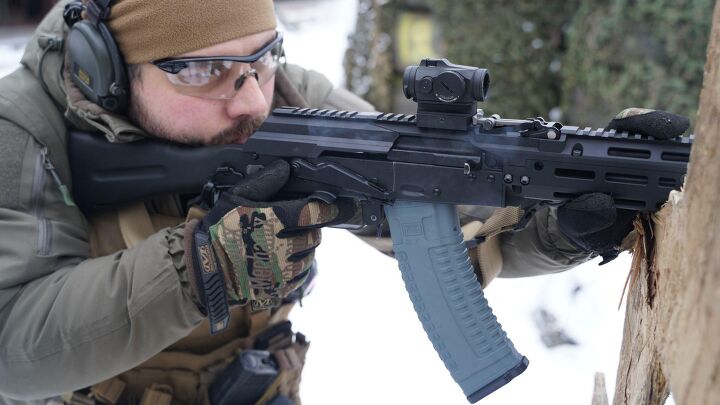
If you just need a red dot and a light, you can just buy a side mount and a cheap lower handguard and solve the problem without breaking the bank.
Conclusion - What to Choose?
Despite decades of import bans, there are still plenty of interesting imports available in the US market. The first is Zastava Arms USA, which offers both rifles imported from Serbia and rifles manufactured in the USA from parts kits.
If you are into the history of Yugoslavian conflicts, the second option might be interesting, since those M70AB2 rifles have original furniture that often features examples of wartime “trench art”. Those guns have chrome-plated barrels and cost just under $1000. Keep in mind that Zastava rifles have their own specs, so you wanna be careful when buying parts and accessories.

Zastava Arms ZPAP M70 7.62x39mm AK
The second is WPB from Poland. Recently, TFB TV toured their factory and made several interesting videos about the manufacturing process of those rifles. The retail price is similar to Zastava, just over a grand, but that seems to be a fair market price in this day and age.
If you’re looking for a cheaper option, WASR-10 from Century Arms is a good deal. It won’t win any beauty contest, but it is a reliable AK with the same cold hammer forged chrome plated barrel. As of December 2025, you can still find it for $800-$900.

Century Arms WASR-10 7.62x39mm AK
There are also plenty of well-made US-manufactured AKs; however, they cost the same as imports. And if we look at what was happening at the US gun market in the last 50 years, pretty much any imported AK has more collector value. So it makes sense to buy imported AKs while they are still available.
We are committed to finding, researching, and recommending the best products. We earn commissions from purchases you make using the retail links in our product reviews. Learn more about how this works.

Vladimir Onokoy is a small arms subject matter expert and author of "From Balkans to Babylon: Zastava AKs of Yugoslavia, Serbia, and Iraq", the first English-language book about the history of M70 and Tabuk AKs. Over the years he worked in over 20 different countries as a security contractor, armorer, field analyst, product manager, and consultant. His articles were published in Recoil magazine, Small Arms Review, Small Arms Defense Journal, Overt Defense and Silah Report. He also worked as the historical consultant for movies and weapon history books, namely "Vickers Guide: Kalashnikov" series, and Ian McColum's "Small Arms of WW2: Soviet Union". You can contact him here vonokoybooks@proton.me
More by Vladimir Onokoy


Comments
Join the conversation
Whenever I am buying an AK I use the following process: