FBI Ballistics Expert Explains Why 9mm Beat .40 S&W

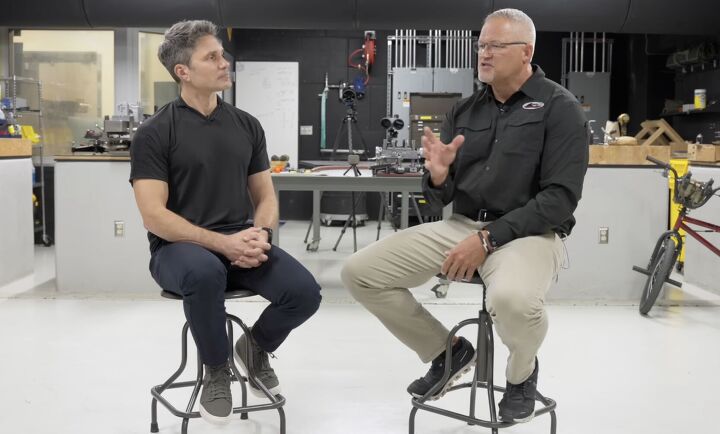
James Reeves recently got access to one of the most secretive facilities in American law enforcement: The FBI's Ballistic Research Facility in Huntsville, Alabama. What he learned there should settle a lot of internet arguments about caliber selection.
The short version? Modern 9mm ammunition, with the right projectile, performs just as well as .40 S&W in FBI testing. And yes, they have the data to prove it.
Meet the Man Behind FBI Ammunition Selection
James's tour guide was “Scott,” who spent 23 years with the FBI, the last 16 at the Ballistic Research Facility. Before joining the bureau, he was a Missouri State Trooper for five years and a deputy sheriff in Boone CountyMissouri. He's been involved in shootings, served overseas in Afghanistan, worked SWAT and sniper programs, and ultimately ended up running what started as "three dudes in a trailer" at Quantico.
That trailer is now a proper laboratory where the FBI conducts the most rigorous ammunition testing in American law enforcement. And Scott's job is to make sure FBI agents have the best possible chance of surviving a gunfight.
Pre-1986, the FBI's sidearm situation was a mix of revolvers in .38 Special and .357 Magnum, some 9mm semi-autos, a few High Powers, even some double-stack 1911s. There was variety and not much science behind the choices.
"It certainly doesn't withstand the rigors of how guns are looked at today. There was a lot of, ‘Hey, this works well for us.’," Scott said.
All of that changed on April 11, 1986.
The Miami Shootout Changed Everything
The 1986 Miami shootout is well-known to most gun people, but here's the short version: FBI agents pursued two bank robbers in a black Monte Carlo, ending in a four-minute gunfight with somewhere between 119 and 130 rounds fired. Special Agents Benjamin Grogan and Jerry Dove were killed.
The shooting exposed serious problems with FBI ammunition choices. The bureau was using a 115-grain 9mm hollow point, which failed catastrophically in the real world.
"It didn't have the ability to penetrate intervening barriers and then to enter the human target and penetrate deep enough to disrupt a vital organ," Scott explained. "We buried two special agents because of it."
Here's the key point that gets lost in caliber debates: the 9mm didn't fail. The bullet the FBI chose failed.
The Aftermath: Revolvers Are Done
In 1987, the FBI held a wound ballistics symposium, bringing in experts from around the country. Two major decisions came out of it.
First, revolvers were finished as FBI duty weapons. The reason was simple: magazine capacity and reload speed in a traumatic environment. It's one thing to reload a cylinder on a flat range. It's another when you're bleeding, there's glass everywhere, and people are shooting at you.
Second, they needed to figure out caliber selection. The debate centered on 9mm, 10mm, and .45 ACP. The .40 S&W didn't exist yet.
The 10mm Experiment
The FBI decided to go with both 9mm and .45 ACP. They started issuing the Sig Sauer P226 and P228 in 9mm in the late 1980s and early 1990s. SWAT teams would eventually get Springfield Professional models in .45 ACP. But the 10mm Auto became a major research project starting around September 1988, when the idea of a formal Ballistic Research Facility took shape.
10mm Auto looked perfect on paper, offering high magazine capacity with serious performance. The FBI adopted the Smith & Wesson 1076 chambered in 10mm.
Then reality set in.
"There were huge issues for us with 10 millimeters," Scott said. The recoil impulse in a fleet of shooters, as opposed to individuals who buy guns for themselves, created functional reliability problems. The FBI eventually sent about half their 1076s back to the custom shop for rework.
"If one of their guns had gone back and been reworked, they loved it," Scott noted. "And then you had the other group go, 'I couldn't get that thing to function to save my life, almost literally.'"
Enter the .40 S&W
If you slow down a 180-grain 10mm bullet enough to make it manageable, you might as well shoot a .40 S&W—which is exactly what the .40 is: a short 10mm that shoots the same projectiles.
Winchester and Smith & Wesson developed the .40 S&W, and the FBI decided it could deliver everything they needed without the 10mm's problems. In 1996, Glock won the FBI contract with the Model 22 and Model 23.
The Glock 22 worked well with full-power .40 S&W loads. The compact Glock 23 was another story. Agents experienced significant malfunctions with the full-power 180-grain loads running around 1,150 fps.
"Everybody first goes, 'Hey, what's wrong with the ammo?'" Scott explained. "We then transitioned to Glock 23s, and the shooters with the smaller, more concealable guns were still taking that incredible recoil impulse, and the system started to fail for us."
The FBI backed the velocity down to 980 fps, which helped with the G23s. But they eventually went back to full-size Glock 22s, and "all of a sudden everybody's happy on the firing line."
The Science That Brought 9mm Back
Around 2007, FBI researchers started noticing something: modern 9mm projectiles were performing essentially the same as .40 S&W in FBI protocol testing. By late 2010, when Scott arrived at the BRF, the conversation about switching back to 9mm was getting serious.
In 2012, the FBI ran an ammunition procurement that made the case even stronger. Scott asked Dave Emery at Hornady why 9mm had improved so much compared to other calibers.
Emery's answer: "Because you allow us velocity."
He explained that manufacturers could engineer 9mm bullets at higher velocities while maintaining functional reliability across a fleet of guns. That extra velocity window let them design projectiles that performed more consistently through barriers and into targets.
"There's not a nickel's worth of difference between the two," Emery told Scott about 9mm versus .40 S&W.
The FBI looked at literally thousands of tests. The data was clear: modern 9mm could match .40 S&W performance.
The Practical Advantages of 9mm
Beyond terminal performance, 9mm offered significant advantages.
The FBI brought people from across the bureau to test both calibers on a controlled course. Office personnel who'd never held a gun, all the way up to Hostage Rescue Team operators.
Six out of ten shooters were faster and significantly more accurate with 9mm over .40 S&W.
The system worked better. Shooters could manage the gun. Magazines fed reliably. Recoil was manageable even in compact guns.
And the FBI could run full-power 9mm loads without the reliability issues they'd seen with full-power .40 S&W in compact platforms.
Overcoming Institutional Resistance
Getting the FBI to adopt 9mm again wasn't easy. Scott and his team published a 200-page book in June 2013, laying out the case. The scientific research was solid, but the bureau was fighting emotion.
"Had we wanted to transition to a 46 caliber, everybody would have been on board today," Scott joked. "Looking at going from a .40 diameter to a .35 diameter bullet, they're like, 'You guys are going to get us killed again.'"
The accusation that the switch was about saving money or improving qualification scores came up repeatedly. Scott addressed it head-on: "We would never have gone down this road if it didn't make us better in our gunfights against our human adversaries. Period. That was the only driving force for this."
In 2014, Scott briefed the senior leadership at FBI headquarters. After his presentation, the head of finance pointed out that Scott hadn't mentioned costs at all.
"I haven't because I don't think saving the life of an FBI agent has anything to do with dollars and cents," Scott replied.
The finance guy insisted on knowing the cost impact anyway: roughly $500,000 in annual savings in training costs at the FBI Academy alone.
"This is a hell of a good idea. We gotta go," the finance executive concluded.
What This Means for You
The FBI's research has driven commercial ammunition development. According to Scott, "That technology and their efforts to be better on the FBI protocol tests is all over the shelf at Bass Pro and Cabela's and any gun store you go to."
So what should you look for?
Scott recommends looking at 135- to 147-grain 9mm projectiles. "Typically, your law enforcement lines, every major manufacturer has it. It's pretty clear on the box at the store. Those grain weights seem to be the most consistent with the right design and the right velocity."
For 124-grain bullets, you're going to need +P to get adequate penetration. As for 115-grain or anything lighter? Forget it, Scott said—the FBI doesn't look at lightweight bullets anymore.
When Reeves asked him about +P in heavier bullets like 147-grain, he couldn't give a simple answer. "That's a hard question to answer because I don't know enough about the projectile."
Fair enough. This is why interviewing scientists is frustrating—they won't give you the simple answer you want.
The Real Lesson: It's About the Bullet
Here's what matters most from this interview: the FBI's journey through calibers wasn't really about caliber at all. It was about projectile design.
Would .40 S&W have made a difference in the 1986 Miami shootout? Yes. Would 9mm with the right bullet? Also yes.
"Frankly, I'm not sure that it existed," Scott said when asked what the right bullet would have been in 1986. The closest option might have been a subsonic being developed for the Navy—what Scott called "a 1479."
The FBI protocols—those six barrier tests developed in the early 1990s—drove ammunition manufacturers to engineer better bullets. Modern bonding processes, whether electrochemical, heat-based, or mechanical, let manufacturers create projectiles that penetrate barriers consistently and reach vital organs reliably.
"We can't find a caliber right now that's better than the 9mm Luger with the right projectile picked for it," Scott concluded.
What the FBI Carries Now
The FBI transitioned back to 9mm in 2015-2016. They're running modern 9mm hollowpoints with manageable recoil, high capacity, excellent reliability, and terminal performance that matches what .40 S&W was delivering.
We're going to have more content from this visit. If you want the full technical details, the complete video is available on TFB TV.
For now, the takeaway is simple: if you're carrying 9mm for self-defense, make sure you're using quality defensive ammunition in the 135- to 147-grain range from a reputable manufacturer. The FBI's research says you're not giving anything up compared to larger calibers.
And honestly, after listening to Scott explain the science behind the decision, I'm inclined to believe them.
Josh is the Editor in Chief of The Firearm Blog, as well as AllOutdoor and OutdoorHub.
More by Josh C


Comments
Join the conversation
O wonder how the 5.7 or 327 mag compare.
6 out of 10 shot a 9mm better than a .40. Is this just generally or is it broken down by experience, IE novice / HRT? Far too general a statement to use for declaring 9mm King.