The Rimfire Report: Up-Close With a First-Issue Smith & Wesson Model 1

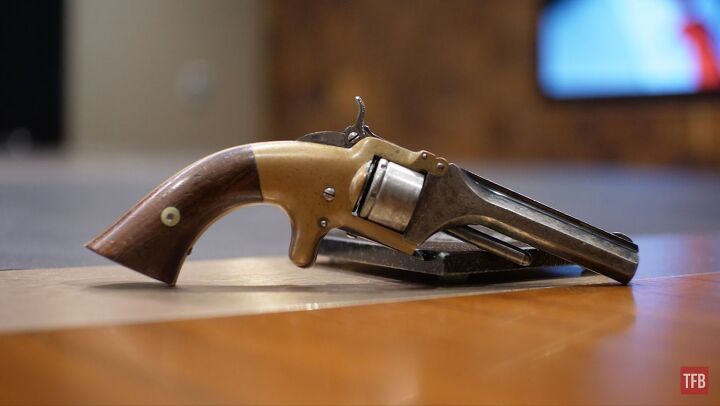
Hello and welcome back to another edition of The Rimfire Report! This week, I’ve got something a little different than our typical run of ammo and gun reviews. A few weeks ago, I was able to visit the modern-day Smith & Wesson facility in Maryville, Tennessee. While the sheer scale of their new operation and upcoming on-site training facility were certainly captivating, the highlight of the trip, for me, was a rather unexpected and insightful presentation delivered by firearms researcher and historian, Mr. Mike Helms. Mike came prepared with a great presentation along with rare examples from his own Smith & Wesson collection, including his very own Smith & Wesson Model 1, first issue, serial number 5. A chance to get to touch and look at such a rare firearm was an opportunity I couldn’t pass up, so I took some extra time to snap a few photos and pick Mike’s brain for a bit while we had the revolver out. Today, I’ll share some of the most interesting facts about this unique and historically significant firearm for both Smith & Wesson and the firearms world itself.
More Rimfire Report @ TFB:

The Rimfire Report: Up-Close With a First-Issue S&W Model 1
First off, who is Mike Helms? Mike is a highly respected firearms historian, author, journalist, collector, and all-around good guy. Mike has a particular focus on Smith & Wesson and the rise of the cartridge-load revolver during the 1850s and 1860s. His expertise extends across firearms history from the late 18th to the 20th century.

Beyond his written works and lectures, Mike is also probably well known to others due to his television appearances, including his notable presence in Season 14 of the TV show Swamp People. His passion for advancing the study of arms history as a legitimate and important fields is very apparent from just a few moments of talking to him - but we got a whole 30 minutes for him to break down S&W’s pedigreed history with firearms, with a good chunk of that focusing on today’s core topic - the Model 1 - serial number 5.

The S&W Model 1 - The First of Many
Mike's presentation featured a rather rare display of his personal collection, including highly sought-after gems like the fabled Registered Magnum and one of only two copper-plated Olympic competition revolvers. However, as I mentioned before, the gun that stole the show for me was his personally owned Smith & Wesson Model 1 – serial number 5.

For those unfamiliar, the Model 1 can be considered the foundation of modern firearms, representing the company's first firearm and the first commercially successful revolver to use self-contained rimfire cartridges. Its introduction in 1857, designed to fire the .22 Short cartridge, revolutionized personal firearms by offering a practical, easy-to-load alternative to the prevalent percussion cap systems. The foundation for this innovation was an exclusive license Smith & Wesson secured for the Rollin White patent, which granted them a near-monopoly on the cartridge revolver market until 1868.


Serial Number 5
What made Mike's Model 1, serial number 5, so extraordinary was its incredibly low position in the manufacturing sequence (obviously). The earliest months of the second Smith & Wesson partnership (established November 18, 1856) were slow, with a working prototype only appearing in March 1857, and by November of that year, only five working firearms had been produced. To hold a firearm that was among these very first off the production line, a direct link to the very inception of Smith & Wesson as we know it today, is a rare opportunity for any firearm geek, let alone a rimfire nerd like me.

We were incredibly fortunate to be allowed to handle this piece of history, though Mike very kindly requested that we refrain from moving the action or dry-firing it. Given its age and the inherent risk of damage to a literal firearms artifact, I was more than happy to oblige. Mike was also generous enough to allow me to take all the photos featured in this article, truly making the experience unforgettable. While it would have been great to get to shoot the Model 1 (like we did with the Registered Magnum), the Model 1 used 22 Shorts, which at the time were not nearly as powerful as today’s modern 22 Short examples from CCI - meaning it was best to not shoot the gun lest we risk damaging it - though, he did demonstrate the very unique two-piece hammer and operated the action for us (very carefully).


Model 1 Issues & Commercial Success
During our brief aside chat, Mike explained how these early Model 1s, particularly those within the first few hundred production numbers, exhibit subtle variations and hand-fitting indicative of their pioneering manufacture. Mike’s research suggests that this particular Model 1, being from the 1st Variant (serial numbers 1-213) of the First Issue, is believed to be the earliest surviving Smith & Wesson revolver from 1857, potentially serving as a tool room sample used for creating the tooling for future Model 1 production.

As with any commercially successful firearm, the Model 1 underwent significant evolution, passing through three distinct " issues" and over twenty different variations during its 25-year production run, many of which pose a challenge for collectors. The earliest, like this example, fall into the First Issue category, produced between 1857 and 1860. Despite initial production challenges, 1858 marked a breakthrough year with over 2,500 Model 1 guns sold, attributed to its ease of use and compact size.

The success of the Model 1 led to the construction of a purpose-built factory starting in late 1859, and a significant redesign (known as the 2nd Issue) in 1860 to streamline mass production. Its design, while simple by today's standards, was groundbreaking for its time, ushering in an era of practical cartridge-firing handguns and firmly establishing Smith & Wesson as a major player in the firearms industry. The Model 1's success directly contributed to the company's ability to develop larger and more powerful firearms, eventually leading to legendary designs and the modern masterpieces we see from S&W today, including my favorite - the modern 686 Plus.

Closing Thoughts
My visit to S&W, and particularly Mike Helms' presentation, was a stark reminder of how far firearms technology has come, but also a good look back at the foundational pieces that paved the way. As someone who has developed a very pointed interest in historical rimfire firearms over the last 6 years, I was both happy and humbled to see this pristine example of a Model 1. After all, it’s not every day you get to touch a foundational piece of firearms history.

I will be having a nice chat with Mike in a future episode of TFB’s Behind the Gun Podcast. If you’re like me, and you want an even deeper dive into the actual operational history and fascinating story of how Mike discovered the truth behind personally owned Model 1 – serial number 5 – be sure to tune into an upcoming episode of TFB's Behind the Gun podcast, featuring Mike himself! Until then, let me know your thoughts on the Model 1 in the comments below, and as always, thanks for stopping by to read The Rimfire Report, and we’ll see you all again next week!

Reloader SCSA Competitor Certified Pilot Currently able to pass himself off as the second cousin twice removed of Joe Flanigan. Instagram: https://www.instagram.com/ballisticaviation/
More by Luke C.








Comments
Join the conversation
It’s tiiinnnyyy