The Rimfire Report: Beretta Olympia – The Dual-Action Italian Trainer

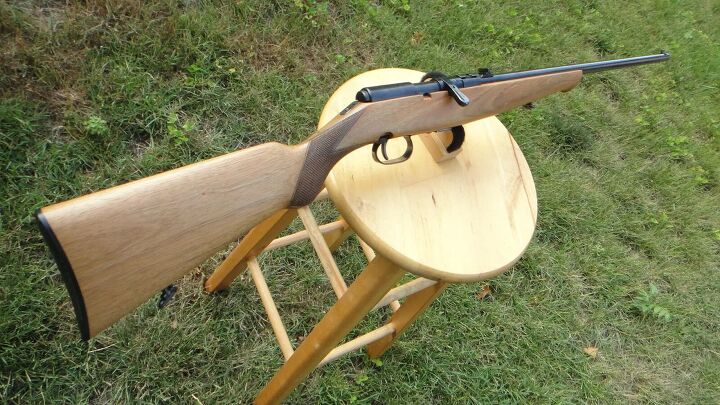
Hello and welcome back to another edition of The Rimfire Report! This ongoing series is all about the rimfire firearm world, its many guns, and, of course, all the other cool topics surrounding one of my all-time favorite cartridges. This week’s subject comes courtesy of yet another GunBroker Auction gun that sparked a bit of digging. When it comes to rimfire rifles with true historical character, the Beretta Olympia .22LR is an almost entirely unique firearm when compared to today’s world of semi-auto plinkers. The Olympia’s claim to fame is its ability to function as both a semi-automatic and a bolt-action rifle, giving shooters two ways to train all contained within one very handsome “classical target weapon.”
More Rimfire Report @ TFB:
- The Rimfire Report: New Distributor Exclusive Ruger 10/22 Rifles
- The Rimfire Report: CCI 22 Shot Shell In Clear Ballistics Gel
- The Rimfire Report: An Examination of CCI 22 Shot Shell (Rat Shot)

Origins: A Rimfire Rifle for Soldiers
Most of the information for this article I have gleaned from the free-to-download Beretta Olympia Manual. If you’re at all interested in digging into the rifle’s nuts and bolts yourself, you can download a copy of it here. The Olympia was designed in post-WWII Italy, when every major European army was searching for ways to make training efficient, affordable, and practical for new recruits. Rather than burn through expensive service ammunition, Beretta developed the Olympia as a .22LR trainer for soldiers—a platform to mimic the feel and handling of centerfire bolt actions and carbines, but with much less noise and recoil for those raw recruits.

You can see the military DNA in its stock lines and robust action, which mimics a lot of bolt-action and semi-auto service rifles of the time. Some say that the Olympia somewhat mimics the Egyptian Hakim rifle, which Beretta coincidentally manufactured Olympia rifles for.

Beretta also makes the very similar but slightly different Beretta Super Sport 22LR. The Super Sport Carbine had slightly different checkering, sights, stock contour, and bolt handle. Aside from that, both rifles had user-adjustable triggers, came with one 5-round magazine and one 10-round magazine, and also required no tools for takedown and cleaning with the included cleaning rod.

Mechanics: Bolt Action and Semi-Auto, By Design
The true reason for the Olympia’s enduring reputation lies in its mechanical party trick—the ability to switch, at will, between semi-automatic and manual bolt-action operation. The reason for this odd action was the Italian Army’s demand for a versatile trainer that could cover both semi-auto duty and bolt-action duty. While the rifle itself has military roots, for me the most interesting thing about the Olympia design is its wonderfully simple yet effective way of achieving the versatility it is lauded for.
In semi-auto mode, firing a round cycles the bolt using the recoil spring, ejecting the spent shell and feeding the next round from the magazine - literally like any other gun. Simply rotating the bolt downward, as you would when closing the bolt on any bolt-action, allows you to run the rifle in bolt-action mode. The bolt can simply rotate slightly more into a special recess carved inside the receiver. This disables the automatic cycling, meaning each shot requires a manual lift, pull back, and slam forward of the bolt—accompanied by that uniquely satisfying mechanical sound. Essentially, you replicate the operation of Italy’s service rifles, round by round, as intended for precision training. Unlike most rimfires, where the mode is fixed by design, the Olympia’s hybrid system offers genuine choice that requires no tools to switch and, most importantly, does it without breaking the bank with an expensive and complicated mechanism.

(Alleged) Reliablity
Unfortunately, I’ve never had the opportunity to get my hands on, let alone shoot, an Olympia rifle. However, according to a few different online sources and videos, on the range, the Olympia apparently feels exactly like what you’d expect from Beretta’s mid-century craftsmanship. The thick bull barrel adds heft, soaking up the negligible recoil of .22LR and lending stability for offhand shooting. Most owners claim they can get sub-1” groups at 50 yards with quality ammo, which is not unheard of for rimfire rifles of the era, with many noting that their well-aged rifles have particularly good triggers for a military trainer - probably thanks to that adjustability I mentioned earlier.

A lot of reliability for rifles of the time came down to magazines. Magazines are usually 5 rounds with 10-rounders available as well through Triple K Manufacturing (incorrectly listed as the “Olympic”). Most examples you will find today will be missing one or both magazines; they’re not as common as Ruger spares, but getting by with one isn’t a chore, especially if you’re intent on slow-fire, deliberate shooting with one 5-rounder. Most shooters note that they typically get solid reliability, even with old-stock magazines and a variety of ammo. Malfunctions are rare, cleaning is uncomplicated, and almost every owner’s review mentions a sense of mechanical refinement that makes the rifle satisfying to shoot in either mode.

Collector Status, Value, and Availability
The Beretta Olympia has earned a reputation not just as a versatile military training rifle but as a sought-after rifle for its shootablity, and more importantly, as a collector’s item due to its unique dual-action mechanism and historical military pedigree. No longer in production, clean and well-maintained examples are relatively rare but not unheard of. Many examples were imported by various state-side importers over the years, and virtually all examples found today will have the importer markings, typically J&G Sales, as well as PW Arms here in the States. However, original serial numbers will still give you the ballpark date for when your particular example was made.

To get a rough estimate on the gun’s current value, I took a look at some recent online auction records and sales data. Even a brief search shows the Olympia typically commands prices in the range of $700 to $900 for rifles in good to very good condition, sometimes accompanied by original magazines and accessories (factory Beretta diopter sights are highly sought after). An example from a 2024 auction sold for around $700, and this example wasn’t even in pristine condition.

Goes to show that if it’s rare enough, even rifles with some wear and patina can sell for much more than their actual material value. Smaller dealers and surplus outlets occasionally offer the Olympia for as low as $330 to $450, particularly if the finish shows signs of use or if the rifle includes limited accessories. In terms of availability, the Olympia can occasionally be found in the United States through specialty firearm auctions, collector exchanges, and online marketplaces such as GunsAmerica and auction houses specializing in surplus military arms.

Final Thoughts: The Duality Done Right
GunBroker has once again served as the inspiration for yet another bucket-list rimfire gun I’ll have to track down and review for myself. It’s interesting to see a unique design like this that dates back to the 50’s and is not just ingenious in its design for its ability to switch firing modes at will, but for its absolute simplicity of design, making it an affordable option for the post-war era Italian military.

I’d be interested to hear if you’ve ever owned, shot, or bought one of these. Does it live up to its online reputation of being extremely accurate and reliable? Do you think they are worth the current going rate for one of these unique rifles? Let all of us know your thoughts down in the comments, and thanks as always for stopping by to read The Rimfire Report! We’ll see you all again next week!

All image sources are hyperlinked
Reloader SCSA Competitor Certified Pilot Currently able to pass himself off as the second cousin twice removed of Joe Flanigan. Instagram: https://www.instagram.com/ballisticaviation/
More by Luke C.






Comments
Join the conversation
Affascinante