Precision Grenadier System - Northrop Grumman and Barrett Team Up


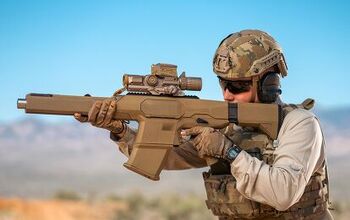
Northrop Grumman and Barrett Firearms have entered a teaming agreement to produce the weapon portion of the Precision Grenadier System, a shoulder-fired 25mm grenade launcher. Northrop Grumman is advancing the PGS and its accompanying ammunition development to address domestic and international customer needs, and the stated purpose of the alliance is to get the capability to the warfighter faster.

The division of labour is clear. Northrop Grumman leads PGS prototyping and 25mm ammunition development. Barrett manufactures the weapon and integrates the inductive setter, the component that lets the warfighter program Northrop Grumman's 25mm ammunition. Barrett will produce the PGS weapon at its facility in Nashville, Tennessee. Both companies bring proven expertise in commercial and military weapons production, and the combination is meant to enable rapid innovation and delivery to domestic and international allies. The agreement was marked with a signing between Bryan James, CEO of Barrett, and Jenna Paukstis, Vice President and General Manager of the Weapon Systems Division at Northrop Grumman (see above).
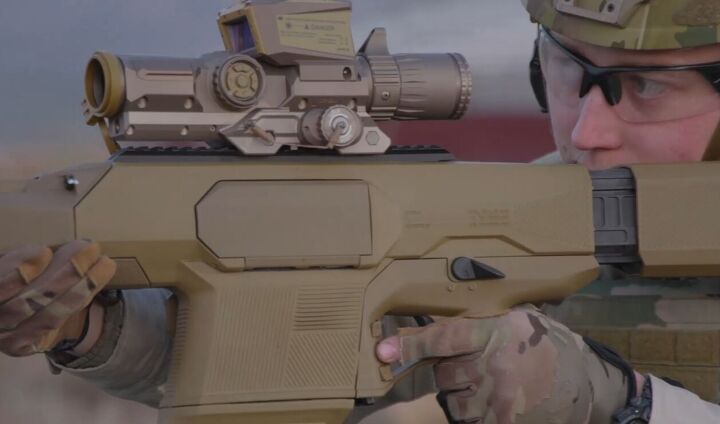
So what is the weapon actually for? The PGS is a shoulder-fired 25mm grenade launcher that gives the infantry squad a way to defeat targets in defilade, fight in close quarters battle, and engage small unmanned aircraft systems. Those are three very different problems. Defilade means an enemy behind cover, where a flat-trajectory rifle round has nothing to hit, and an airbursting projectile can reach over or around the obstacle instead. Close quarters battle means rooms, trenches and breaching, where a precision explosive round is the wrong tool entirely. And sUAS means small drones, which have become one of the hardest targets an infantry squad faces, since they are small, fast, often overhead and frequently out of effective range for small arms.

The ammunition suite is where those jobs get solved. The High Explosive Air Burst round is programmable and carries a dual warhead, and it can be fired in airburst or point detonate mode, which is the counter-defilade answer. The High Explosive Proximity round incorporates a proximity sensor that identifies the target and fragments the projectile in flight to defeat stationary or moving UAS, and it needs no programming at all, so the shooter does not have to dial anything in while a drone is moving. The Close Quarter Battle round is a buckshot load for breaching, room clearing, trench clearing and close-range counter-UAS work. A Target Practice round completes the family as a low-cost inert trainer, ballistically matched to the HEAB and proximity rounds, which keeps training realistic without burning through expensive live ammunition. Is a programmable airburst round worth the complexity at squad level?

In terms of production, Northrop Grumman points out that its position in advanced medium-caliber ammunition lets the PGS leverage existing automated production lines for the airbursting, proximity and close quarters rounds, which should help with both cost and volume if the system reaches full production.
TFB has covered the Northrop Grumman PGS previously, and we have also looked at Barrett's Squad Support Rifle System, the company's own earlier entry into the PGS space.

Northrop Grumman Precision Grenadier System in brief:
- Shoulder-fired 25mm grenade launcher for the infantry squad
- Defeats targets in defilade, supports close quarters battle, engages small UAS
- Northrop Grumman leads prototyping and 25mm ammunition development
- Barrett Firearms manufactures the weapon and integrates the inductive setter
- Weapon production at Barrett's Nashville, Tennessee facility
- High Explosive Air Burst: programmable dual-warhead fragmenting round, airburst or point detonate
- High Explosive Proximity: proximity-fused anti-UAS round, requires no programming
- Close Quarter Battle: buckshot round for breaching, room and trench clearing, close-range C-UAS
- Target Practice: inert trainer ballistically matched to the HEAB and proximity rounds
Is 25mm the right caliber for a shoulder-fired squad grenade launcher, or would you want something larger?
Photo credit: Northrop Grumman and PGS video.
Ex-Arctic Ranger. Competitive practical shooter and hunter with a European focus. Always ready to increase my collection of modern semi-automatics, optics, thermals and suppressors. TCCC Certified. Occasionaly seen in a 6x6 Bug Out Vehicle, always with a big smile.
More by Eric B



Comments
Join the conversation
This doesn't have an underbarrel rifle?
Unfortunately China way ahead of us with their qlu-11 grenade machine gun. 15-rounds and it shoots 40mm HV. It's only downside is it has to be fired from the prone or emplaced but this might be too little, too late. 25mm has a more limited payload, but if its main use-case is precise counter-defilade it should work just fine.