NSWC Crane’s New Drone Killer Cartridge (DKC) Technology

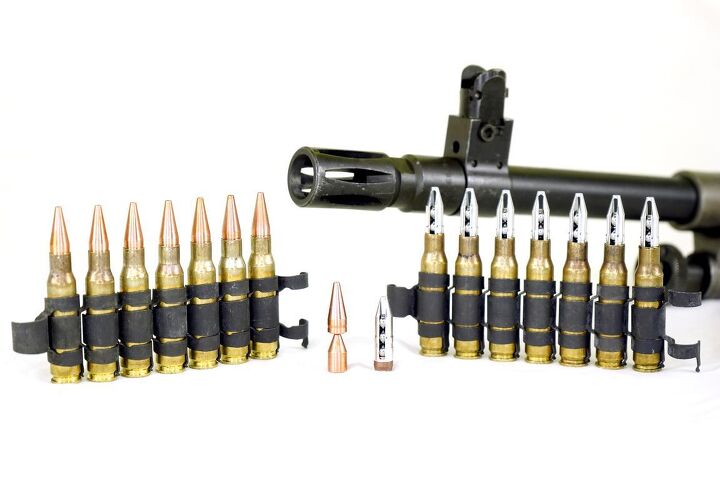
Multi-projectile cartridges for anti-drone warfare are arguably the most rapidly developing type of small arms ammunition, with new options being introduced throughout the world at a frequency unseen before. Last week, we took a look at the latest multi-projectile cartridges developed in Russia, Switzerland and Lithuania. Well, the United States Naval Surface Warfare Center Crane Division (NSWC Crane) has been working on this type of ammo too and has just recently announced its new Drone Killer Cartridge (DKC) ammunition technology.
Anti-Drone Devices and Ammunition @ TFB:

The NSWC Crane DKC ammunition has two flavors: Pelletized and Segmented. The projectile of Pelletized DKC ammunition is a row of tungsten alloy pellets encased in a discarding sabot. The Segmented DKC ammunition has a one-piece projectile that breaks inside the bore into several spin-stabilized sub-projectiles.


The primary advantage of the DKC technology over shotgun ammunition is its greater range. Additionally, this ammunition is designed to be used in standard-issue firearms with no modifications, so there is no need to have a separate dedicated anti-drone weapon or attachments. The Drone Killer Cartridge is also advertised to be an affordable technology. In the pictures published by NSWC Crane, we can see 5.56x45, 6.5 Creedmoor, 6.8x51, 7.62x51, 9x19, .338 Norma Magnum and .50 BMG DKC cartridges; however, this technology is scalable and can be applied to other calibers and cartridges. According to NSWC Crane, during a recent demonstration at Camp Atterbury in Edinburgh, Indiana, DKC achieved a 92% success rate against drone targets.
All DKC products are U.S. Government-owned intellectual property with U.S. nonprovisional utility patent applications and Patent Cooperative Treaty applications on file. The Drone Killer Cartridge technology is available for licensing to commercial ammunition and defense manufacturing. To learn more about the licensing, visit TechLink.

NSWC Crane is a naval laboratory and a field activity of Naval Sea Systems Command (NAVSEA) with mission areas in Expeditionary Warfare, Strategic Missions and Electromagnetic Warfare. The warfare center is responsible for multi-domain, multi-spectral, full life cycle support of technologies and systems enhancing capability to today's Warfighter.
Pictures by Naval Sea Systems Command, www.navsea.navy.mil
Managing Editor Being a lifelong firearms enthusiast, Hrachya always enjoys studying the history and design of guns and ammunition. Should you need to contact him, feel free to shoot him a message at Hrachya@TheFirearmBlog.com
More by Hrachya H


![[SHOT 2026] UDC M-PACT Metal Injection Molded (MIM) Cartridge Cases](https://cdn-fastly.thefirearmblog.com/media/2026/01/22/20341/post.jpg?size=350x220)

![[SHOT 2026] Winchester SXR2 Semi-Auto Rifle Keeps The Fudd Dream Alive](https://cdn-fastly.thefirearmblog.com/media/2026/01/21/15091/post.jpg?size=350x220)


Comments
Join the conversation
Almost all targets were stationary. You can hit stationary targets with regular bullets. Target identification and aim-assistance will drive actual hit probability. Increasing amount of metal in the air helps, but only so much.
How about a 10 gauge firing 3.5 inch shells out of a 36 inch barrel? With modern technology felt recoil could be reduced to manageable levels. A semi automatic with a long magazine tube should but a lot of large size pellets into the air or a semi automatic with a magazine such as Mossberg is making now.