Fudd Friday: The Brush-Busting Question

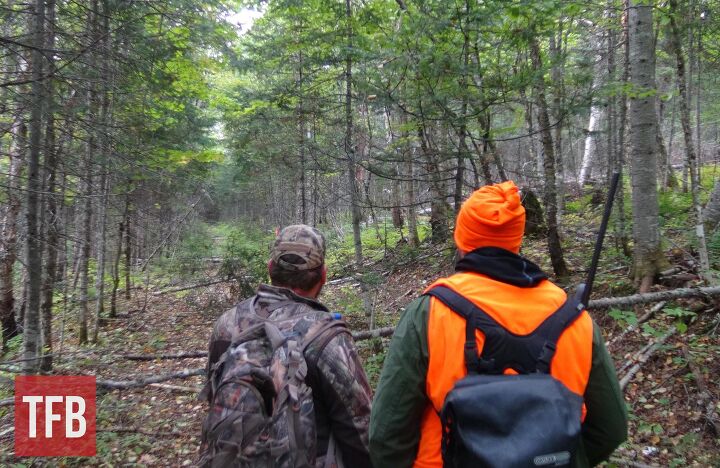
Our four-man party was four days into moose season on the Quebec-New Brunswick border. It had been a lot of hard hunting that week; I’d missed a chance at a smasher bull in the opening minutes of the season when I couldn’t pick him up in my scope. We’d covered a lot of miles on foot since, some of it through rainy weather, and the nights had dropped well below freezing even though it was only September. We’d passed on several cows and a young bull, but as day followed day, it looked like my dream of a big bull was never going to happen. And then it all came together, in the way that every hunter dreams of—and it almost fell apart right away, too.
Retro fudd firearms @ TFB:
Quebecois guide Jason Tremblay had joined our party for the afternoon, since his client had already tagged out, and within minutes he had us on a big bull. It was my tag, and I shot first, squeezing a shot off from the 7mm Magnum when I had the crosshairs on the moose’s sternum—and nothing happened. Well, something happened—a stump directly to the left blew up as the bullet hit it. I’d been so busy shooting at the moose that I hadn’t considered the bush in front of me, which had apparently deflected the round.
Unhappy with this turn of events, I stepped sideways around the bush and racked another round in the Remington. I aimed another slug into the same spot on the bull's chest, and my brother-in-law sealed the deal with a .308 through the ribs (and a good thing, too, as my second shot had hit square but the bullet had shattered on impact—we picked pieces of copper jacket from our meat all winter).
The moose was dead within minutes, and our hunt ended on an incredible high—and forever drove home the lesson to me that when you’re in the woods, a single errant twig can make or break your hunt.
An age-old problem
Modern outdoorsman ethics mean that most hunters only shoot at stationary animals when they have a clear shot path. But for generations, this wasn’t how it worked; hunters pursued deer or other game on foot, instead of sitting in a stand, and they took the shots that they had, not the shots they wanted.

The Benoit family from the northeast would be a good example of this style of hunting, pursuing big bucks on foot across Maine or Ontario. When you’re hunting like this, you might only have a split second to get a shot off that will make or break your season. Under those conditions, you can easily miss seeing a twig that deflects your bullet enough to turn a solid hit into a clean miss—or worse, a wounding shot that results in a tracking job of hours or days, sometimes without success.
Testing the supposed solution
When I was a young hunter, the commonly accepted wisdom to deal with this scenario was to use a so-called “brush-busting” round. Locally, many guys I knew went to a .30-06 for this reason; they figured it had the power to push through bush and smash a buck. Other friends espoused the .45-70; supposedly, the heavy .45-caliber slugs would be less likely to be knocked off-course by a branch.
But none of them ever tested this theory scientifically, and I was quite interested when I recently read Francis E. Sell’s 1980 book Art of Successful Deer Hunting (a reprint of an older title originally called The Deer Hunter’s Guide). Sell hunted deer on foot for many years, very successfully, and attacked the brush-busting question as scientifically as possible. He set up tests where he fired at targets behind bushes and measured bullet deflection afterwards.

The obvious problem with his experiment is the variable density of the bushes he was shooting through—it’s a variable that you can’t really control properly. However, he at least laid the groundwork to learn basic principles about whether or not any rifle rounds can actually be considered brush-busting, with less deflection when fired through a bush when compared to other rounds.
Sell blasted away with a very wide range of cartridges, trying to determine the optimum bullet weight and shape, as well as velocity. His findings: A velocity between 2,200 and 2,500 fps deflected the least, and was also less likely to have the bullet blow up when hitting a branch or twig. He found that a bullet weight of 150 grains or heavier also made a big difference. He did not note any significant difference between different bullet shapes, and also did not note any difference resulting from bullet diameter—6.5x55 and .270 performed well, along with cartridges using .30-caliber and even .35-caliber bullets. He did, however, note a test where 500-grain .45-70 bullets performed inconsistently in his test, with two bullets “screaming off into the forest” when fired at a target through brush, and then the next two bullets showing no deflection at all.
Funnily enough, Sell noted that high-velocity, high-performance cartridges fared poorly in his brush-busting experiments. Conversely, the .30-30 performed very well in his test, particularly when loaded with a 170-grain bullet. This book was written off experiences that happened 50 years ago, and back then, you heard the same tropes you do now: Fans of performance and modernity sneered at the .30-30 as being old-fashioned, while faithful fudds still used the cartridge due to its excellent real-world performance. In the 2020s, we’re still seeing that argument play out.

The bottom line
I think it’s good that modern hunters are taught to be more careful with their shots; it’s good to see improved safety and less wounded game. But as hunters increasingly move towards stand hunting, I do miss the mindset of pursuing game on foot—some of my best deer hunting memories come from days that I never got a shot off, but I spent hours pursuing tracks in the woods and swamps around my home, always hopeful. But if you hunt that way, you do run the risk of things going wrong when an errant bullet gets put astray by twigs or branches between you and your target.
My takeaways are this: First, as a hunter, you need to always consider what happens if you miss. Missing a shot at a skylined deer due to brush deflection could be fatal, but not for your intended target. Or hitting a black bear in the guts might mean a long night of tracking a dangerous animal that will be in a most unpleasant mood when you finally close in. If you can avoid brush-busting shots, do so.

But, like in my opening story, sometimes stuff happens. Thankfully, that story ended safely and with an easily-retrieved animal, but part of that success was due to being ready for quick-but-careful follow-up shots. You should always be ready to shoot until the job is done, and the same goes for your hunting partners.
And finally, don’t expect folk wisdom to automatically solve the brush-busting problem for you. Sell’s experiment showed that muzzle energy alone won’t brush-bust, or magnum calibers would have performed tops in his tests, which wasn’t the case. And don’t expect heavy bullets will automatically solve the problem either, as his experiences with .45-70 rounds showed. A sensible rifle with a sensible load might be the best solution for your hunting scenario—but maybe the best thing is to take some targets into the woods with the rifle you already have, and figure that out for yourself.
Professional hoser with fudd-ish leanings.
More by Zac K


Comments
Join the conversation
More recent testing shows modern spitzers showing less (but still considerable) deflection than brush busters.
Do you recall if the .45-70 Sell was using were old school round nose lead or modern flat nose copper jacketed? I would think there'd be a significant difference in post-impact behavior between a jacketed bullet and what's essentially a super spicy musket ball.
A brushbusting test could easily be conducted scientifically, at least as far as comparing different loads/bullets by using the same metrics for all; use a specific range to a paper target, zero a gun to that range in a bench rest and note the average group size, then put a row of cheap disposable chopsticks from a specific maker standing up in a 2x4 with holes drilled in it at a specific distance between gun and target and shoot more groups, noting how the size changes.