Wheelgun Wednesday: Silencing the Gap - Part 3


Welcome back to Wheelgun Wednesday, our weekly article series where we cover everything related to revolvers. Today’s topic is the technical challenge of effective sound suppression of revolvers. In Part 2 we looked at “Gap Sealing Cartridges”, now we’ll investigate the most exotic solution: “Silent Cartridges”.
Wheelgun Wednesday @ TFB:
Wheelgun Wednesday: Silencing the Gap – Part 3
Concept
This week we look at the third of our arbitrary categories of revolver silencing solutions: the “Silent Cartridges”. This is by far the most advanced and unobtainable option, born for very specific military needs and therefore inexistent, and likely not legally replicable, on the civilian market.
These cartridges are known for employing a captive-piston design, which, unlike Anton Chigurh’s Captive Bolt Pistol, propels a projectile towards the target, ideally with no release of high-pressure gas. The whole concept of the cylinder gap being a hindrance to suppression is completely eliminated, and the firearms shooting these rounds do not even need a silencer to drop their sound signature!
This feat is accomplished with the aforementioned piston: upon firing, the ignition of the powder load drives forward, within the case, a piston that imparts momentum to the bullet (or payload), the piston then seals the expanding gas inside the case by lodging itself in the mouth of the shell.
While the noise reduction gain is fairly obvious, the disadvantages are limited ballistic performance and the risk of putting back in the holster something that is now a potentially unstable pressure vessel.
Let’s have a look at the two most known uses in revolvers of this concept.
American noiseless cartridge
The US Army investigated quite a few designs for silent cartridges, mostly during the Vietnam War. Some of these designs (such as the Teleshot for 12 Gauge shotguns) employed an expandable membrane propelling the projectile(s) and sealing the gas in the case, while others adopted the piston approach.

The most famous cartridge, and most relevant to us, is the one developed by AAI for the Quiet Special Purpose Revolver (QSPR). The firearm is an S&W 29 with a .40″ barrel brutally chopped to about 1.4″ in length, the cylinder bored out to accommodate the large diameter case, and left with paper-thin walls, as the pressure-bearing task is accomplished by the case.

The role of the revolver was arming the “tunnel rats” tasked with the not-so-enviable mission of clearing the enemies’ tunnels. The lack of blast was therefore beneficial, while the very close combat scenario did not require accuracy and performance over longer ranges. The captive-piston cartridge therefore shoots a buckshot load of 15 tungsten balls at about 750 fps from the smooth .40″ caliber barrel.

The noise level is reportedly comparable to a suppressed .22LR pistol.
Russian Silent Round
Probably the most famous, and most adopted, silent cartridge family was developed in Russia. Since the 1960s the Soviet Special Forces have been equipped with a variety of firearms adopting captive-piston rounds. One of these, the 7.62×42mm SP-4, saw its use in a very peculiar revolver, the OTs-38, designed by the famous firearms designer Igor Stechkin.
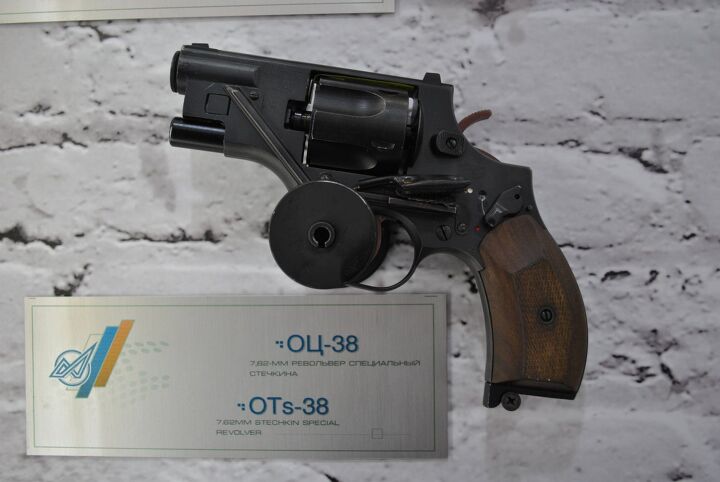
Yours truly had the chance to handle one of these revolvers (no firing, unfortunately), apparently still marketed to Russian-friendly nations up to at least 2017. Besides the low barrel topped by a laser sighting device, odd side swinging cylinder opening, and the presence of a safety lever, everything else on the OTs-38 feels normal, the magic is all in the cartridges.

The gap between the cylinder and the barrel, now no longer a concern, is visibly wide, but what catches the attention is the gap between the cylinder and the recoil shield. However, the rounds, held by full moon clips, due to their pressure-bearing design, are thick and solid so any unsupported area is perfectly safe. The action SA/DA, although potentially neutered for the exhibition floor, felt quite good, much better than expected. On a side note, the trigger and the hammer had a very odd-looking finish, almost plum color.

The 7.62×42mm SP-4 cartridge is the quintessential captive-piston design: an aluminum alloy piston, pushes the bullet forward, while keeping it centered, and then stops its travel in the neck of the case, preventing leakage of the expanding gas. The bullet is basically a mild steel rod, quite long to benefit as much as possible from the push from the piston. The projectile has a driving band up-front to engage the riflings. It should be noted that as soon as it disengages from the piston, the bullet is slowing down in the barrel, which looks to be around 1.7″ long.

As for the QSPR, the noise level is reportedly comparable to a suppressed .22LR pistol, while at close range the ballistic performance is likely in the .380 ACP range.
Conclusions
What do you readers think about these cartridges? Would you pay a tax stamp on each of them, just to be able to shoot the most compact, quietest firearm? Do you think there are other ways to achieve this result without angering the authorities? Maybe a solution based on compressed air?
Do you know of other examples of captive piston designs that we did not mention?
As usual, let us know in the comments.
Italian firearm enthusiast, Giorgio has a passion for innovative or plainly unusual mechanical solutions. He's also interested in manufacturing technologies with a recent focus on additive manufacturing.You can contact him at giorgio_o at zoho dot com and you'll find him in the comments section as Giolli Joker.
More by Giorgio O


![[SHOT 2026] Daniel Defense DD4 X1 Will Take Them To The Next Level](https://cdn-fastly.thefirearmblog.com/media/2026/01/21/15211/shot-2026-daniel-defense-dd4-x1-will-take-them-to-the-next-level.jpg?size=350x220)


Comments
Join the conversation
Knights Armament made the best of the silenced revolvers using a Ruger Redhawk and specialized telescoping ammo.
These are, in fact, very quiet. Also consider that some force on force marking rounds use this mechanism, but the companies try to avoid selling them to the public, perhaps due to the weird legal gray area.