Silencer Saturday #432: KAC Silencer Design Theory

Good afternoon, everyone, and welcome back to TFB’s Silencer Saturday, brought to you by Yankee Hill Machine, manufacturers of the new Victra 20-gauge shotgun suppressor. This week, we are taking a look at some interesting information from Knight’s Armament Company about their silencer designs. They even included a patent that helps control first-round pop.
Silencer Saturday @ TFB:
- Silencer Saturday #431: What Other NFA Rules Could Be Changed?
- Silencer Saturday #429: New Things At NRAAM 2026
- Silencer Saturday #428: Should You Run A Silencer In Competition?
- Silencer Saturday #427: 2026 ATF NFA Data
- Silencer Saturday #426: Mid-bore Rifle Silencers
Images from KAC or public patent filings
“Intro to KAC Suppressor Design Concept”
KAC released a nine minute YouTube video that starts out with some Knight’s silencer history. They show off some of the classic models like the M16 Navy, M110, and M9 Snap On. No silencer nerd would complain about some gratuitous pictures of the legends, so thank you Knight’s for providing them. Here are a few of those in still image format for your viewing pleasure.


The video goes on to describe the various KAC silencers, their features, and how they differ from earlier models in the lineup. Along with the expected marketing angle, which highlights the benefits of a Knight’s silencer as compared to the rest of the market, the video also digs into some more general suppressor knowledge and theory. For example, they describe the internal volume of a silencer as being roughly analogous to horsepower. More internal volume means more potential performance. Displacement may have been an even better example, but horsepower is more readily understood by most people.
Another topic that receives a good overview is backpressure. Rather than a simple surface-level “extra backpressure is bad” explanation, Knight’s gets into some deeper details. Their silencers do not simply vent gases forwards so they don’t go back up the bore. Instead, they are timed to release most of the gas pressure just after the bullet exits the bore, but before the bolt has unlocked. This timing reduces stress on the bolt by dropping the pressure before the bolt is open, and it keeps the noise at the shooter’s ear at a minimum.
Knight’s Auto-Purge Patent
The most interesting and unique part of the video was the discussion of KAC’s Auto-Purge system and the associate patent. First round pop, AKA FRP, is a well-known phenomenon and silencer design. The first shot is almost always louder than successive shots. FRP is not just an additional noise signature, it also results in extra flash. For people who use their silencers in situations where extra noise and flash can cause incoming fire to focus on their location, FRP is more than an inconvenience.
KAC did research into the causes of FRP and figured out why it happens. FRP is caused by the oxygen within the silencer combusting as the first round ignites it. After that first round has burned off the gases, the successive shots are much quieter. Short of firing your silencer in outer space or filling it with some type of non-combustible gas, it is very difficult to truly eliminate first round pop. Filling a silencer with a nonreactive gas is not very practical, so KAC sought alternate methods of evacuating the oxygen from the silencer.
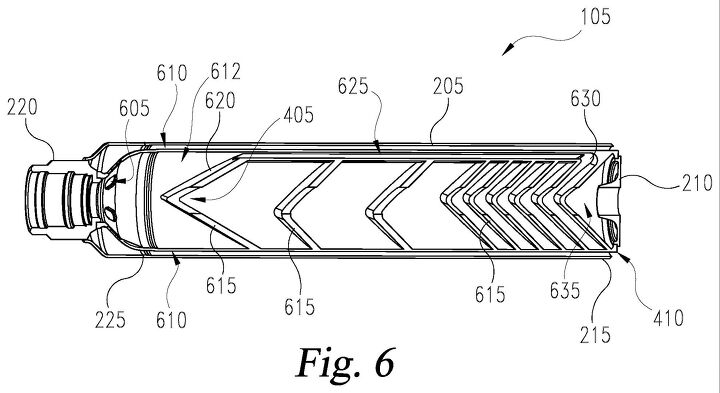
Their solution to the problem is very clever indeed. Knight’s calls it the Auto-Purge system, and it has a patent filing that explains how it works in great detail. The key idea is allowing the expanding combustion gases from the shot to bypass the main baffle stack and get ahead of the bullet before it exits. In this patent image, note the gap with the #1025 label. It is offset from the bore passage:

In Figures 22 and 23 we can make out this gas passage, though the image quality leaves a lot to be desired. Figure 22 shows the bullet in flight passing through the bore of a stylized silencer. #612 and #620 shows the gases following and propelling the bullet. Those gases are expanding to fill the spaces inside the baffles. The real magic is shown at #625. That is the parallel gas route that bypasses the main expansion chambers. Note that the shaded area representing the gas volume is ahead of the projectile at this point.

In Figure 23, we can see that the gas in the bypass route is well ahead of the bullet and is flowing back into the main baffle space from the front. The combustion gases have already done their burning at this point and have little or no oxygen left. Unlike the air being displaced by these gases, there is nothing left to burn up to create added first round signature. This also works for successive shots, or if there is a break in the firing cycle and oxygen is able to build up in the silencer again. Each shot forces the oxygen from the silencer to keep the signature at a minimum.

While this sounds like the typical forward venting seen in most reduced backpressure silencers, this is a purposeful design that requires a lot of modeling and testing to get right. If the bypass gas route is not fast enough, it would not purge the oxygen from the silencer. If it is too fast it risks being unnecessarily loud. Executed properly, this is a very elegant solution that keeps overall firing signature at a minimum while also cutting down on backpressure.
Thanks for joining us for another edition of Silencer Saturday. We are getting to see some really clever designs and there is no indication of that trend being over any time soon. We will see you back here next week for another installment.

SILENCER SHOP – HANSOHN BROTHERS – DEADEYE GUNS
MAC TACTICAL
ALL YHM PRODUCTS AT BROWNELLS
DEALERS: If you want your link to buy YHM suppressors included in future Silencer Saturday posts, email: silencers@thefirearmblog.com
AKA @fromtheguncounter on Instagram. Gun nerd, reloader, attorney, and mediocre hunter.
More by Daniel Y


Comments
Join the conversation
The explanation on the first round pop is a bit misleading. In a rifle, all the powder that's going to burn has done so in the first 1-3 inches of the barrel. You can see it in the pressure curve - around the peak pressure is where this occurs. This means what goes out the barrel (and through the suppressor) is a mixture of super-heated flammable gasses, not still-burning powder. On the first shot, these flammable gasses mix with the oxygen in the suppressor and light off. Muzzle flash is the same thing.
If I understand the explanation correctly, the system is routing some gas around the baffle core, then reintroducing it from the front. This is not a new technique and was incorporated in SCRC silencers as far back as the 1980s. It's possible Knight has modified and refined the process.