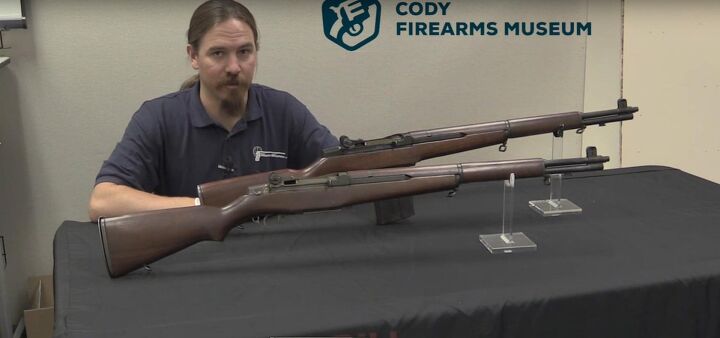
Winchester's Magazine-Fed M1 Garand Variants at the Cody Museum, Courtesy Forgotten Weapons

In the fourth part of the series of articles I am writing on the Lightweight Rifle program of the 1940s and ’50s, we looked at some of the experimental rifles that were being tested and evaluated during and just after World War II as potential replacements for or upgrades to the excellent M1 Garand semiautomatic rifle. The goal of these programs was ambitious: To create a rifle – based on the M1 – that would provide all the functions of the military infantry rifle, submachine gun, and automatic rifle, thereby achieving the “all in one” squad level infantry small arms package. This concept was called the “paratroop rifle”, possibly in reference to the German Fallschirmjeagergewehr (translated: paratroop rifle) FG-42 which itself was designed as an “all in one” weapon for paratroops.
Two contracts were let, one to Springfield Armory, and the other to Remington Arms Co., but Winchester’s CEO Edwin Pugsley also caught wind of these developments and was determined that Winchester would also embark on its own program to create a select-fire, box magazine fed M1 derivative, resulting in an effort that would be led by talented Winchester (and later Ruger) designer Harry Sefried. Two of the prototypes created in this effort are covered in the Forgotten Weapons video below:
While it’s true that Winchester had no formal contract for these rifles, the program to develop a “paratroop rifle” was a formal program, and very nearly resulted in the adoption of a new infantry weapon: Springfield Armory’s T20E2. This rifle was recommended for production in a quantity of 100,000 for the upcoming invasion of the Japanese home islands, and likely would have been standardized as the U.S. Rifle, Cal. .30, M2. However, the atomic bombs ended the war before this could happen, and the program continued as a development program for another 12 years before any of the fruits of its labor would eventually be adopted – resulting in the short-lived M14.
If you’re interested in Winchester’s program to develop a select-fire M1 Garand variant, you can read my article Light Rifle, Part IV: The M1 Garand Learns To Rock And Roll. I also recommend checking out Sefried’s patents on the mechanisms used in these rifles, US2464418 and US2386722.
Nathaniel is a history enthusiast and firearms hobbyist whose primary interest lies in military small arms technological developments beginning with the smokeless powder era. He can be reached via email at nathaniel.f@staff.thefirearmblog.com.
More by Nathaniel F





Comments
Join the conversation
First, here is a direct link to Nathaniel's previous article regarding full-auto M1 Garand variants.
http://www.thefirearmblog.c...
Ian is showing Sefried's second generation of the full-auto conversion, which may explain why its patent was filed so late. The first generation prototype is commonly misidentified as a Garand pre-T20 prototype, but you can't mistake the various design features seen in Sefried's original patent filed in August 1944.
https://www.google.com/pate...
The magazine with the spring-loaded lips was designed by none other than Stefan K. Janson, better remembered for the British EM2 bullpup. Janson left the UK after the EM2 was rejected. The magazine patent can be seen here:
https://www.google.com/pate...
I still remember the day we fired our M-14's for final qualifications. It was bitter cold, snowing/sleet off and on all day. The mags were preloaded for us but were sitting out in the weather so they were iced up as well. The pop-up targets were frozen and if your hit did not knock it down, no recorded hit. You could even see the hole at the 50 yd. one but the scorer was not allowed to count it. Of the 240+ men shooting, 42 bolo's were reported to the battalion C.O. He was livid, of course. These men were taken back to the range and "qualified" a couple of days later. I shot the worst score of my training period that day.....barely qualifying as Marksman. I was as pissed as the C.O. It prevented us from any type of elite training down the line, i.e. sniper school. Loved that old M-l4 though.