How to Choose the Right Optic for You


The right optic is a cornerstone of your firearm. They can add range, reliability, or target acquisition speed. A gun without an optic is like a car without a steering wheel. There are numerous different optics on the market, but how do you choose the right one for you?
Types of Optics
Before we talk about choosing the right optic, let’s take a look at the different kinds of optics on the market today.
Iron Sights
These are metal or polymer sights built into your firearm or attached to your firearm. They contain no electronics or glass. When you aim at an object with iron sights, a decent part of the target is covered by the sights, leading to reduced overall visibility. The rear and front sights need to be aligned for proper shot placement, leading to slightly slower target acquisition. No glass and no battery make them very durable, usually, and they are also economical.

Red Dot Sights
A red dot optic is a non-magnified optic where a red dot (or green dot) is projected onto a lens. Red dots have been around since the 70s, but have recently seen a boon in popularity due to performance and new technology. The optic does not need to be lined up, and the red dot itself takes up less space in your vision, leading to faster shooting. The optic also allows the user to be able to shoot with both eyes open. They are generally considered to be faster and easier than most other optics, and are now more affordable than ever to boot. They are available for rifles and pistols. They are available as open emitter, meaning the emitter is open to the elements, and the optic has one lens, and closed emitter, meaning the optic is fully enclosed from the elements.

Holographic Sights
A holographic sight is similar to a red dot sight, except the reticle is projected via a laser in a much more advanced fashion. The result is a clearer reticle that can be much more complicated. These tend to be better suited to magnify, and for those with astigmatism. They are also heavier and more expensive. A popular holographic sight is the EOTech.

Prism Scopes
A prism scope is a fixed magnification sight. Instead of using an emitter or multiple lenses, it uses a glass prism and an etched reticle. They are simple, durable, and have their advantages and disadvantages. A fixed prism is usually much smaller than a rifle scope, but lacks a zoom function. One of the most well-known prism scopes is the Trijicon ACOG. It is a 4x power sight. Prisms are also available in the 1x variety, which may be beneficial over a red dot optic for someone with astigmatism or who wants to add a magnifier. Prisms do have an eye box, which requires your eye to be at a predetermined distance and location from the lens. I haven’t seen too many people with perfect vision trading in their red dots for 1x prisms, but there is an argument to be made for them. If you can look past the eye box (pun intended), you end up with an optic that doesn't require a battery, and a reticle that is much crisper under magnification than a red dot.

Low Power Variable Optic (LPVO)
An LPVO is a rifle scope that has the ability to zoom from a low power (usually 1x) to a high power (usually 6 or 8x). They add a lot of versatility and performance to a modern sporting platform like the AR-10 or AR-15. The 1x in theory acts like a red dot sight, allowing you to shoot with both eyes open rapidly. The ability to zoom up to 6x allows you to stretch the legs of the 5.56 cartridge much further than a pair of iron sights would allow. At 1x magnification, the field of view and eye relief won’t be as good as a red dot. At higher magnification, depending on the model and price range, the optic may not perform as well as a long-range rifle scope. They can also be heavy, chunky, and expensive. If you have to switch from shooting something at 10 yards to something at 300 yards in 3 seconds, with one optic, there's no substitute, though. The LPVO is seeing a surge in popularity, and we’re beginning to see some models that are usable at lower price ranges. The U.S. military has adopted them in some cases, and many believe they are the future. If you find yourself wanting to build a firearm that’s capable and comfortable in making a 300-yard shot and a 10-yard shot, look into the LPVO.

Rifle Scope
The term rifle scope can be used as a kind of catch-all for any optic mounted to a rifle. Most people usually call an LPVO an LPVO, and a prism sight a prism sight. I usually refer to a rifle scope as a rifle optic with two lenses that is capable of magnifying a target, and having its lowest power being more than 2x. There are a ton of rifle scopes on the market. There are way too many to list in this article. Heck, Leupold has more than 140 scopes listed on their website alone. Rifle scopes help you nail those far-away shots, but aren’t always usable at close ranges. A 3-9x40 scope is a scope that magnifies from 3x to 9x, and the diameter of the objective lens is 40mm. Rifle scopes usually use a physical reticle; the reticle is not projected, and the scope does not rely on batteries, although sometimes batteries are used to augment the reticle. The fact that the reticle is not projected means it can be easier for the human eye to pick up under magnification. They make rifle scopes for specific calibers to compensate for bullet drop, and there’s a wide variety of ranging reticles to choose from.

So now that we have a few different common optic types in mind, let’s take a look at some of the key factors that are probably relevant to your optic-buying decision.
Common Use Cases and Questions to Ask Yourself
Are you planning to shoot at a target from over 50 yards away from a fixed location, such as a hunting blind?
If so, you could benefit from a magnified optic. A magnified optic will allow you to see your target at a distance, and they usually have reticles to help you compensate for bullet drop. Buying an LPVO, prism, or a regular scope will be entirely dependent on your budget and use case. I would look for clarity and quality of glass, reticle options, magnification, eye relief, and focal plane. Usually, if you spend more, you get more. Still, there are budget options on the market that get the job done. Who’s to say you need to spend $2,500 for a scope for a teen's first deer hunting rifle, or an emergency disaster rifle?
Are you planning to shoot multiple targets inside of 50 yards very quickly?
If so, you might want a non-magnified optic, like a red dot, 1x prism, or holographic sight. Look for one with a large window if shooting competition. If the firearm is for defense, you may want to look at an optic that has been adopted by law enforcement and the military. They usually have the budget to torture-test these kinds of things.
Do you have bad astigmatism?
If so, you may want to consider a prism optic or a holographic optic over a red dot if you’re looking for a non-magnified optic. The red dot can bloom into a starburst for those with bad astigmatism, although I hear the green dot is better for those with the condition. The downside to a holographic optic is the price, although they are usually well worth the cost of admission. The downside to a 1x prism is the eyebox, although it is relatively forgiving. Try to look through a few in a store. Different eyes see reticles differently. I don’t have an astigmatism, but if I look directly at a red dot reticle, it will starburst. If I focus on a target and “float” the dot over the target, it’s not an issue, though.
Do you enjoy punching holes in paper on the weekend with your retro build, or an inherited collectible? Do you value reliability over seeing further or acquiring a target faster?
If so, iron sights will probably do the job just fine. An optic will add a ton of performance to a firearm, but that’s not to say that you always need it. There have been many fights and hunts that have been successfully completed with the old pair of trusty iron sights. Some people don’t want to trade in their truck with roll-down windows and analog buttons for one with CarPlay and radar-operated cruise control. I get it. There’s always going to be a satisfaction that comes with nailing that long shot with the old tried and true.
Are you setting up a rifle or pistol for home defense?
What kind of defender are you? Do you set calendar reminders to change the batteries in your optics yearly, or is your firearm collecting dust in some unassuming shoe box at the top of the closet? Do you have a house in the suburbs or live way out in the sticks? Could you get by with an unmagnified optic? Do you have to deal with predators, pests, and possible home invasion? Be honest with yourself about how often you’ll maintain an optic, what level of magnification, clarity, and durability you’ll need, and set your sights on an optic from there. You wouldn’t want to pick up a gun relying on a red dot, just to find out it’s been dead for the past six months.
Are you shooting with night vision?
Does the optic you're considering have a night vision compatible reticle, and are you going to be able to get your tube behind it? Is the optic going to be clear enough for your nods to focus through them, while still being in focus for the outside world?
Are you going to be outside in adverse conditions with your pistol?
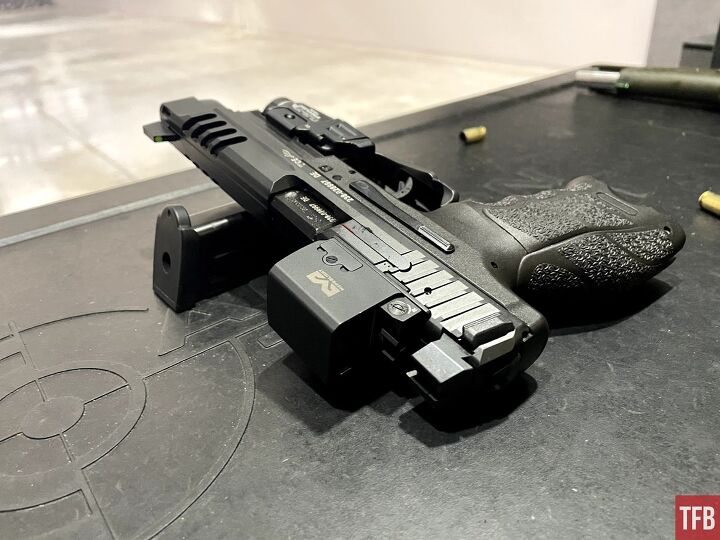
If so, you might want to look into a closed emitter red dot. Open emitters are usually cost-effective, but can go down if a piece of dirt or debris makes its way to block the emitter from projecting. The optic can also act like a little bowl, and pick up t-shirt lint, pollen, and just about anything else that might fall into it. Even an open emitter concealed under a t-shirt will get some gunk and funk on the backside of the lens that you’ll have to periodically clean out.
Other Questions
- Are you going to be lugging the firearm around quite a bit?
- Are you going to be doing a lot of reps where you will be bringing the firearm from low ready to eye level?
- Should you spring for a lightweight option, or are you ok with taking on some more weight?
- Do you need a compact option?
Cost generally indicates the quality of an optic in most cases, or does it?
In today's world, there are always daily deals, new models being introduced, and older refurbished models being sold at a discount. Try to set an amount you want to spend, and look at optics with good reputations within that range.
The Sig Sauer Romeo 5 Gen 2 has an MSRP of around $150. It’s a basic and reliable red dot sight that doesn’t have very many features. The Romeo 9T is also a red dot sight and has an MSRP of around $4,000. Will you be able to benefit from the extra features that a 9T provides? I’ll leave that up to you and your use case.
You can spend a lot of extra money on optic features that you may never use. You can also underspend and get an unreliable mess. I won’t name names, but in college, I bought a super-budget $25 scope that wouldn’t hold zero. I ended up spending more money on ammo to re-zero the optic than I would have had to buy a decent one from the get-go. Fortunately, most name-brand optics these days are pretty good. Still, it may be alluring to buy an optic from an unknown manufacturer for a steal, only to realize why the manufacturer is unknown.
Unfortunately, counterfeit optics are also very common in this day and age. It may be tempting to scoop up what looks like a good deal on a $75 Romeo 5 on eBay, only to find out that it’s a counterfeit. Be wary of used optics from private parties and sellers with limited reputations.
In the optics world, cost isn’t everything, but it is usually an indicator. On red dots, things like clear glass, bright emitters, extra buttons, and R&D can drive the price up. On rifle scopes, more money can get you things like better glass, internals, more field of view, less eye fatigue, and just a generally better experience.
Figure out a ballpark for how much you want to pay. Find optics with a good reputation in the range. Buy from reputable places, and you should be fine. Don’t be pressured to spend more money on the optic than you need to, but also know that the cheapest option isn’t always the best option. You may have a better time shooting golf balls at 200 yards with an $1,800 LPVO, but you might find that you can still nail the shot with a $400 LPVO. If you spend most of your time shooting at 10-30 yards, a good $150 red dot may suit you just fine.
Fan Favorite Setups: They’re popular for a reason
Close-Range Budget Rifle Setup
A red dot and flip magnifier are hard to beat if you have good vision. The magnifier can be removed, and doesn’t have to be re-zeroed. This can remove weight and complexity from the firearm. It can be added back for those one-off longer shots, or just general preparedness. The red dot can be difficult to focus on under magnification. If you find yourself taking a lot of longer-range shots, it might be best to step up to a holographic and magnifier combo.


Mid-range Tactical Setup
A 4x prism and top-mounted red dot. We’ve all seen these in video games and war movies as the Trijicon ACOG and RMR combo. These were fielded by US forces in combat scenarios. When the Marines started fielding these in the early 2000s, it was seen as very good and almost revolutionary. The prism sight allows you to see those far-away shots, and the RMR is a red dot that’s mounted up top for those close-range encounters. Years later, and this is still a great setup, albeit pricey. Primary Arms makes a great competitor at a fraction of the price.

Competition Pistol
If you are shooting an action-based competition in a division that allows red dots, most people lean towards a red dot with a large window and somewhat larger MOA dot (3-6 MOA). It’s pretty common to remove your front sight post and run the competition with the red dot by itself, although I don’t mind the front sight post being there. These big-window dots are usually open emitters. Popular options are the Trijicon SRO, Romeo3Max, and the Vortex Defender. Gideon and Swamp Fox have also introduced some big-window pistol optics that look promising as well.

Summary
In conclusion, picking an optic is tricky and not one-size-fits-all. It's a tough decision and should be based on your use case, budget, and your taste in firearms and optics. I know it can be pretty stressful to sink a lot of money into an optic hoping it’s the right match for you, and I like to think the reviews here at TFB help you on the journey.
Lifelong firearm enthusiast with a passion for shooting handguns. 12+ year concealed carrier. Shooting competition enjoyer.
More by Cameron H


Comments
Join the conversation
BACK IN THE BAD OLD DAYS REAL MEN LIKE WYATT EARP AND ELMER KEITH USED IRON SIGHTS BECAUSE THATS ALL A REAL MAN NEEDS NOT SILLY ELECTRIC GIZMOS THAT WILL STOP WORKING WHEN YOU REALLY NEED THEM GOBBLESS!!!!!!!!!!!!!!!!!!!
Tecnology is the gradual development of something. Can't go back to old ways. Having an edge always good. Be in war, sport competition or law enforcement. So, optics is here to stay (for now). Laser around the corner.