Fudd Friday: The .250-3000 Walked So The .243 Could Fly

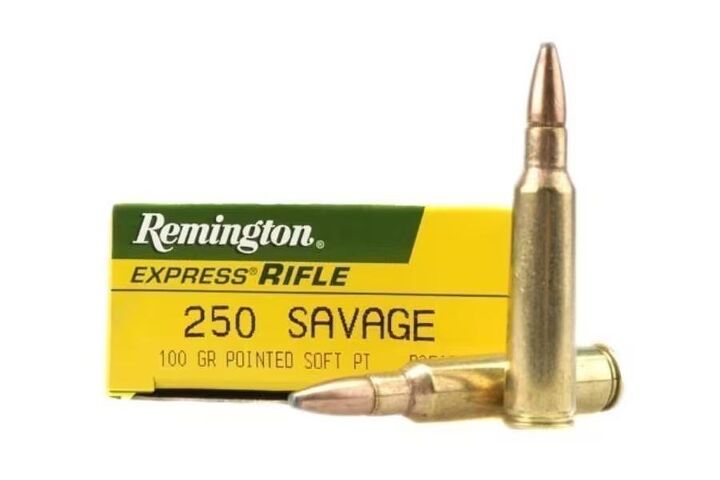
Before World War II, and especially before World War I, the rifles of the whitetail-hunting world looked a lot different from today. Lever-actions ruled supreme, and they were often chambered for rounds that have fallen from favor. These include .33 Winchester, .303 Savage and even .44-40. But to me, the most interesting of them all is the .250-3000. This round served many hunters very well, and was one of the best choices in the first half of the 20th century—and now it’s long, long gone from popularity.
Savage Arms classics @ TFB:
- Fudd Friday: Seven Decades Of The Savage 110
- The Rimfire Report: Single Shot "Revolver" – The Savage 101 Story
- POTD: Savage Arms' M1907 Pistol that Almost DEFEATED the 1911
- Fudd Friday: Escape From SHOT - Las Vegas Antique Arms Show 2026
The .250-3000 was the brainchild of Charles Newton, one of the great firearms designers of the early 20th century. Newton long collaborated with Savage Arms, coming up with classics like the .22 Hi-Power and the .300 Savage. The .250-3000 slotted in between those two rounds, as sort of a middleweight cartridge aimed at practical small game hunting. It hit the market in 1915, as World War I raged in Europe, but the U.S. had not yet entered.
As the first commercial cartridge claimed to break the 3,000 fps mark, the .250-3000 (you can see where the name came from) was the hotshot of its day. Unfortunately, the greatest hype for the cartridge, its blistering speed, was also its worst enemy. Under Savage’s advisement, Newton used an 87-grain bullet to reach that 3,000 fps mark, but bullet technology of that day was not what it is today. Those 87-grain bullets had a reputation, rightly or wrongly, for being easily knocked off course when woods hunting, or blowing up instead of holding together for deep penetration. Newton would have preferred to use a 100-grain bullet, but then he couldn’t achieve the sacred 3,000 fps mark.

Or at least, that was the story about this cartridge for years. Despite the alleged shortcomings of the lighter 87-grain bullets, a lot of people bought them, and a lot of hunters killed a lot of deer with them. As is so often the case with lighter hunting rounds, the stories around gun store counters are often not reflective of real-world performance—more on that in a minute.
Demand for that heavier bullet was there, and eventually 100-grain loads became available. Peters introduced a 100-grain load (moving at 2,800 fps) in the early 1930s, but by then, the round was a proven killer, particularly in Savage’s lever-action rifles.
Lever-actions dominated hunting sales in that pre-World War II era, but most Marlins and Winchesters came with tube magazines and couldn’t safely use pointed bullets. The tips of these bullets would set off the primer of the next cartridge in the mag, causing a most unpleasant and dangerous explosion in your face. Savage’s lever-action rifles, with their rotary magazines, could handle spitzer rounds, and many in-the-know hunters, especially hunters with money, bought the Model 1899 and Model 99 as a result. Old-time hunting books are full of photos or stories about these guns in the hands of serious outdoorsmen.

One example I remember is Grass Beyond The Mountains, a memoir by Rich Hobson Jr. of his early ranching days in the interior of British Columbia, before World War II. Hobson and his associates were hard and tough men, mostly adventurous and experienced cowboys who scraped some money together to start new cattle companies in BC’s vast and empty wilderness grasslands. In their early years, they had to live off the land, and when Hobson and his crew went moose hunting, he took along his trusty Savage lever-action in .250-3000. He would have trusted that rifle implicitly, and trusted the cartridge’s ability to get the job done—they could have starved otherwise.
Another great memoir is Lawrence Koller’s Shots at Whitetails, based on his decades of northeastern whitetail hunting before World War II. Koller was a guide, a gunsmith and a dedicated deer hunter. His book has a decently long chapter on selecting a gun for whitetails, and Koller recommends the Savage 99 in .250-3000 as having sufficient power without punishing recoil—it’s what he personally used for years.

In that chapter, he wrote:
“This rifle was my first ‘high-power’ job, and for me, it has always been a wonderful rifle for taking whitetail deer. At the time I first began to hunt with the caliber, my deer hunting friends gave me the big raspberry. The rifle was entirely too small, bullet too fast; it would blow up on the first twig it touched — and to top it off it was hardly big enough to more than scare a deer.
“Strangely enough, I killed the first three bucks shot at with this rifle. One buck was struck in the neck, the others through the chest cavity; all three dropped as though struck by lightning.”
Koller recommended the .250-3000 because it was much easier to shoot accurately than the .300 Savage, he figured, due to lesser recoil. And that was the idea of many people who bought the gun, but three things came together to drive this round into obscurity.
First off, other options came along that offered more power. When the .250-3000 was introduced, it had an excellent blend of shootability and hitting power, but other rounds eclipsed it. In the 1930s, the .257 Roberts was commercialized, with just a bit more jam. If you wanted a quarter-bore, and you weren’t stuck on the lever-action layout, then you bought a .257 Roberts. Or if you wanted a lever-action with more hitting power, then you could buy a .300 Savage, which was itself based on the .250-3000 casing.

The second reason is closely related—the rise of the bolt-action. While there were .250-3000 bolt-action rifles, in pre-World War II days, it was never as popular as other rounds like the .257 Roberts mentioned above, or the .30-06. After the war, the floodgates of cartridge development were wide open, and lever-actions lost a lot of market share to bolt-actions, as well as semi-autos and even pumps.
The third reason is that everything the .250-3000 did, the .243 could do better. The .243 fits into short-action lever guns like the Savage 99 and later the Winchester Model 88 and Browning BLR. In the real world, most hunters would probably never notice any practical difference between the rounds’ performance. On paper, especially back when people actually cared what hunting magazines thought about cartridge development, the .243 was faster, and people thought that made it superior. I would suggest that any deer hit by either round at 250 yards or less would probably not notice the difference, and since that’s where the vast majority of deer are killed, there is almost certainly no practical difference.
You can still buy .250-3000 ammunition factory-loaded, but you’ll pay even more than you will for .300 Savage in my experience. That makes it one of the most expensive non-magnum deer rounds available; handloading is the only practical way to shoot a lot of this cartridge. Either way, if you’ve got a rifle in .250-3000, there is no reason you couldn’t use it to take a deer this season.
Professional hoser with fudd-ish leanings.
More by Zac K


![[SHOT 2026] Hogue New Grips for 2026 - Wrapter, G10 & More](https://cdn-fastly.thefirearmblog.com/media/2026/01/31/17001/post.jpg?size=350x220)
![[SHOT 2026] Zastava M84 Machine Gun Cometh!](https://cdn-fastly.thefirearmblog.com/media/2026/01/21/03291/post.jpg?size=350x220)


Comments
Join the conversation
If you want to duplicate .250-3000 performance in an AR-15 look no further than the Sharps Rifle Company's 25-45 Sharps. It drives a Speer Hot Cor 87 grain bullet to approximately 3000 FPS. The shell case is a simply a necked up 223/5.56 shell case. Factory ammo out of my 20" gas gun runs 2950 FPS. I killed the first 5 deer I shot with it with one shot and I did not have to track any of them. Then alas, I aged out of hunting.
Fun fact, the 250-3000 Ackley Improved is so statistically close to the 25 Creedmoor that you can use the same load data for both. And the 25 creed is the best of the Creedmoors.