#Infantry
US Army's XM1158 ADVAP Round REVEALED: Tungsten-Cored EPR-Based Design Is Cheaper, Quicker to Produce

Until now, the US Army’s 7.62mm XM1158 Advanced Armor Piercing (ADVAP) round has been a mystery. The round, which was rumored to be the basis for the now-cancelled Interim Combat Service Rifle (ICSR) program, is supposed to allow existing weapons in the 7.62x51mm caliber to defeat advanced body armor out to combat ranges. Speculations about its configuration ranged from an improved traditional tungsten cored round to a discarding sabot design firing uranium flechettes, but the answer to this mystery was recently revealed in an issue of the Picatinny Voice. The ADVAP, it seems, is built on the technology of the 7.62mm M80A1 EPR, but using a tungsten core. From the Picatinny Voice article by Audra Calloway:

Turkish GRSAN to Enter AR Market

GİRSAN, known better for the Turkish handguns and shotguns that get imported into the United States, has appeared to step foot into the commercial AR15 market. Several online Turkish news organizations ( VIDEO7 and KG) have published articles detailing what appears to be a GİRSAN press conference that shows a GİRSAN employee demonstrating the company’s entry into the AR field. The articles specifically mention that the rifle is an “Infantry Rifle”, intended for law enforcement customers. However, one of their plans is to try and compete for serial MPT76 production, already underway at MKE, Sarsılmaz, and Kalekalip. The Turkish Armed Forces number some 500,000 plus troops, and the current MPT76 production plans only call for around 45,000. If there is an operational requirement to produce more, the government will probably come looking for other private sector small arms manufacturers.

Army Chief of Staff Milley Says Next Rifle Will Have Much More Range, Be More Accurate Than M4 Carbine

At an AUSA breakfast conference yesterday, US Army Chief of Staff General Mark Milley gave us a hint at exactly what the US Army’s next rifle could look like, and the focus was on extended range capability. The rifle, Milley said, will give a 10x improvement in capability through the type of ammunition, optics, and degree of chamber pressure specific to it, with the aim of providing the soldier a weapon with much more accuracy and range than the current M4 Carbine. Milley also clarified that the term “10x” was not intended to be a precise measurement of the capability growth, but rather a term indicating significant improvement. The new rifle will come as part of an effort that also includes new artillery, tanks, aircraft, and virtual reality training facilities, Milley said.
Pratt & Miller Defense's Infantry Moving Target System

Michigan based Pratt & Miller Defense recently updated their Trackless Moving Targets- Infantry variant this year for I/ITSEC 2017. The company makes 4×4 vehicles (with targets mounted on them) that move autonomously on a training ground and react to fire. Right now it appears that the company has human-sized targets and full vehicle shaped ones but ideally as long as it can fit on the chassis, the vehicle could probably work with the target. The company is trying to create a solution for the infantry wherein it resembles a more realistic battlefield instead of stationary Ivan targets that mechanically drop down when hit.
Why NGSAR Is DOOMED TO FAIL (Brief Thoughts 006)

It’s almost 3 in the morning, and I’m lying awake in bed thinking about small arms. I’m trying to put everything out of my mind so I can go to sleep and wake up in the morning, go to the range, and bring you some raw ballistic data. So of course what pops into my head is an almost complete article about just why the Army’s latest whizzbang rifle program is doomed to collapse in a heap. All I have to do is write it.
US Army's NGSAR to Be Chambered for 6.8mm MAGNUM Round?

Is the US Army pushing for a new high-powered 6.Xmm caliber with their new NGSAR program? Recently, the listing for the NGSAR industry day in December was updated with a document describing in part the agenda of the second conference. Scheduled for 9:45 in the morning in the document is a 15 minute long presentation on “Ammunition Data – Surrogate Projectile and Specs”, presented by Todd Townsend, David Charowsky, and Mark Minisi. Minisi’s name may not be well-known, but it will be familiar to astute students of recent wound ballistics literature: It was Minisi who developed the finite element analysis-based tissue damage model, which has been refined over the past decade at ARDEC through PM Maneuver Ammunition Systems (PM-MAS). Mr. Townsend is also likely representing PM-MAS, now under the leadership of Colonel Hector Gonzalez.
LSAT Cased Telescoped Ammunition, and the Problem of Cookoff (Brief Thoughts 002 Follow Up)

In the comments section of my recent Brief Thoughts article regarding caseless ammunition, there was a discussion about whether the cookoff issues of caseless would also be problem for LSAT-style polymer cased telescoped ammunition. Based on conversations I have had with subject matter experts regarding polymer cased ammunition in general, I noted that a lower cookoff threshold is one of the challenges I would expect CT ammunition developers to face. However, after some back-and-forth in the comments, I decided to contact LSAT/CTSAS program officer Kori Phillips regarding this issue (as it was not something I covered in my three-part interview with her), and she kindly agreed to allow her comments on the matter to be published here on TFB. They are below:
US Army to Hold Industry Day for Next Generation Squad Automatic Rifle
The US Army will be holding a second Industry Day for its Next Generation Squad Automatic Rifle program, which seeks to replace the M249 light machine gun with a new longer-ranged, lower signature automatic rifle. The Industry Day will be held at Picatinny Arsenal on December 12th and 13th. The Army is also accepting white papers concerning NGSAR by January 16th, 2018. The updated NGSAR listing is available here.

Is POWER ARMOR on the Horizon? New Technologies Could Unlock the Door – Brief Thoughts 003

When the subject is the future of infantry, the conversation inevitably turns to one thing: Powered, armored exoskeletons. Since the publication of Heinlein’s Starship Troopers in 1959, the concept of an armored suit with enhanced mobility from an internal power source has fascinated military futurists, quickly solidifying as a military fiction staple, and even appearing repeatedly in official “future soldier” concepts from armies and companies around the world.
"It'll Never Happen" – Until It Does! Caseless Ammunition, and Looking Back – Brief Thoughts 002
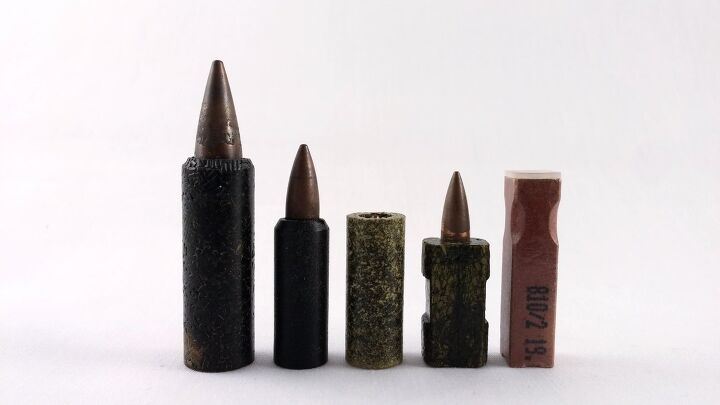
Caseless: The ammunition designer’s holy grail, and the engineer’s worst nightmare. It would obsolete the cartridge case overnight, resulting in cheaper, lighter, and more compact ammunition. Weapons would be able to carry 50, 60, or more rounds in slim, inexpensive magazines, and expel them at a rate of fire much higher than current weapons are capable of – not only because the ammunition is lighter and therefore more could be carried to feed such thirsty guns, but because the extraction and ejection cycles of the weapons themselves could be eliminated.
Level IV Armor, and the Future of Small Arms: Brief Thoughts 001

With Level IV armor rising in availability, calls for “overmatch”, and the increased presence of urban warfare, will designers be able to meet the requirements for future small arms? Forumgoer Poliorcetes raised this question in a discussion at the Military Guns & Ammunition forum:
Modular Scalable Vest Finishes Final Round of Testing
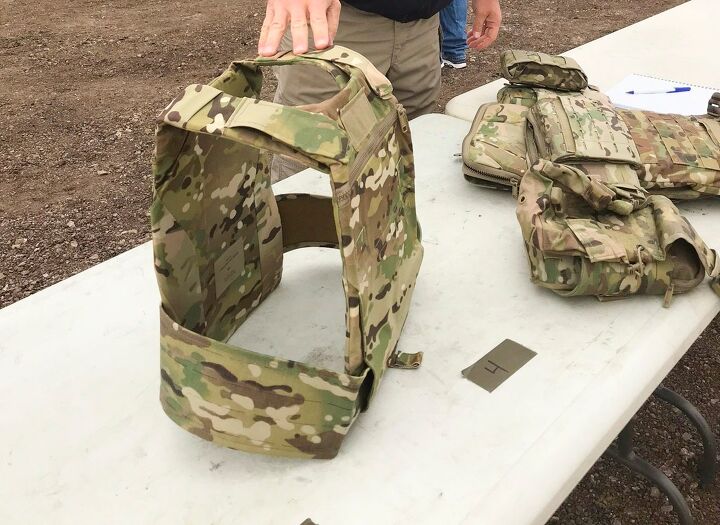
The US Army’s latest improvement to the soldier’s gear has finished its final round of field testing. The testing was conducted in mid-October by soldiers with the 71st Ordnance Group and the 10th Chemical Hazardous Response Company, at Fort Carson, Colorado. From an article at the Army News Service:
Thales EF88 Completes First Operational Deployment
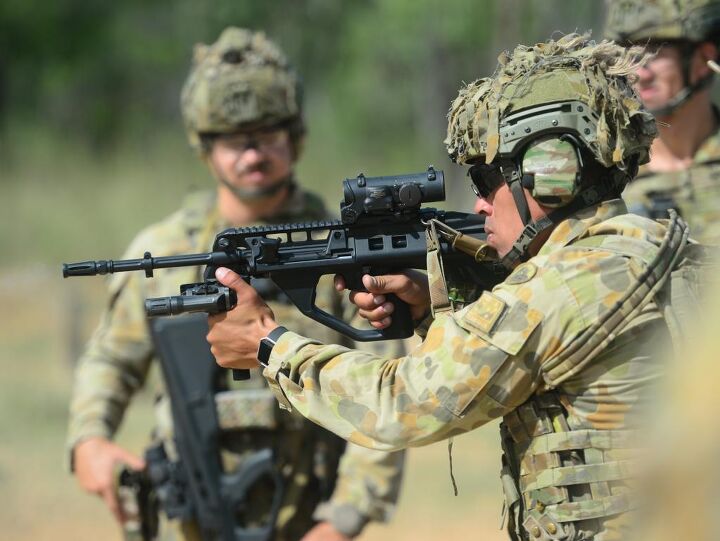
The Thales EF88 assault rifle has seen its first operational deployment, and the reception is reportedly very warm. According to an article in Defence Connect, the rifles were deployed with Task Group Taji 5 (5th rotation), a battalion of Australian Defence Force advisers for Iraqi forces deployed as part of Operation Okra. The article reads:
9x39mm: AR-15 for Moose? [Modern Intermediate Calibers 026.2]

Previously, we compared the Russian 9x39mm subsonic sniper round to its Western counterparts, including the .300 AAC Blackout and the .45 ACP. As it stands now, the 9x39mm is a subsonic round only – no supersonic loads exist for it currently. But… What if they did?