#Defence
Verney-Carron Defense's New Precision Rifle
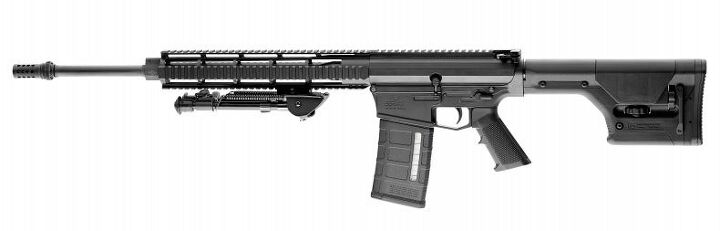
With a contract to replace the French Army’s bolt-action FRF2 sniper rifle expected in the near future, Verney-Carron, one of France’s premier sporting gun makers is positioning itself to win the contract.

Brazil Orders More 5.56 IMBEL IA2 Carbines

Brazil has moved to procure 4,000 new 5.56x45mm IMBEL IA2 Carbines. The state owned Indústria de Material Bélico do Brasil or IMBEL, has been awarded a contract worth over $7 million.
New Zealand Army Begins Fielding New Rifle: LMT MARS-L

Over the last few month the New Zealand Army has begun fielding its new standard issue infantry rifle, the LMT MARS-L. The MARS-L is replacing the F88 Austeyr which has been in service since 1988.
New Steyr AUGs for Austrian Military Police

The Austrian Army’s Military Police are to be issued a new version of the Bundesheer’s standard issue rifle, the StG 77. The new StG 77A1 MP will be issued to the Bundesheer’s military patrol and military police (Militärstreife) units. The official handover of the first 50 rifles took place on the 5th April.
Venezuelan Kalashnikov Plant to Begin AK-103 Manufacture in 2019

Production at the long-planned and troubled Kalashnikov factory in Venezuela reportedly edges closer as politicians announce production is scheduled to begin rifle in late 2019. The construction of the plant was first confirmed way back in 2006.
British Army Set to Drop Light Machine Guns

The British Army is set to move away from its use of the FN Para Minimi or L110A2/A3 at the fire team level. During a seminar at the 2018 Future Soldier Technology conference, held in London 12th-14th March, the CO of the British Army’s Infantry Trials and Development Unit confirmed that the L110A2/A3 would be dropped. The move will widen the debate around suppressive vs precision fire.
Chinese Commandos Deploy with QTS-11 Integrated Combat System

China’s People’s Liberation Army Ground Force (PLAGF) has equipped elements of its special operations forces with the QTS-11 infantry integrated combat system. The system includes China’s QTS-11/ZH-05 integrated rifle and 20mm grenade launcher.
German Army Seeks New Optic for Future G36 Replacement

The Federal Agency for Equipment, Information Technology and Use of the Federal Armed Forces (BAAINBw) has released a tender worth 125 million Euros (approximately $153 million) for 103,090 combat sights.
Heckler & Koch G36 for Latvian National Guard

Latvia’s armed forces and border guards are set to receive new Heckler & Koch G36s. On the 11th January, the Latvian Ministry of Defence issued a press release announcing the new contract with the German small arms manufacturer. The 7 year contract, worth 13 million Euros or $16 million, is said to be for both rifles and other types of weapons – probably including H&K’s AG36 40mm grenade launcher, already in Latvian service.
CornerShot Clones From Around the World

Ever since the CornerShot system was launched in 2003 it has been the focus of international interest and has inevitably been copied by others. The original system was designed by retired Israeli Army Lt.Col. Amos Golan, who with American investors, established Corner Shot Holdings.
Danish Army Begins Pistol Trials to Replace SIG P210

The Royal Danish Army, Hæren, are reportedly about to embark on trials to replace the venerable SIG P210, which has been in Danish service since 1949.
Portuguese Army Plans New Small Arms Programme

Portugal are about to embark on a major new small arms procurement programme. Jane’s reports that Request for Proposals for new infantry weapons will be issued soon.
Indian PDWs: JVPC/MSMC Carbine

In the mid-2000s, India began looking for a carbine to replace their 9mm L2A3 Sterling submachine guns which they inherited from the United Kingdom. Two weapons were developed, one by the Ordnance Factory Board (OFB), and another by the Armament Research and Development Establishment (ARDE), a subdivision of the Defence Research and Development Organization (DRDO). The Ordnance Factory Board produced the AMOGH carbine, while the DRDO produced the Modern Sub Machine Carbine (MSMC, also known as the Joint Venture Protective Carbine, or JVPC). These weapons reportedly competed against each other, and by the early 2010s, the MSMC had been selected as the Sterling replacement.

Indian PDWs: AMOGH/MINSAS Carbine, the INSAS That Never Grew Up

In the mid-2000s, India began looking for a carbine to replace their 9mm L2A3 Sterling submachine guns which they inherited from the United Kingdom. Two weapons were developed, one by the Ordnance Factory Board (OFB), and another by the Armament Research and Development Establishment (ARDE), a subdivision of the Defence Research and Development Organization (DRDO). The Ordnance Factory Board produced the AMOGH carbine, while the DRDO produced the MSMC. These weapons reportedly competed against each other, and by the early 2010s, the MSMC had been selected as the Sterling replacement. However, the AMOGH is still being marketed to customers by the OFB, and has reportedly been purchased by the Indian Coast Guard.
Barrett M107A1 and MRAD to Be Procured by New Zealand Defence Force

The New Zealand Defence Force (NZDF) is procuring two long range rifles from US manufacturer Barrett Firearms Manufacturing. The island armed forces will be purchasing the .50 BMG caliber M107A1 anti materiel rifle as well as the .338 Lapua Magnum caliber Multi Role Adaptive Design (MRAD) sniper rifle. The rifle buy is for forty M107A1 anti material rifles, forty two MRAD sniper rifles, and optics, suppressors, accessories, packaging, and all other ancillary equipment as part of a “total system” purchase. The weapons are a part of the New Zealand Defence Force’s modernization effort, which has included new handguns, infantry rifles, machine guns, and other weapons. According to NZDF material released along with the announcement, the MRAD sniper rifles will be replacing the NZDF’s legacy Accuracy International Arctic Warfare rifles in 7.62mm NATO caliber, bringing a considerable increase in range and capability to New Zealand snipers. As well, M107A1 .50 caliber anti materiel rifles will give the NZDF the ability to attack vehicles and installations out to 1,500m. Both weapons are reportedly slated for use not only by the New Zealand Army, but the New Zealand Special Air Service (SAS), as well. Procurement of the weapons under a sole source contract followed six weeks of testing of several competing rifles in Waiouru, where more than 10,000 rounds were expended in evaluation.