#ColdWar
The Soviet Silenced “Tishina" Grenade Launcher

During the Cold War, there were requests for many specialized weapon systems, as modern armed conflicts are fundamentally different from the cataclysmic wars of the last century. Fortunately, full-scale military operations the size of Verdun or Kursk seem not to be the course of future battle. Instead, modern conflicts are often prolonged and low-intensity, with a heavy reliance on small specialized teams. Warfighting doctrines have largely adapted to this reality and configured their weapon designs to meet soldiers' needs in these modern environments. Discretion is often key to avoiding disturbing local elements and maintaining a low profile for one’s own survival. For that, next-generation silenced weapons are necessary.

16 Vickers Machine Guns in Action!

On 3 July, the ranges at Bisley, the UK’s historic home of shooting, hosted a very special shoot. Vickers Machine Guns fired 16,000 rounds of ammunition with a crowd of nearly 1,000 people gathered to watch. It had been 20 years since the last time this many Vickers Guns had fired together. The event was held to commemorate the 100th anniversary of the disbandment of the Machine Gun Corps – the British Army’s corps of expert machine gunners formed in 1916 which disbanded in July 1922.

Helios House Press Launches Kickstarter for Covert Cards: Weapons of the Cold War

Ever wanted to combine your love for card games, guns and the Cold War? Well, at last, you can with Helios House Press’s Covert Cards: Weapons of the Cold War. The project is the brainchild of Justin Baird, the talented designer behind the new Armax journal, as well as the Headstamp and Helios House books. Justin and Helios have created two separate packs, and a full house of extras, which look at prototype firearms and weapons developed by East and West during the Cold War.
Inside a 1966 Recognition Guide for Soviet Weapons

It’s 1968, the Cold War has gone hot and you’re a British soldier somewhere in northwest Germany. The 3rd Shock Army is coming straight at you and you’re trying to decide if the Soviet motor rifle regiment infantry attacking your defensive position is bringing up a DShK or an SGM. You reach for your trusty copy of Recognition Handbook Foreign Weapons and Equipment (USSR) Group III Infantry Weapons.
The Rimfire Report: The Clandestine High Standard HDM

Hello and welcome back to another edition of The Rimfire Report. In this ongoing series we discover, review, and discuss anything and everything surrounding the rimfire firearm world. This week we’re taking a trip back in time to the end of WWII and into the realm of the Cold War. The High Standard HDM is one of the few rimfire pistols to have had a chance to play a part in both theatres and with good reason.

Not All G3's are H&Ks – the Rheinmetall G3

When we think of the iconic Cold War G3, we automatically think Heckler & Koch – but that wasn’t always the case. When the fledgling West German Army adopted the, now famous, roller-delayed rifle it was produced by not just H&K but another famous German arms manufacturer – Rheinmetall.
Winchester's Experimental Cold War Submachine Gun
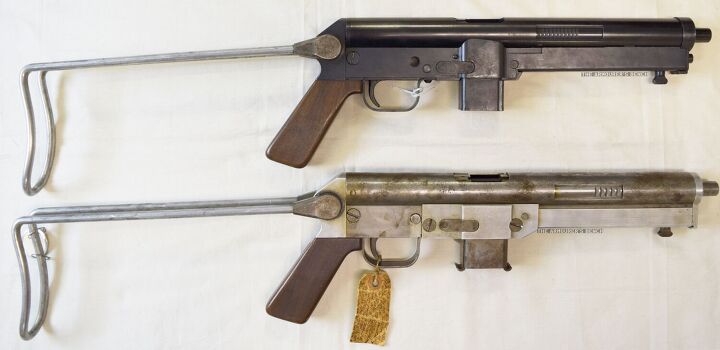
When we think of the Winchester Repeating Arms Company we think of lever actions and maybe some of John Browning’s designs. We don’t tend to think of Cold War submachine guns, but in the mid-1950s Winchester developed a 9×19 ‘NATO Burp Gun’. During a research trip to the Cody Firearms Centre at the Buffalo Bill Center of the West earlier this year, I was able to examine, disassemble and film the Winchester SMG for my video project, the Armourer’s Bench.
NATO's Forgotten First AK: The Madsen LAR

The Cold War is famous as the squaring off of two superpowers: The United States, and the Soviet Union, and their duel-by-proxy in Asia, the Middle East, and the Americas. The standard rifles of each side, as well, became proxies: On the Soviet side, the famous AK-47 (more properly AK and AKM), and on the US side the M14, FAL, and later the M16. As early as the late 1950s, however, the AK’s success led to it being copied by NATO member nations, and perhaps the very first of these was the Madsen LAR.

Kalashnikov Media Show Off an Early AK Prototype

Kalashnikov Media continue their fascinating series looking at rare Russian small arms, the latest video brings us a look at an early, pre-production prototype AKS.
A Belt-Fed Bren Gun with a Fatal Flaw: The Experimental X11E4 at The Armourer's Bench

After World War II, the UK sought to modernize its small arms, many of which were based on designs originating from before the First World War. For its medium machine gun, the British were still using the reliable but increasingly obsolete Vickers water cooled gun in .303 caliber. With the adoption of the 7.62 NATO by the UK, trials were held to select a new air-cooled general purpose machine gun, which resulted in the adoption of the excellent Belgian MAG. In these trials, however, was tested a belt-fed variant of the magazine-fed Bren gun, called the X11E4. This gun is the subject of an article over at The Armourer’s Bench, as well as an accompanying TAB video, embedded below:
![REVIEW: POF G3 Sporter .308 [GUEST POST]](https://cdn-fastly.thefirearmblog.com/media/2024/05/06/13684738/review-pof-g3-sporter-308-guest-post.jpg?size=720x845&nocrop=1)
Georgian Armed Forces to replace PKM with M240B

The Georgian Ministry of Defense has released statements and even staged a demonstration wherein the land component of the Georgian Armed Forces will replace the 7.62x54R PKM medium machine guns with FN Herstal 7.62x51mm NATO M240Bs. This will be a gradual replacement over the next year or so as PKMs become switched out with M240Bs within the infantry and mechanized forces of the Republic of Georgia. Because the announcement specifically mentions “U.S. made” M240Bs, we’ve taken that to possibly mean that this purchase is either through Foreign Military Sales programs or that these are at least M240Bs previously in use by the U.S. Army and were replaced by M240Ls in active Army service.

Hill & Mac Gunworks CETME-L and CETME-LC Update | SHOT 17

Hill & Mac Gunworks’ flagship is their ambitious project to create an affordable, shootable reproduction of the WWII-era German StG-44, but another thing they have been working on is a recreation of the CETME-L Cold War era Spanish assault rifle. Unlike their StG, which is being made from the ground-up, the CETME-L effort centers around the use of parts kits, now available relatively inexpensively on the surplus market.
M1 Carbine in 8mm Kurz? The Spanish 7.92×33 CB-51 Prototype Assault Rifle

The M1 Carbine is a lightweight, handy weapon that is well-liked by many. One of its weakest points for many people, however, is its cartridge: The .30 Carbine caliber is regarded by some as being too weak to be a true intermediate caliber round fully capable of effective 300m fire. Still, the .30 Carbine is short, so maybe there is another caliber out there that could fit into an M1 Carbine’s action while giving it a little more punch… It turns out that during the late 1940s and early 1950s, at least one Spanish small arms designer felt the same way, and invented the gun in the Forgotten Weapons video below:
Bruce Canfield On the Winchester LMR, at American Rifleman

What if the Mini-14 had arrived over a decade earlier, and been a pound lighter? Would it have still played second-fiddle to the AR-15, or would US troops be using classically-lined rifles of wood and steel right up until today? Was there really an alternative to the “Buck Rogers” space-gun-like AR-15 in the late 1950s and early 1960s?