Wheelgun Wednesday: Throwing It Back With The Ruger Service Six

by
Daniel Y
Published: January 3rd, 2024

Thanks for joining us for another installment of Wheelgun Wednesday here on TFB. This is my first time writing one of these posts, so it is fitting that I talk about my first revolver. This 4-inch Ruger Police Service Six has been with me since my teenage years and it continues to serve me well.
Wheelgun Wednesday @ TFB:
Ruger makes, and has made, all sorts of revolvers. The first gun I ever shot was a stainless steel Ruger Single Six Convertible. Ruger also makes big bore hunting revolvers like the Redhawk Alaska, cowboy-style options in the Vaquero family, and the LCR family for concealed carry use, among others. There is also the GP100 family of double-action .357 Magnum revolvers, which is most akin to the gun we are discussing today.
The “Six” Family
Not so long ago, double-action revolvers were the standard for law enforcement and military users. Soldiers, airmen, police officers, and concerned citizens alike often opted to carry revolvers even when semiautomatics were becoming common. Ruger wanted to compete in that space and introduced the Security Six in the 1970s. That one gun grew into a family of revolver models with names ending in “Six.” The Security Six had a square butt and adjustable sights. Next came the Service Six which swapped the adjustable rear sight for a fixed rear sight cut into the top of the frame. The final iteration was the Speed Six which kept the fixed frame sight but added a rounded butt for easier concealment.
The vast majority of Six-series revolvers were chambered in .357 Magnum. However, models were also produced in .38 Special and 9mm. Expect to pay a price premium for a 9mm model, if you can find one.
Prices are also higher for guns with a history of military or certain law enforcement use. Obviously, a standard model with lots of wear and a property mark from a random small police department will probably not command much of a price premium, if any. But some of the guns with “US” property marks on the frame can sell for multiple thousands of dollars. I once had an opportunity to purchase a Speed Six with Naval Investigative Service and US markings like the one shown in this video. I passed, then regretted my decision and went back to buy it only to see that it had already sold.

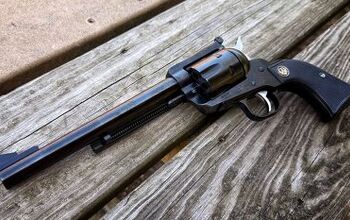
Ruger Police Service Six in .357 Magnum.

Ruger Police Service Six in .357 Magnum.
My Service Six
This gun was bought by my dad at a gun show in Alaska. It has a 4-inch half-lug barrel and blued finish and is marked as a Police Service Six. I carried and shot it a lot in my youth, and it was the first handgun that was really “mine.” I bought HKS speedloaders and Hogue grips with my lawn mowing money, because that was about the extent of available accessories.
The Hogue grips worked fine, but never really felt right to me. I couple of years back I happened across a set of Pachmayr grips still in the original box. They were $5 on a shelf of old, unsold gun parts. I switched to those and have not looked back. They fit better in hand and look much more correct on a gun like this than a set of Hogues with finger ridges ever would.
I also eventually picked up a Safariland 568 holster to carry the Service Six. It is marked as fitting a Smith & Wesson K-frame revolver but it fits the Ruger perfectly. That holster also has three adjustment screws running along the rear edge that allow for adjustable fit and retention.

Safariland 568 holster for S&W K-frame holding the Security Six.
Shooting the Service Six is fairly similar to any other .357 revolver this size. Recoil is present but not abusive like shooting magnum loads in 5-shot pocket wheelguns. Shooting with .38 Special ammo is very tame and makes for good groups, but it is not nearly as exciting as shooting the full-power stuff. Ruger used a very heavy frame design in this family of guns and that extra weight is beneficial to recoil control.
The sights are one of the low points, with the rear sight being only a groove cut into the top of the frame. Yes, it does work. But it leaves a lot to be desired compared to the irons on most semiautomatics, or the adjustable sights found on many other revolvers. And while the sight picture is nothing to write home about it is one of the most durable sight designs possible. You would have to bend the frame to get this rear sight to move.

The sights are not amazing, but they do work.
As with other Ruger double actions, the cylinder release is a push button. It pivots into the frame of the gun. In my opinion, this is almost as good as the Smith & Wesson-style release that slides toward the muzzle. And it is definitely better than the counterintuitive rearward motion of the Colt guns.

Note the button cylinder release.
Conclusion
If you are looking for a nostalgic wheelgun that is a shooter, check out a Speed Six, Security Six, or Service Six. They can be found quite a bit cheaper than a Smith & Wesson (not to mention the Colt snake guns!) but are still a solid piece of American gunmaking. The Ruger may not match the panache of the other revolvers of the era but they are still high on 1980s vibes and shootability without breaking the bank.
AKA @fromtheguncounter on Instagram. Gun nerd, reloader, attorney, and mediocre hunter.
More by Daniel Y




![[SHOT 2026] Hush Puppy Project Expands to Ruger RXM and Sig P365](https://cdn-fastly.thefirearmblog.com/media/2026/01/28/22171/post.jpg?size=350x220)

Comments
Join the conversation
The "counter-intuitive rearward motion" of the Colt system is one of the only systems which doesn't try to unlock under recoil; objects at rest tend to stay at rest, and that includes buttons and latches found on guns; as the gun is fired, they want to remain stationary, while the rest of the firearm wants to suddenly and rapidly accelerate rearward. Thusly, things like latches you push forward, or downward, tend to unlock under serious loads, in lightweight guns, which Service Six is not really subject to, but still, the Colt system is better. If you spend enough time shooting magnum loads in lightweight magnum J-frames, you'll see what I mean.
Ruger also has the cylinder turning the wrong direction (another flaw that Colt fixed at the dawn of the 20th century, but S&W never has), which can effect the accuracy and durability of the system.
At least Ruger had the good sense to not put the deepest part of the cylinder stop notch directly over the chamber like S&W does; this is where every S&W cylinder cracks, always. Been like that for 125 years.
Probably over 50 years ago, my dad bought this. I had a problem with the cylinder rubbing on the forcing cone at one point and took it to a gunsmith and it's been fine since. (Though I don't shoot it much anymore
I appreciate the article and the info about the Safariland 568.
https://uploads.disquscdn.c...