TFB Review: Pulsar Thermal Spotters – Axion XQ38 and XQ38 LRF


IMAGE QUALITY
The sensor at the front is 384×288 pixels @ 17 µm with a NETD

Shooting an AR-300 Blackout, with 7″ barrel (gas is too low so it needs manual charging). This is with a Surefire compensator.

We also tried a Ruger 10/22. Here you can see some of the muzzle flash as well as the empty case ejecting.

Below: the B&T APC9, a 9x19mm suppressed.

Below is an example of a roe deer at around 80-100 meters. The weather is cold, around +5C and the fog is starting to rise. The sun has just set and you can barely see the animal at this distance with your eyes.

The picture above is from the video just below. This is filmed from a car.
One thing you should be beware of is the conditions when the thermal image or video was taken, and also the distance to the object. Marketing material is usually taken in the best possible conditions, which means on a dry, sunny day. Below is an example from a fairly humid night, the fog is starting to rise from the ground and it’s been around +15C all day. Distances are from 100-500+ meters.
Below: Still picture from the video. It’s easier to see in the video when they move. These are three roe deer at about 250 meters in “medium-difficult” conditions.

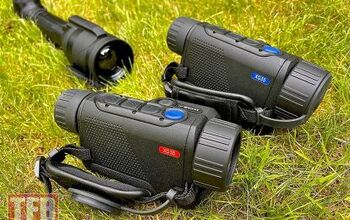
The XQ38 LRF adds another 50 grams for a total of 400 grams (0,4 kg) and is bulkier than XQ38. But it is also easier to hold steady with two hands.

The battery system is a B-Pack mini APS5, and they were easy to use and good enough for one night out or longer. A power bank connected via a USB Type-C socket can be used as an external power source.

The Axion XQ38s are Made In Lithuania. They come with a 3-year warranty. The batteries have a 1-year warranty.

An outline of differences and similarities in the table below. The “minus” sign means the feature is not included in that model:
| Feature | Axion ХQ38 | Axion LRF XQ38 |
| Built-in video recorder | + | – |
| 8 Color palettes | + | + |
| Image Detail Boost function | + | + |
| 3 Calibration modes | + | + |
| 4 Preset observation modes | + | + |
| Display off function | + | + |
| Stadiametric rangefinder | + | – |
| Built-in precise laser rangefinder | – | + |
| «Picture in picture» function | + | + |
| Wi-Fi. Integration with iOS and Android devices | + | – |
| Stream Vision application support | + | – |
| Firmware update | + | – |

Pulsar have a lot of options, almost too many to keep track of, but if you want to step up the game from the XQ38s, your next option is going to be the upcoming Helion 2 XQ50F or the Accolade 2 Thermal Binoculars. If a smaller size is your priority, then check the Axion XM30S. You can also compare them to the new Zeiss DTI 3/35 Thermal Spotting Camera.

If you’re looking for a thermal sight, then the Pulsar Thermion or the Trail 2 is for you. We reviewed the Trail 2 LRF here (for Europe), but the Trail 2 LRF XQ50 and XP50 for the US market may be of more interest to you?
TFB is currently hard-testing Pulsar’s new Thermal Vision Front Attachment Krypton FXQ50. In fact, yesterday, we shot 300-meter groups with it with satisfactory results. There is also the Leica Calonox which we also hope to try soon.

You can find the Axion XQ38 here and the Axion XQ38 LRF model here. Next-up, TFB is doing reviews of the Pulsar Krypton FXG50 Front-attachment (which can also be used as a scanner with an option) and the Leica Calonox.
Conclusion
We as consumers always want more, but it’s easy to forget how quickly these thermal devices have developed just in the past year, and how good they have become. Both of these two devices offer outstanding performance for the price. Priced around €2,400, I think the XQ38 LRF is the most affordable thermal imaging monocular with LRF capability on the market at the moment. The XQ38 model is €2,000, just a tiny step up from the XM30S in terms of price, but with a much better performance. Unless the size is your primary concern, you should definitely go with the slightly bigger model (XQ38). I’m looking to get one of these for myself, but the biggest problem seems for me to decide if I need the LRF over the video recording or not.
What are your thoughts about going with video recording or the LRF?
Ex-Arctic Ranger. Competitive practical shooter and hunter with a European focus. Always ready to increase my collection of modern semi-automatics, optics, thermals and suppressors. TCCC Certified. Occasionaly seen in a 6x6 Bug Out Vehicle, always with a big smile.
More by Eric B





Comments
Join the conversation
It’s kinda off topic, but I’m wondering how those plastic B&T magazines have held up for you? The APC9 looks like a nice rifle, I’m just afraid of those plastic mags.
Given a choice over the Pulsar xq-38 series and the Zeiss DTI 3/35 and ignoring cost as an issue...simply performance and size, what would be your choice? Use would be for spotting deer/elk size game out to 1200 meters, -5 C to 15C, 60% relative humidity or less, daylight hours typically early morning and later afternoon.